
RPAS Regulations Canada: 2026 Practical Compliance Guide
A drone’s weight alone doesn’t tell you which rules apply. To understand RPAS regulations Canada requires you to consider the aircraft, the planned operation and the airspace together. A sub-250 g drone, for example, is exempt from pilot certification and registration requirements, but that doesn’t mean every location or flight is unrestricted.
If the rules feel scattered, you’re not alone. Certification requirements, airspace authorization and restrictions at a specific site answer different questions, and meeting one requirement doesn’t automatically clear the others. The right checks depend on what you’re flying, how and where you intend to fly, and whether the operation falls under Basic, Advanced or another pathway.
This guide explains how those factors shape your preparation, which official sources to consult before launch, and how to work through a practical pre-flight compliance process. You’ll also see where structured training can help build your regulatory knowledge, and when an applicable certification pathway may involve a professional flight review. The aim is a clear sequence of checks, so you can identify what applies before you arrive at the flight site.
Key Takeaways
- Start by assessing your aircraft, planned operation and airspace. These factors help determine which RPAS regulations Canada requires you to check.
- Separate aircraft registration from pilot certification and operation-specific approvals; the requirements don’t apply identically to every flight.
- Check airspace and site restrictions separately from your pilot certificate, and confirm any required authorization before flying.
- Use a consistent preflight sequence to review your aircraft, credentials, location and conditions. If a requirement is unclear, stop and verify it with an official source.
- Build confidence with current Transport Canada guidance and structured training; consider a professional flight review when pursuing an applicable certification pathway.
What RPAS regulations in Canada cover, and how to identify your flight category
RPAS means remotely piloted aircraft system: the aircraft and the equipment used to control it. Canada adopted the term in its 2019 regulations; the broader history of the Unmanned aerial vehicle (UAV) helps explain why several names for drones remain in common use. For pilots, the practical task is to connect federal aviation rules with the restrictions that may apply at a particular site.
Start with three screening factors: your aircraft’s characteristics, the operation you plan to conduct, and the airspace where you intend to fly. These factors interact. A pilot certificate addresses pilot qualifications, for example, but it doesn’t by itself authorize a flight in controlled airspace or override a site restriction. A general guide can help you identify what to check, but it can’t determine whether every location or flight plan is permitted.
Regulatory classification is not permission to fly. Classification helps identify which rules, credentials and approvals may apply. Permission for a particular flight also depends on airspace, location and any applicable restrictions or authorizations.
How aircraft characteristics affect the rules
Weight is a key starting point. Transport Canada’s current guidance says drones under 250 g are exempt from registration and pilot-certificate requirements, though they must still be flown safely. Drones from 250 g to 25 kg must be registered, and the pilot may also need a certificate depending on the operation. These are separate checks: registering an aircraft doesn’t certify its pilot, and a pilot certificate doesn’t register a drone. Operations involving aircraft over 25 kg require a Special Flight Operations Certificate (SFOC).
Check the aircraft’s actual weight and configuration, including any equipment that changes its take-off weight. Then confirm the requirements for that specific aircraft using current Transport Canada RPAS guidance. Don’t rely only on a model name or an old summary.
How the planned operation changes the compliance picture
Visual line of sight (VLOS) means the pilot keeps the aircraft visible without relying on a camera display to maintain awareness of its position. More complex operations may include flying beyond visual line of sight (BVLOS), which can involve additional requirements and approvals. The same aircraft may therefore require different preparation for different missions.
For example, a pilot might use one drone for a visible flight in an open area, then plan to use it for a BVLOS task. The aircraft hasn’t changed, but the operation has. The applicable pathway depends on the full plan, including the airspace and operating environment. Before flying, verify the current rules and any required authorization with the relevant official sources.
RPAS registration and pilot certificates: check what applies before flying
Registration, pilot certification and operational approval answer different questions. Use the table to identify which requirements to verify for your aircraft and planned flight, rather than assuming every pilot needs the same credentials.
| Check | What it applies to | What to verify |
|---|---|---|
| Aircraft registration | The aircraft itself | Drones weighing 250 g to 25 kg must be registered with Transport Canada before flight, and the registration number must be clearly marked on the drone. Confirm the process and current requirements. |
| Pilot certificate | The person operating the drone | Basic or Advanced certification may apply, depending on the operation. Check the current category, prerequisites and conditions. |
| Operation-specific approval | A particular type of operation | Some operations may require additional authorization or an SFOC. Confirm what applies to the exact flight, aircraft and operating context. |
When should a pilot check registration requirements?
Check the aircraft’s weight and configuration against current Transport Canada guidance. Drones under 250 g are exempt from registration and pilot-certificate requirements, while aircraft over 25 kg require an SFOC. For a drone between 250 g and 25 kg, registration is required; the registration number must be clearly marked. Confirm the current registration process and details through the Transport Canada drone safety guidelines.
Registration identifies the aircraft in the federal system. It does not grant permission to fly at a particular site or in restricted airspace. Check those restrictions separately.
Which pilot certificate or training pathway may be relevant?
Transport Canada’s standard pilot certificate categories are Basic Operations and Advanced Operations. The operation informs the relevant pathway, not simply the pilot’s preference or whether the flight is recreational or commercial. More complex operations may involve additional requirements, such as a Level 1 Complex pathway and an RPAS Operator Certificate. Confirm the current terminology and conditions before planning.
For a fuller breakdown, look for The Complete Guide to Transport Canada Drone Certification in 2026. If you’re pursuing an Advanced or Level 1 Complex certification pathway, a flight review may be relevant; What is a Drone Flight Review in Canada? A Professional Guide for 2026 explains its role. Caswell Aviation Ltd offers online courses, optional in-person training and applicable flight reviews to support preparation. Explore its drone training options if structured learning would help you build your knowledge.
Airspace, people, and operating conditions: the limits to verify
A pilot certificate confirms that you meet a qualification requirement for an applicable operation. It doesn’t grant blanket permission to fly in every airspace, near every person, or from every location. Before launch, assess the flight plan against federal RPAS rules, airspace requirements and any restrictions tied to the site.
These checks work together. A site may appear suitable, but its airspace could require authorization. Conversely, airspace authorization doesn’t necessarily give you access to private property or override a site owner’s conditions. Treat each as a separate check in your RPAS regulations Canada review.
How to check airspace and required authorization
First, identify the airspace for the planned location and confirm whether your operation requires authorization. Transport Canada sets federal aviation rules; NAV CANADA provides information and processes relevant to airspace, including authorization for drone flights in controlled airspace. Consult the NAV CANADA Drone Flight Planning resource, then verify current procedures and any conditions attached to an authorization.
Check the details for the actual flight, not just the general area. Location, timing, operating limits and the conditions of an authorization can all matter. If airspace status or approval requirements aren’t clear, pause and confirm them with the appropriate official source before proceeding.
What to assess around people and the operating site
People-related limits depend on the operation and applicable category. For Basic Operations, the research brief specifies that the drone must remain more than 30 metres horizontally from bystanders. Don’t apply that figure as a universal rule for every operation; verify the requirements for your category and planned flight.
At the site, check who controls access and whether permission is needed to take off, land or conduct the activity there. A landowner’s permission addresses site access, not federal aviation compliance or airspace authorization. Public spaces may also have rules or restrictions set by the responsible authority, so confirm them before arriving.
Assess conditions that could affect safe control and compliance, including visibility, wind, obstacles and nearby people or property. If conditions change, reassess whether the planned operation remains appropriate. A careful site review brings the separate requirements into one practical decision: can this aircraft, pilot and operation proceed here, under the conditions that apply now?
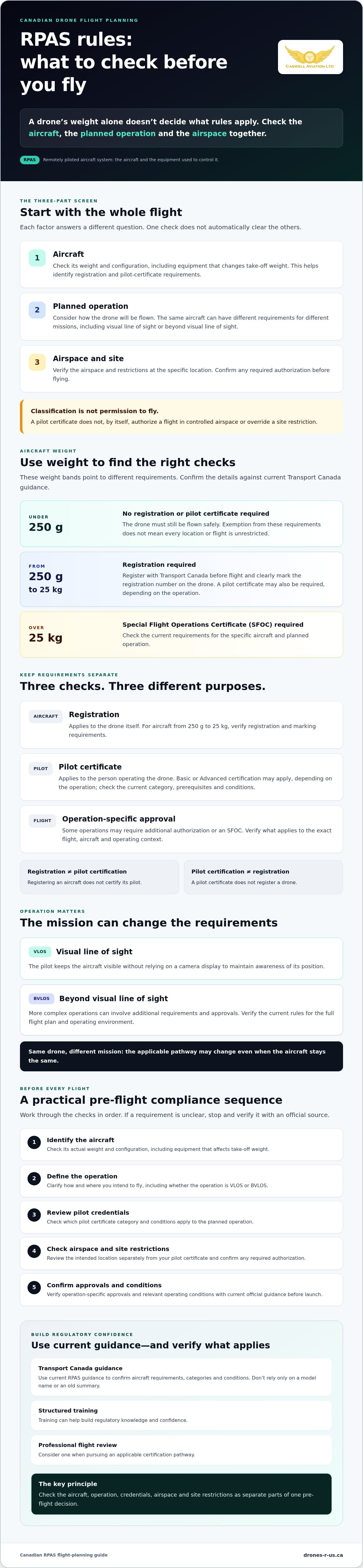
A preflight RPAS compliance checklist for Canadian drone pilots
A repeatable review helps turn RPAS regulations Canada into practical checks for a specific flight. Work through each step before launch, and repeat the review if the aircraft, location, people or plan changes.
The six checks to complete before launch
- Identify the aircraft. Confirm its weight and configuration, and check whether registration applies. If it’s registered, verify that its registration details are current and the number is marked as required.
- Define the operation. Write down what the flight involves, including whether it will remain within visual line of sight or use a more complex operating method. The operation helps determine which rules and approvals to check.
- Confirm the pilot’s credentials. Verify that the pilot holds the applicable certificate and meets its conditions. Don’t assume that a certificate suitable for one operation covers another.
- Check the airspace. Confirm the airspace status for the location and time, and determine whether authorization is required. Review any authorization conditions that apply to the planned flight.
- Confirm site access and permissions. Check who controls the take-off and landing area, whether access permission is needed, and whether the site authority has restrictions. Site permission doesn’t replace aviation authorization.
- Reassess conditions. Review visibility, weather, nearby people and obstacles against the limits for the applicable operation. If conditions or the plan have changed, assess the flight again before proceeding.
Stop and verify: If you’re unsure whether a certificate, authorization or restriction applies, don’t guess. Pause the flight plan and confirm the requirement with the relevant official source. Record applicable approvals and their conditions so they can be checked during preparation.
Where to confirm uncertain or changing requirements
Use current Transport Canada guidance and the applicable Canadian Aviation Regulations to check federal requirements. For airspace information and any required authorization, consult the relevant NAV CANADA resources. Ask the authority responsible for the site about access and local restrictions. These sources address different parts of the decision, so check each one that applies.
Pay particular attention to effective dates and transitional provisions when rules or guidance change. Confirm that a page or approval applies to the flight date, aircraft and operation you’re planning. If you can’t resolve a conflict or uncertainty, delay the operation until you can verify the requirement.
This checklist supports preparation, but it can’t guarantee compliance or replace current official guidance. Structured learning can help you understand the requirements and prepare for applicable certification pathways. Caswell Aviation Ltd offers online drone courses and in-person training, as well as relevant flight reviews.
Build RPAS compliance confidence through current guidance and training
RPAS requirements and official guidance can change. Before each operation, check the current Transport Canada information and applicable Canadian Aviation Regulations rather than relying on a saved checklist alone. Confirm that the rules, procedures and any approvals you reviewed still apply to your aircraft, operation, location and planned flight date.
Self-study is useful for building familiarity with the rules, but it isn’t the same as formal training or a pilot certificate. Training can help you understand how an operating category applies to a planned flight; Transport Canada remains the authority for regulatory requirements and certification. Neither a course nor a flight review should be treated as a substitute for checking official sources.
When structured training may be useful
Consider structured learning if you’re unsure which certificate pathway fits your intended operation, or want help turning regulatory concepts into sound preparation. Caswell Aviation Ltd offers online drone courses and optional in-person training. These options can support knowledge and readiness, but no training provider can promise a particular certification outcome. Check the current Transport Canada requirements for the pathway you’re considering.
Next steps for pilots preparing for an applicable flight review
A flight review may be part of a particular certification pathway. Confirm whether one applies to your circumstances, and check the current requirements before arranging one. Caswell Aviation Ltd provides Advanced and Level 1 Complex flight reviews. For broader certificate information, consult The Complete Guide to Transport Canada Drone Certification in 2026, then verify details against current official guidance.
Use the practical sequence in this guide to identify what you need to confirm: aircraft, operation, pilot credentials, airspace, site and conditions. If that review reveals a genuine training need or an applicable flight-review requirement, explore drone training and flight reviews from Caswell Aviation Ltd. Make the decision based on the operation you plan to conduct, and return to official sources before each flight.
Make each flight a deliberate compliance decision
Reliable RPAS regulations Canada preparation starts with three questions: what aircraft are you flying, what operation do you plan, and where will it take place? Keep registration, pilot certification and any operation-specific approval separate. Then check airspace, site restrictions and operating conditions. A certificate or site permission alone doesn’t clear every requirement.
Use a repeatable preflight review, and verify current official guidance before each operation. If a requirement or authorisation is unclear, pause and confirm it rather than relying on assumptions. Recheck your plan if the aircraft, location, people or conditions change.
For pilots who want help understanding an applicable certification pathway, Caswell Aviation Ltd offers online courses and optional in-person training. Advanced and Level 1 Complex flight reviews are also available where relevant to the pathway. Training supports preparation; Transport Canada remains the regulatory authority, and requirements should always be confirmed through current official sources.
If structured learning or a flight review fits your next step, explore Caswell Aviation Ltd drone training and flight-review services. With a clear process and careful checks, you can approach each flight with greater confidence.
Frequently Asked Questions
Do I need a licence to fly a drone in Canada?
For most drones weighing 250 g to 25 kg, you need the pilot certificate that applies to your operation, rather than a general-purpose licence. Transport Canada’s standard pathways include Basic and Advanced Operations, with requirements shaped by factors such as airspace and proximity to people. A certificate doesn’t authorize every flight or location. Check current Transport Canada guidance to identify the applicable category and any additional approvals.
Do I need to register my drone in Canada?
You must register drones weighing 250 g to 25 kg with Transport Canada before flying, and clearly mark the aircraft with its registration number. Drones under 250 g are exempt from registration, while operations involving aircraft over 25 kg require a Special Flight Operations Certificate. Registration applies to the aircraft, not the pilot, and doesn’t grant permission to fly at a particular site. Confirm current requirements through official guidance.
Can I fly a drone anywhere in Canada if I have a pilot certificate?
No. A pilot certificate doesn’t give you unrestricted access to Canadian airspace or every location. You may need authorization for controlled airspace, and site owners or responsible authorities can set access restrictions. Other operating limits may apply based on the operation and nearby people. Before flying, check airspace status, required approvals and site conditions separately, then confirm that your certificate covers the planned operation.
What happens if I fly a drone without following Canadian regulations?
Flying contrary to applicable requirements can lead to enforcement action, and penalties may apply depending on the circumstances and the rule involved. The consequences can’t be determined from a general summary alone. Before operating, check the current Canadian Aviation Regulations and Transport Canada guidance for your aircraft and flight plan. If you’re uncertain whether a requirement applies, pause and verify it with an official source instead of assuming it’s optional.
Are the rules different for drones under 250 grams in Canada?
Yes. Drones weighing less than 250 g are exempt from Transport Canada registration and pilot-certificate requirements. That exemption doesn’t mean every flight is unrestricted: pilots must still fly safely and consider airspace, location and site rules. Also confirm the aircraft’s actual weight in its flight configuration and check current guidance, especially if equipment changes its weight or the planned operation raises additional concerns.
How do I check whether my drone flight is allowed in Canadian airspace?
Start with Transport Canada’s current RPAS guidance, then consult NAV CANADA for applicable airspace information and authorization requirements, including for controlled airspace. Check the exact location and planned operation, and review any conditions attached to an authorization. Also confirm site access with the responsible owner or authority. RPAS regulations Canada require more than a certificate check, so verify each applicable requirement before launch and recheck if plans change.
Leave a comment