

Flying a Drone Near an Airport: Canadian Rules and Steps for 2026
Airport distance is only the first check, not a green light to launch. If you're searching for rules on flying a drone near an airport, the key question is whether your planned operation is allowed in that airspace and whether you have the required qualifications and authorisation.
It's understandable to focus on how close an airport is. In Canada, the general distance limit is 5.6 kilometres from an airport, but controlled airspace, the type of operation, and other restrictions can affect what you may do. A map check alone won't confirm that a flight is permitted.
This guide explains how to check airspace, distinguish distance limits from controlled-airspace requirements, and confirm the steps to take before flight. You'll learn when to stop and choose another location, when NAV CANADA authorisation may be required, and how Transport Canada certification fits into the decision. If your operation calls for more advanced knowledge, Caswell Aviation Ltd can help you prepare through expert training and applicable flight reviews.
Key Takeaways
- Check airport proximity and airspace designation separately. One check does not replace the other.
- Review the site and airspace step by step to identify restrictions and determine whether authorization is required.
- For flying a drone near an airport Calgary, verify the specific location and operation rather than relying on distance alone.
- Use a pre-flight go-or-no-go checklist covering your aircraft, operating rules, qualifications, current restrictions, and authorization.
- Online or in-person training can strengthen your understanding of advanced requirements, but it does not approve a flight.
Flying a Drone Near an Airport in Canada: What Must You Check First?
Airport proximity and airspace designation are related checks, but neither grants permission to fly. If you’re researching flying a drone near an airport Calgary, don’t treat distance from a runway or airport boundary as a complete go-or-no-go test. Identify the exact flight location first, then verify its airspace and the rules for your aircraft and planned operation.
A remotely piloted aircraft system (RPAS) is the drone and the equipment used to control it. Controlled airspace is airspace where aircraft movements are managed under specific requirements. Transport Canada regulates RPAS operations in Canada. Airport surroundings may also have operational restrictions, so requirements depend on the precise site and flight, not just the nearest airport.
How airport proximity differs from controlled airspace
An airport can be nearby without proximity alone telling you whether the site is in controlled airspace or what restrictions apply. A site farther away may still fall within controlled airspace. Check the airspace classification and all applicable airport-related restrictions for the proposed location. A distance threshold can be one relevant rule, but it is not universal permission to fly or a substitute for checking airspace and authorization requirements.
Which Canadian rules apply to your drone operation?
Canadian requirements distinguish between Basic and Advanced operations. Which rules apply depends on factors such as the aircraft, where and how you plan to fly, and your pilot qualifications. Being qualified for one type of operation does not automatically meet the requirements for another location or operation.
Use this distinction as a starting point, not a certification guide. Review the applicable requirements in the Canadian drone regulations guide, then confirm details with current official information. This overview of Canadian drone regulations provides broader context, but it should not replace Transport Canada rules or current aeronautical information.
For a practical first review, write down the location, aircraft category, intended operation, and pilot qualification. Then check for airspace or site restrictions and determine whether authorization is required. This guide can support your planning, but it does not grant permission or replace official authorization. If you can’t confirm the requirements for the flight, pause and verify them before launching.
How to Check Airport Airspace Before a Drone Flight
Check the exact site and operation, not just the nearest airport. For anyone searching “flying a drone near an airport Calgary,” the same practical first step applies across Canada: verify the location, then confirm its airspace and the rules for your planned flight.
- Identify the exact site. Pinpoint the launch and operating area. A nearby street, park, or field may have different airspace or site restrictions.
- Check current airspace. Review the location in NAV CANADA’s NAV Drone service and note the airspace designation and information relevant to your operation.
- Review restrictions. Check airport-related restrictions, current aeronautical information, and applicable NOTAMs. Look for temporary changes that could affect the site or flight.
- Confirm authorization. Determine whether the operation requires authorization and whether it has been granted for the proposed location and activity. If you can’t verify the requirements, don’t launch.
Use NAV Drone and official airspace information carefully
NAV CANADA manages Canadian air traffic services, and its NAV Drone service supports drone airspace planning and authorization requests in controlled airspace. Use it to investigate the proposed site and review the process available for your operation. Features and procedures can change, so confirm current instructions directly with NAV CANADA. A map result is a planning aid, not permission to fly.
Compare map information with Transport Canada drone flying rules and current aeronautical information. Consult Transport Canada for operating rules, NAV CANADA for airspace and authorization information, and current NOTAMs for relevant notices. A search for “flying a drone near an airport Calgary” can help frame the question, but only current official checks can inform your decision for a specific flight.
Check temporary restrictions and site-specific conditions
Make a fresh check close to flight time. NOTAMs and other restrictions may affect a site after an earlier review. Aeronautical requirements are separate from permission to access or use land, so check relevant landowner, facility, and local site-access rules too.
If information is unavailable, unclear, or conflicting, pause and seek authoritative clarification. Don’t treat an apparently open map as confirmation that every requirement is met. For pilots who want to build knowledge of complex airspace, online and in-person drone training can support preparation, but training does not replace required authorization.
Is Flying Near an Airport Automatically Illegal? Common Misconceptions
No. Being near an airport does not, by itself, tell you whether a specific drone flight is legal. But an apparently open map does not prove that a flight is allowed, either. The decision depends on the airspace, applicable restrictions, your qualifications, any required authorization, and whether you can operate safely.
Keep four separate questions in view:
- Legal permission: Do the applicable Canadian rules allow this aircraft and operation at the proposed site?
- Airspace authorization: Does the airspace or operation require authorization, and has it been granted for this flight? NAV CANADA explains its process for NAV CANADA drone flight authorization.
- Pilot qualification: Do you hold the certificate and meet the requirements for this operation?
- Safe operating judgement: Can you maintain control and respond appropriately to conditions at the site?
These checks are related, but none replaces the others. Authorization does not remove the need to follow applicable operating rules or make a flight safe in unsuitable conditions. An airspace map that shows no obvious restriction is not a substitute for confirming current information and requirements.
Why a drone certificate is not blanket permission
A pilot certificate establishes privileges for the operations it covers. It does not clear every location, remove site restrictions, or automatically authorize a specific flight. Confirm that your qualification matches the proposed operation, then check whether separate authorization is needed. Transport Canada’s current certification requirements should guide your review. Use a Canadian drone certification guide as a learning aid, not as a substitute for official rules.
A certificate qualifies the pilot; it does not grant permission for every flight.
When the safest decision is not to launch
Postpone the flight if authorization is missing, an applicable restriction is active, the airspace information is unclear, or you can’t maintain safe control. Airport traffic and emergency activity can affect the risk picture, so conditions that seemed manageable during planning may change. Recheck current information and assess whether the operation remains safe.
Don’t base a go decision on assumptions, an old screenshot, or informal advice. If you can’t resolve uncertainty through authoritative information, choose another site or wait until you can verify the requirements. A new location may still require its own airspace and site checks. Making a conservative decision is part of responsible flight planning, not a failure to complete the operation.
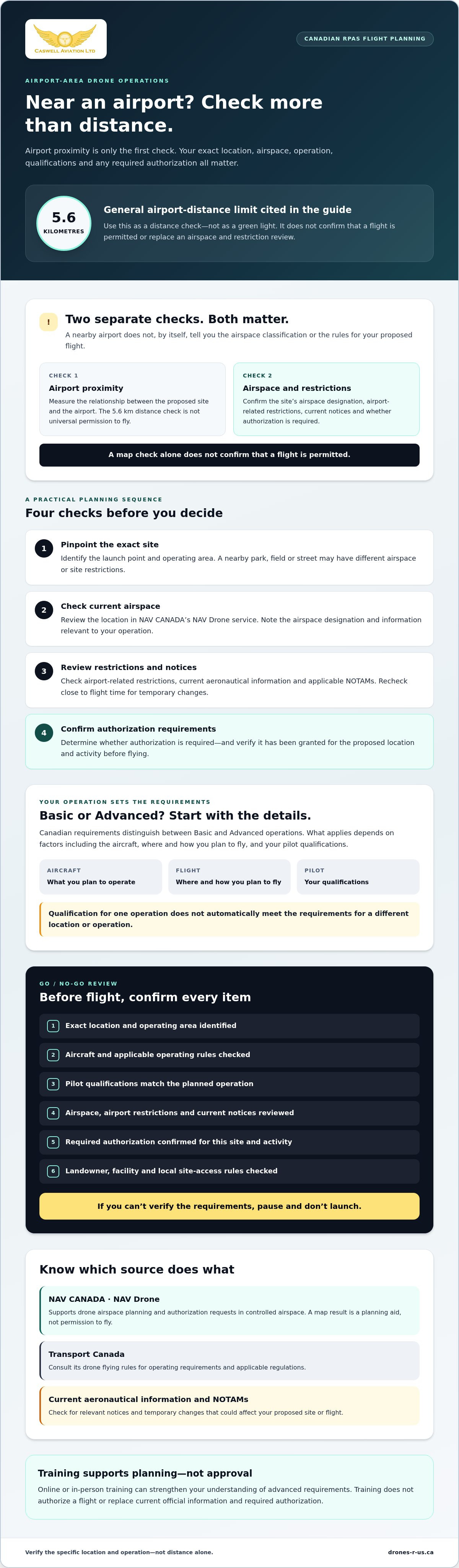
A Pre-Flight Checklist for Drone Flights Near Airport Airspace
A repeatable checklist turns airspace research into a clear decision. Complete it for the specific flight, then record whether you’re proceeding, seeking clarification, or stopping. Don’t rely on a previous plan: airspace information, restrictions, site conditions, and authorization details may change.
Confirm the operation, aircraft, and pilot requirements
Start with the details that define the flight. Check current Transport Canada and NAV CANADA information against your proposed operation, and record what you verified.
- Site: Note the exact operating area and confirm that you’re allowed to access and use it.
- Aircraft: Record the aircraft and its applicable category. Check the rules that apply to it.
- Operation: Describe what you plan to do, including where and how the drone will operate.
- Pilot: Confirm that your certificate and qualifications apply to this operation.
- Airspace and restrictions: Review current airspace information and applicable restrictions, including relevant NOTAMs.
- Authorization: Determine whether the flight requires authorization or another specific approval. Confirm that any required authorization covers the planned operation.
Qualification, authorization, and safe operating conditions are separate checks. Completing one does not replace the others.
Make and document a defensible go-or-no-go decision
Before launch, assess conditions as they are now. Confirm that weather and visibility suit the operation, site access remains available, and your communication plan and emergency procedures are workable. Consider whether anything at the site could prevent you from maintaining safe control. If conditions have changed since planning, reassess instead of relying on an earlier decision.
Keep a simple record of the site, aircraft, operation, information sources checked, time of review, and any relevant authorization. This makes your decision traceable and helps identify which details need to be rechecked before a later flight.
- Verified and authorized: Proceed only if you’ve confirmed the applicable requirements, obtained any required authorization, and judged the operation safe.
- Unclear: Pause and seek clarification from the appropriate authoritative source before deciding.
- Restriction, missing authorization, or unsafe condition: Don’t fly. Resolve the issue or choose another site.
If you can’t confidently complete these checks, strengthen your knowledge before planning a more demanding operation. Explore online and in-person drone training to build your understanding of operating requirements and flight planning.
Build the Skills to Plan Airport-Area Drone Operations
Before planning a flight near airport airspace, define the operation, check current official requirements, and identify any training you need to interpret them confidently. Airspace planning involves more than locating an airport on a map. You need to understand how the aircraft, operating rules, pilot qualifications, site, and any required authorization relate to the specific flight.
Training can help build that foundation, but it does not grant permission to fly in restricted or controlled airspace. Confirm requirements with Transport Canada and NAV CANADA, and assess each planned operation on its own terms.
When online or in-person drone training may help
Consider structured instruction if you’re unsure how to interpret airspace information, apply operating rules, or plan a flight that calls for advanced knowledge. Online courses can support rule knowledge and preparation, while in-person training offers another learning format. Caswell Aviation Ltd provides online and in-person training for Transport Canada Advanced and Level 1 Complex certifications. The appropriate training depends on the operation and the qualifications it requires.
Explore drone training and certification resources as a next step in preparing for more complex operations. Course participation alone does not guarantee certification, airspace authorization, or approval to conduct a particular flight. You’ll still need to meet the applicable requirements and confirm any authorization separately.
How a flight review fits into pilot preparation
A flight review is distinct from authorization to conduct a specific operation. It may be relevant to an applicable pilot qualification pathway, but it does not approve a flight location or replace permission from the responsible authority. Caswell Aviation Ltd offers professional flight reviews for pilots pursuing applicable advanced operating qualifications. Check the current requirements for your intended pathway before deciding what preparation is needed.
Make your next step practical: write down the operation you want to conduct, verify the official rules that apply, and identify any gaps in your knowledge or qualifications. If you’re unsure how to interpret the requirements, seek suitable training before relying on assumptions. For structured preparation, explore drone training options and choose a learning path that fits your intended operation.
Plan Your Next Flight With Confidence
Airport proximity is a reason to check carefully, not a complete answer about whether a flight is permitted. Before launching, verify the exact site’s airspace, current restrictions, applicable operating rules, pilot qualifications, and any required authorization. If information is uncertain or a safety condition isn’t met, pause and choose a clear next step rather than relying on assumptions.
If you’re researching “flying a drone near an airport Calgary,” keep the core distinction in mind: a pilot certificate does not authorize every flight, and a map result does not confirm that all requirements are satisfied. Each operation needs its own current checks and a defensible go-or-no-go decision.
Caswell Aviation Ltd offers online and in-person training for Transport Canada Advanced and Level 1 Complex certifications, along with professional flight reviews for applicable pilot qualification pathways. A flight review may support a relevant pathway, but it does not provide airspace authorization for a particular operation.
Explore online and in-person drone training to build your knowledge and prepare for your intended operations. With careful planning and suitable preparation, you can make sound decisions and fly responsibly.
Frequently Asked Questions
Can I fly a drone near an airport in Canada?
Yes, some flights near airports may be possible, but you must confirm the rules for the specific operation before take-off. The general limits are 5.6 kilometres from an airport and 1.9 kilometres from a heliport unless applicable authorization allows otherwise. Operations closer to an airport may require an Advanced Pilot Certificate and NAV CANADA authorization. Check current airspace, restrictions, aircraft requirements, and official rules for your planned flight.
Is it illegal to fly a drone close to an airport?
Not automatically, but being close to an airport doesn’t mean a flight is permitted. The answer depends on the site’s airspace, applicable restrictions, your qualifications, and whether the operation requires authorization. An apparently open map or a pilot certificate alone isn’t enough to establish that a flight is legal. If a restriction applies, authorization is missing, or you can’t verify the requirements, don’t launch until you’ve clarified the situation.
How do I check whether a drone flight is allowed near an airport?
Start by identifying the exact operating site, then check its airspace and restrictions using current official information. Review Transport Canada’s rules and NAV CANADA’s NAV Drone service, and check applicable NOTAMs close to flight time. Confirm whether your aircraft and operation require a particular qualification or authorization, and whether any required authorization covers the planned flight. Also check land access and site rules. If details conflict or remain unclear, pause and seek clarification.
Do I need an Advanced certificate to fly near an airport?
For a drone operation that requires a pilot certificate and is closer than the general airport distance limit, an Advanced Pilot Certificate may be required, along with NAV CANADA authorization where applicable. Requirements depend on the aircraft, operation, location, and airspace. An Advanced certificate doesn’t give blanket permission to fly near every airport or approve a specific flight. Check current Transport Canada requirements and confirm any separate authorization before planning to launch.
Does a drone app tell me whether I can legally fly?
No, an app is a planning aid, not a complete legal decision. NAV CANADA’s NAV Drone service can help pilots review airspace information and available authorization processes, but a map result doesn’t replace checking current rules, restrictions, qualifications, and site conditions. Confirm that any required authorization has been granted for your operation. If the information is unavailable, unclear, or conflicting, don’t interpret that uncertainty as permission to fly.
What should I do if my planned drone flight is in controlled airspace?
First, confirm the airspace and review the requirements for your exact operation. Flights in controlled airspace require NAV CANADA authorization. Use its current guidance and NAV Drone service to review the applicable request process. Make sure you hold the qualifications needed for the operation, and verify any authorization before launch. If authorization hasn’t been granted or you can’t confirm the requirements, postpone the flight or choose another site.
Can drone training help me prepare to fly near an airport?
Yes. Training can strengthen your understanding of operating rules, airspace, and flight planning, but it doesn’t grant authorization to fly at a particular site. Caswell Aviation Ltd offers online and in-person training for Transport Canada Advanced and Level 1 Complex certifications, as well as professional flight reviews for applicable qualification pathways. A flight review is separate from airspace authorization. Always check current official requirements for the operation you intend to conduct.
Leave a comment