

Drone Ground School in Canada: Training, Exams, and Your Next Steps
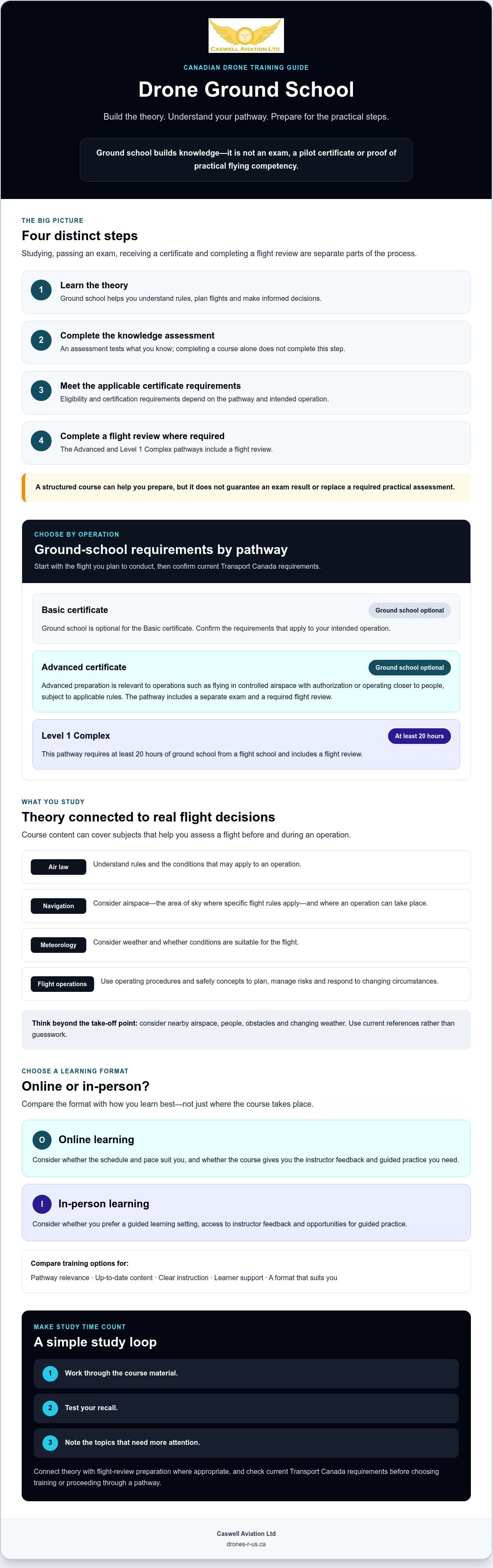
Could you pass a drone exam and still be unprepared for the practical demands of an operation? That’s why drone ground school Canada is about more than memorizing answers. It helps you understand the rules, plan flights and make informed decisions. Studying, passing an exam, receiving a certificate and completing a flight review are separate steps.
If you’re unsure what ground school covers, whether online study suits you or which certification pathway fits your goals, you’re not alone. Requirements can feel unclear, especially when study materials don’t reflect current Transport Canada rules. A structured course can help you prepare, but it doesn’t guarantee an exam result or replace any required practical assessment.
This guide explains what Canadian drone ground school typically teaches, how online and in-person learning compare, and how certification steps differ by pathway. You’ll also find practical ways to organize your study and connect theory with flight-review preparation where appropriate. Caswell Aviation Ltd offers online courses and optional in-person training for Advanced and Level 1 Complex pathways, along with professional flight reviews.
Key Takeaways
- Use drone ground school Canada to build theory knowledge, then confirm the separate certification steps for your intended pathway.
- Compare online and in-person learning by considering your schedule, preferred pace, access to instructor feedback, and need for guided practice.
- Start with the operation you plan to conduct, then check current Transport Canada requirements before choosing a course.
- Make study time count by working through course material, testing your recall, and noting topics that need more attention.
- Assess training options for pathway relevance, up-to-date content, clear instruction, learner support, and a format that suits you.
What Is Drone Ground School in Canada, and What Does It Prepare You For?
Drone ground school is structured theory instruction that helps you prepare for drone operations and the knowledge requirements of a certification pathway. In Canada, this learning may cover remotely piloted aircraft systems (RPAS), the term for a remotely piloted aircraft and the systems involved in operating it. For a general introduction to drone terminology and classifications, see Unmanned aerial vehicle (UAV).
Ground school builds knowledge; it isn’t an exam, a pilot certificate or proof of practical flying competency. Completing a course doesn’t automatically satisfy Transport Canada’s certification requirements. The pathway you need depends on the operation you intend to conduct and your current experience, so check the latest Transport Canada requirements before choosing training.
What subjects can Canadian drone ground school cover?
Course content can include air law, navigation, meteorology and flight operations. These subjects support decisions before and during a flight. Airspace is the area of sky where specific flight rules apply; understanding it helps you assess where an operation can take place and what conditions or permissions may be relevant. Weather knowledge helps you consider whether conditions are suitable, while operating procedures and safety concepts help you plan, manage risks and respond to changing circumstances.
These topics connect theory to real decisions. A site may appear clear, for example, but you still need to consider nearby airspace, people, obstacles and changing weather. Ground school gives you a framework for identifying those factors and consulting current references instead of relying on guesswork.
How does ground school relate to a drone pilot certificate?
Keep the steps distinct: instruction helps you learn, a knowledge assessment tests what you know, and meeting the applicable eligibility requirements allows you to pursue a certificate. Some pathways also include a practical assessment. The Advanced and Level 1 Complex pathways include a flight review, so passing a theory course alone doesn’t complete that step. As of October 2026, ground school is optional for Basic and Advanced certificates, while Level 1 Complex requires at least 20 hours of ground school from a flight school. Confirm current requirements with Transport Canada before proceeding.
Requirements vary by certificate and intended operation, so don’t assume one course or certificate covers every flight. For the certification sequence, consult Transport Canada’s guide to getting a drone pilot certificate. The distinction is simple: ground school develops knowledge, certification confirms you meet defined requirements, and practical assessment evaluates performance where required.
How Drone Ground School Connects to Canada’s Advanced and Level 1 Complex Pathways
Transport Canada’s Pilot Certificate - Advanced Operations and Pilot Certificate - Level 1 Complex are distinct pathways for different operational needs. Choose preparation based on the type of flight you plan to conduct, not simply because you want to fly commercially. Review the current Canadian drone regulations and identify the applicable pathway before selecting a course.
Ground school organizes the theory behind a pathway and helps you understand the rules and concepts tested in its knowledge assessment. It doesn’t replace an exam, establish eligibility or provide operational authorization. Some operations may also require a practical assessment or additional permissions, depending on the circumstances.
What should learners understand about Advanced training?
Advanced preparation is relevant to operations such as flying in controlled airspace with authorization or operating closer to people, subject to applicable rules. The Transport Canada Advanced exam is a separate step, and a flight review is also required for the certificate. Structured theory study can help you work through the subject matter and identify gaps, but it can’t guarantee an exam pass or flight-review result. Consult Transport Canada’s Advanced certificate guide for the current process and requirements.
Caswell Aviation Ltd offers online courses and optional in-person training for the Advanced pathway. When comparing study options, review the Advanced drone training options and consider whether the format suits your experience and learning preferences.
When does Level 1 Complex training become relevant?
Level 1 Complex is a separate pathway for more complex operations, including certain Beyond Visual Line-of-Sight (BVLOS) flights. BVLOS means flying beyond the pilot’s direct line of sight. This pathway has its own knowledge exam and practical flight-review step. Ground school is required, but completing it alone doesn’t confer a certificate or permission to conduct a particular operation. Check current Transport Canada criteria to confirm whether the pathway fits your intended work.
More complex operations can involve requirements beyond course material. Confirm any applicable application, assessment and operational permissions before planning a flight. For detailed rules, consult the existing Canadian RPAS regulations guide and current Transport Canada references.
Study prepares you for the pathway; exams, eligibility, practical assessment and any required permissions determine whether you may conduct the operation. When choosing drone ground school Canada, match the course to your pathway, then verify each required step using current official guidance.
Online or In-Person Drone Ground School: How to Compare Your Options
The right format depends on your schedule, how you learn best and whether you want guided discussion alongside independent study. Online lessons may be easier to fit around other commitments. In-person instruction can give you direct opportunities to ask questions. Neither format replaces an exam, flight review or other requirement for your certification pathway.
| Factor | Online learning | In-person instruction |
|---|---|---|
| Flexibility | Study may fit around your schedule, depending on course access and structure. | Sessions follow a set schedule; confirm the timing before enrolling. |
| Instructor interaction | Ask how and when you can contact an instructor, if that support is included. | Direct discussion can make it easier to raise questions during instruction. |
| Feedback | Check whether the course includes feedback on questions or progress. | Ask what feedback is provided and how it relates to your learning goals. |
| Pacing | You may be able to review lessons at your own pace; confirm whether progress is self-directed. | Learning usually follows the instructor’s session plan and pace. |
| Practical support | Confirm whether any guided practice is included or arranged separately. | Ask exactly what practical elements are included; in-person theory instruction alone doesn’t confirm flight practice. |
When may online drone ground school suit a learner?
Online study may suit you if you need scheduling flexibility or want to revisit lessons before moving on. Before choosing a course, check its pathway coverage, lesson sequence, progress tracking, instructor access and use of current reference material. A well-organized course can support theory preparation, but don’t assume online learning covers every certification or practical requirement.
When can in-person instruction add value?
In-person teaching can provide direct clarification, guided discussion and feedback on questions that come up as you study. It may be useful if you learn by talking through a topic rather than reviewing it alone. Confirm what the instruction includes, how questions are handled and whether practical elements are part of the training. Compare the support offered, not just the delivery format.
Caswell Aviation Ltd offers online courses and optional in-person training for Advanced and Level 1 Complex pathways. To compare formats and course information, explore drone training options. For drone ground school Canada, choose a format that suits your study habits, then verify that it supports the specific steps you still need to complete.
How to Prepare for Drone Ground School and Make Study Time Count
A clear plan helps turn course material into knowledge you can use. First, identify the certificate pathway that matches your intended operation. Then check current Transport Canada requirements, including prerequisites and assessment steps. Once you’ve confirmed the course fits, study its material alongside current official references, practise recalling key ideas and note topics you can’t yet explain confidently.
Use scenario-based questions to apply concepts rather than memorizing terms in isolation. Imagine planning a flight at a new site: what would you check about the airspace, weather, people nearby and operating procedures? Working through those decisions connects course concepts with the responsibilities involved in flight planning. For exam format and requirements, consult current Transport Canada guidance instead of relying on outdated practice questions or assumptions.
What should you check before starting a drone course?
Confirm that the course is designed for your intended certificate pathway and reflects current Canadian requirements. Review its stated prerequisites, how long you can access the material, what instructor support is available and how your progress is assessed. Before enrolling, write down questions about the knowledge exam, practical skills, flight review or next certification step. Clear answers help you judge whether the course addresses your needs.
How can you build a consistent study routine?
Break the material into manageable sessions and schedule regular reviews rather than leaving every topic until the end. After each lesson, write a short summary from memory, then use practice questions to identify gaps. Revisit difficult concepts with instructor support or verified Transport Canada references. If you can explain why a decision matters in a flight scenario, rather than just repeat a definition, you’re building useful understanding.
- Identify: Match your intended operation to the relevant pathway.
- Verify: Check current Transport Canada requirements and course prerequisites.
- Study: Work through lessons in planned sessions and review key ideas.
- Apply: Use scenarios to practise making operational decisions.
- Reassess: List remaining knowledge gaps and confirm what assessment comes next.
Ground school supports knowledge, but it doesn’t replace an applicable practical assessment. Treat theory study and hands-on competency as related but separate parts of your preparation. To review course options for Advanced and Level 1 Complex preparation, explore drone ground school and training options.
Choose Canadian Drone Ground School That Supports Your Next Step
A suitable course should match the certificate pathway you’re pursuing and provide a clear, current foundation for study. Use this checklist to compare options before enrolling:
- Pathway relevance: Confirm the course supports the certificate you’re working toward, such as Advanced or Level 1 Complex.
- Current material: Ask when the content was last reviewed and how it reflects current Transport Canada requirements.
- Clear instruction: Look for explanations that make technical concepts understandable and connect them to operational decisions.
- Learner support: Confirm what instructor guidance or feedback is available if you have questions.
- Format fit: Choose online or in-person training based on your schedule and how you learn best.
These checks help you compare drone ground school Canada options without assuming that a course alone completes certification. Caswell Aviation Ltd offers online courses and optional in-person training for Advanced and Level 1 Complex preparation. Professional flight reviews are also available for relevant certification steps, as a separate service rather than an assumed part of course enrolment.
What questions should you ask a drone ground-school provider?
Ask which pathways the course supports and when its material was last reviewed. Clarify the delivery format, instructor guidance available and whether practical training components are included. Also ask which steps remain separate after the course, including knowledge exams, eligibility requirements and applicable practical assessments. Clear answers help you understand exactly what the training covers and what it doesn’t.
How can training lead into a flight review?
A flight review assesses practical performance and is distinct from theory instruction. Verify whether your specific pathway requires one, what skills or preparation it involves, and how it fits into the certification sequence. Ground-school learning can support your understanding, but it doesn’t guarantee a flight-review result. For a fuller explanation, consult the existing drone flight-review guide alongside current Transport Canada guidance.
Choose training that supports your next step, then confirm each requirement before proceeding. Review drone training and flight-review options to see what may suit your preparation needs.
Build a Clear Plan for Your Drone Training
Choosing drone ground school Canada starts with your intended operation and the certification pathway that applies. Ground school builds theory knowledge, while exams, eligibility requirements and practical assessments remain separate steps. Check current Transport Canada guidance, then choose a learning format that suits your schedule and helps you address knowledge gaps.
Caswell Aviation Ltd offers online courses and optional in-person training for Advanced and Level 1 Complex preparation. Professional flight reviews are also available as a separate service for relevant certification steps. Neither training nor course completion guarantees an exam pass, certificate or flight-review result, so confirm what each option covers before proceeding.
Take the next step at a pace that works for you. Review online drone courses and in-person training, and consider whether the available training and separate flight-review options fit your pathway. With current information and a structured approach, you can prepare with greater clarity. Contact Caswell Aviation Ltd to review training and flight-review options for your next step.
Frequently Asked Questions
What is drone ground school in Canada?
Drone ground school in Canada is structured theory instruction that helps learners build knowledge for drone operations and certification preparation. Depending on the course, topics may include airspace, weather, operating procedures and safety. It can help you understand how to plan and assess a flight, but it isn’t a Transport Canada certificate. Compare the course content with current official requirements for your intended pathway before relying on it for exam preparation.
Is drone ground school required to get a Transport Canada certificate?
It depends on the certificate pathway. Ground school is optional for Basic and Advanced certificates, while the Level 1 Complex pathway requires a minimum of 20 hours of ground school from a flight school, according to current requirements. A private course doesn’t automatically meet every certification requirement. Check Transport Canada’s current process for your pathway, including exam, eligibility and practical assessment steps.
Can I complete drone ground school online in Canada?
Yes, online study is one way to work through drone theory material in Canada. It can let you review lessons and organize study around your schedule. Before enrolling, confirm that the course supports your intended pathway, uses current Canadian references and explains what instructor assistance is available. Online learning doesn’t automatically replace practical training or any assessment required for your certificate.
Does drone ground school guarantee that I will pass the exam?
No. A ground-school course can structure your study and help identify topics that need more attention, but it can’t guarantee an exam result or certificate. Your result depends on your preparation and the applicable assessment. Check current Transport Canada exam requirements, practise applying concepts to operational scenarios and ask the provider how learner progress is assessed and what support is available if you have questions.
What is the difference between drone ground school and a flight review?
Ground school focuses on theory and knowledge preparation; a flight review assesses practical performance where required for the relevant pathway. They serve different purposes, so completing a course doesn’t demonstrate practical competency. The Advanced and Level 1 Complex pathways include a flight review. Confirm current requirements for your certificate and clarify how theory study relates to practical preparation before arranging the next step.
How do I choose between online and in-person drone training?
Compare pathway fit, current course material, instructor access, feedback, pacing and any practical components. Online learning may suit you if flexible scheduling and independent review are priorities. In-person instruction can offer direct discussion and opportunities to clarify questions. Neither format is automatically the better choice. Ask what each course includes, then choose the teaching approach and support that fit your learning preferences and preparation needs.
What does Advanced or Level 1 Complex drone ground school cover?
Course content varies, so check the provider’s current syllabus against Transport Canada requirements. Caswell Aviation offers online courses and optional in-person training for the Advanced and Level 1 Complex pathways. Course completion isn’t a certificate or a guarantee of passing. Confirm any prerequisites, exam steps and applicable flight-review requirements. Caswell also offers professional flight reviews as a separate service, not as an assumed inclusion in every course.
Leave a comment