

Drone Flight Review Calgary: Your Guide to Advanced RPAS Certification in 2026
Preparing for a drone flight review Calgary pilots may be searching for means showing more than accurate control inputs. The assessment also considers how consistently you plan an operation, recognize hazards and make safe decisions.
It’s understandable to feel uncertain about the assessment. Transport Canada’s requirements, the in-person flight portion, paperwork and site survey can seem like a lot to coordinate. A clear preparation plan makes each part more manageable and helps you approach the review with confidence.
This guide explains what to expect during an Advanced flight review and how to prepare. You’ll learn how to organize documents, complete a site survey, check weather and NOTAM information, and practise the flight tasks and emergency procedures covered by the reviewer. We’ll also look at common preparation gaps and how professional training can help you build sound habits. Caswell Aviation provides Advanced and Level 1 Complex flight reviews, along with online and in-person training. Use this guide to prepare methodically for your next certification step.
Drone flight review Calgary: a practical preparation guide
The steps in this guide apply to pilots preparing for a review anywhere in Canada. Use the current Transport Canada requirements and your reviewer from Caswell Aviation Ltd to confirm what applies to your aircraft and planned assessment.
Key Takeaways
- Understand how the practical flight review follows the Advanced written exam and what the assessment is designed to demonstrate.
- Prepare a site survey, flight plan, emergency procedures and checklists before meeting your reviewer.
- Be ready for the briefing, pre-flight inspection and site safety walkthrough at your in-person assessment.
- Practise emergency procedures deliberately and strengthen your pre-flight planning to avoid common preparation gaps.
- Explore how online or in-person training and a flight review can support your next certification step.
The Role of the Flight Review in Canadian Drone Regulations
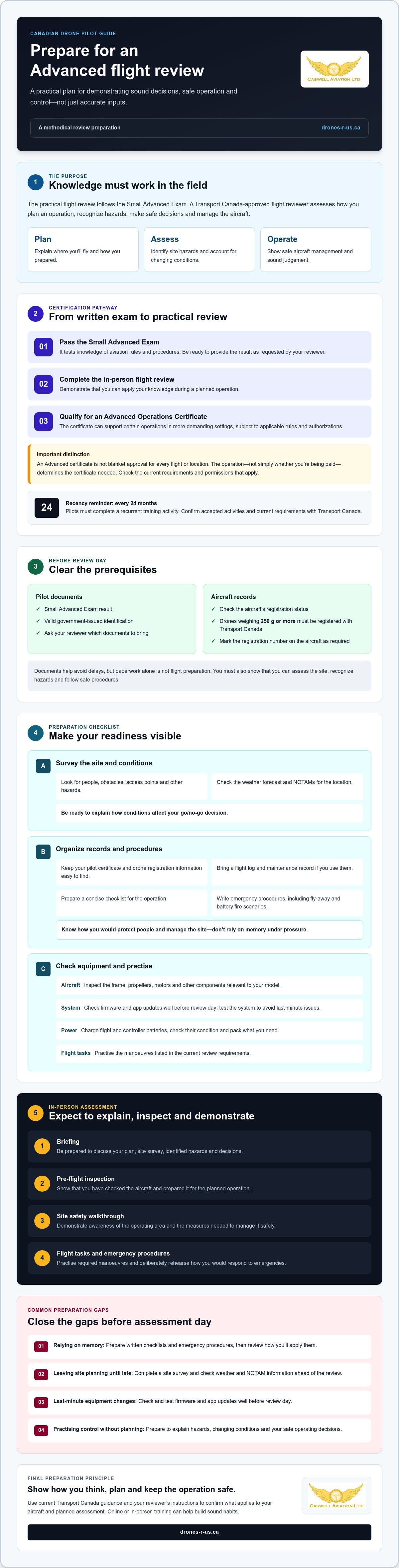
A flight review is the practical assessment required to qualify for an Advanced Operations Certificate. It follows the Small Advanced Exam, which tests your knowledge of aviation rules and procedures. Passing the exam is an important step, but it doesn’t show how you apply that knowledge during an operation. An in-person review gives a Transport Canada-approved flight reviewer the opportunity to assess your planning, judgement and ability to manage the aircraft safely.
Drone operations are subject to safety-focused regulations whether the flight is recreational or for work. The certificate you need depends on the operation, not simply on whether you’re being paid. An Advanced certificate can support operations such as flying in controlled airspace or closer to people, but only when applicable requirements and permissions are met. It isn’t blanket approval for every location or flight.
Advanced vs. Basic Operations: Why the Review Matters
Basic operations have tighter limits on where and how you can fly. Advanced operations may allow flights in more demanding settings, including controlled airspace and certain operations closer to people, subject to applicable rules, aircraft requirements and authorizations. The review checks whether you can manage those added responsibilities through sound decisions, not just competent control inputs.
Commercial intent alone doesn’t determine whether you need an Advanced certificate. The nature and location of the planned flight do. For pilots following the Advanced pathway, the practical review is a required step after the written exam. To maintain certificate recency, pilots must complete a recurrent training activity every 24 months. Check Transport Canada’s current guidance for accepted activities and requirements.
Prerequisites Before You Book Your Assessment
Before arranging your assessment, confirm that you’ve passed the Small Advanced Exam and can provide the result as requested by your reviewer. Check the aircraft’s registration status too. Drones weighing 250 g or more must be registered with Transport Canada, and the registration number must be marked on the aircraft in accordance with applicable requirements.
Prepare valid government-issued identification and ask the reviewer which documents to bring. These steps help prevent avoidable delays, but they don’t replace flight preparation. You’ll still need to demonstrate that you can assess the operating site, recognize relevant hazards and follow safe procedures. The review checks whether your knowledge holds up in practice, where each decision contributes to a safe flight.
Essential Preparation for Your Advanced Flight Review
Good preparation is visible before the drone leaves the ground. Arrive ready to explain where you’ll fly, what hazards you’ve identified and how you’ll respond if conditions change. Transport Canada outlines the practical assessment in its flight review guidance. Use that official reference and your reviewer’s instructions to confirm current expectations, then organize your preparation around the aircraft and location you’ll use.
Documentation and Standard Operating Procedures
Keep your records easy to find. Have your pilot certificate and drone registration information ready. Bring a flight log and maintenance record if you use them to track operations, inspections or repairs. These records can help you answer questions about the aircraft’s readiness and history.
Prepare a concise checklist and written emergency procedures for scenarios such as a fly-away or battery fire. Identify the actions you’d take to protect people and manage the site. Don’t rely on memory under pressure. Review your documents beforehand so you can explain how you’d apply them, rather than simply presenting a stack of paperwork.
Technical Readiness and Gear Organization
Complete a site survey before the assessment. Look for people, obstacles, access points and other hazards that could affect the planned flight. Check the weather forecast and NOTAMs for the location, then be ready to explain how the conditions affect your go/no-go decision.
- Aircraft: Inspect the frame, propellers, motors and other components relevant to your model. Check firmware and app updates well before review day, then test the system so an update doesn’t create a last-minute issue.
- Power: Charge flight and controller batteries, check their condition and pack what you need for the assessment.
- Flight tasks: Practise the manoeuvres listed in the current review requirements, including takeoffs, landings, hovering and emergency procedures. Focus on smooth control and following the reviewer’s instructions.
- Controller setup: Arrange the screen, controls and any harness so you can maintain a comfortable, stable grip while keeping your attention on the aircraft.
Ergonomic equipment can make handling a controller more comfortable. Caswell Aviation offers Fitek Gear harnesses for smart controllers. Select your setup and practise with it before the assessment, rather than making a first-time adjustment on review day. For structured preparation, explore Caswell Aviation’s online and in-person drone training.
What to Expect During Your In-Person Flight Assessment
The assessment is a structured review, not a race to complete manoeuvres. Your reviewer will typically begin with a briefing, confirm the aircraft and operating area, and ask how you plan to conduct the flight. Treat this conversation as part of the assessment: explain your decisions clearly and ask for clarification if an instruction or boundary isn’t clear.
Next comes the site safety walkthrough and pre-flight inspection. Be prepared to identify hazards, confirm that the area suits the planned exercise and explain how you’ll maintain control of the operation. The Transport Canada flight review requirements describe the assessment framework. Review them before the appointment, then follow your flight reviewer’s direction on the day.
Flight Manoeuvres and Emergency Responses
During the practical portion, the reviewer assesses your ability to control the aircraft while maintaining safe operating practices. Tasks may include a controlled takeoff and landing, hovering, and flying a square pattern or circles. The exact exercises depend on the applicable assessment requirements and the reviewer’s instructions. Confirm the current syllabus in advance rather than relying on informal accounts.
You may also be asked to explain or demonstrate how you’d respond to an abnormal situation, such as a lost-link event. Don’t rush. State your intended response, keep the aircraft and people in the area in mind, and act in a controlled way. The reviewer is assessing safe judgement as well as competent control.
What the Reviewer Is Evaluating
Precision matters, but safe decisions matter more than flashy stick work. The reviewer observes how you follow procedures, maintain awareness of the aircraft and surroundings, and respond when conditions or instructions change. If you’re working with a visual observer, communicate clearly. Agree on roles, use concise calls and acknowledge information rather than assuming it was heard.
Expect oral questions about flight planning, operating limits, equipment and emergency procedures. This discussion tests whether you can explain the reasoning behind your actions, not just recite terms. If you don’t know an answer, be direct. Guessing or concealing uncertainty is less useful than taking a careful approach to finding the correct information.
After the flight, the reviewer will debrief your performance and explain the result and any next steps. If you pass, follow the current Transport Canada process to apply for the Advanced Operations Certificate. During a drone flight review, calm communication and deliberate decision-making help demonstrate the safety discipline the assessment is designed to verify.
Overcoming Common Mistakes and Flight Review Anxiety
A review can feel high-pressure, but preventable errors often begin before the aircraft is powered on. Weak pre-flight planning can leave you unprepared to explain the operating area, identify hazards or make a sound go/no-go decision. Use a steady routine, work through your plan deliberately and treat each check as part of demonstrating safe judgement.
Common Preventable Errors
Use this list to identify gaps in your preparation, not as a substitute for the reviewer’s instructions or current requirements:
- Overlooking airspace: Check the relevant airspace information and NOTAMs for the planned location. Be ready to explain how restrictions affect the proposed operation.
- Rushing the site assessment: Scan for people, obstacles and changing conditions before deciding whether it’s safe to proceed.
- Neglecting battery readiness: Confirm batteries are charged and in suitable condition. Check for low-voltage warnings and know how you’ll respond if one appears.
- Moving too quickly during emergency drills: Pause, assess the scenario and follow your planned response. Hasty control inputs can create more risk.
- Relying on automated modes: Understand what the aircraft is doing and how you’ll respond if automation behaves unexpectedly or isn’t available. You’re responsible for maintaining control and situational awareness.
For more context on common drone pilot errors in Canada, look at the habits that lead to mistakes, then practise correcting them before assessment day.
Build Confidence Through Deliberate Practice
Practise required manoeuvres in a safe location where the flight is permitted and conditions are suitable. Rehearse your briefing, checks and emergency responses as well as the control inputs. A mock review with an experienced mentor can help you practise explaining your decisions while completing the tasks. If you arrange practice with another pilot, agree on roles and feedback beforehand.
Manage nerves by treating the reviewer as a professional colleague assessing your readiness, not as an adversary. Listen to each instruction, clarify anything you don’t understand and avoid rushing to fill silence. A well-fitted harness for a smart controller may support a stable, comfortable setup during practice and assessment. Test your equipment in advance so it feels familiar.
For structured preparation, explore online and in-person drone training and build a repeatable routine before your assessment.
Professional Training and Reviews with Caswell Aviation
Preparing for certification involves more than learning manoeuvres. You need to understand the operating requirements, organise your preparation and demonstrate safe decisions during the assessment. Caswell Aviation Ltd provides flight reviews for Advanced and Level 1 Complex certificates, along with online and in-person drone training. These services can help pilots build knowledge and practical readiness around their certification goals.
Flight Reviews and Training for Your Next Step
An Advanced flight review assesses practical competency for the Advanced certification pathway. A Level 1 Complex flight review is for pilots pursuing that distinct certification level. Before booking, confirm which review you need and check the current Transport Canada requirements for your intended operations.
Training can help you focus on areas that need more attention before the assessment. Online courses provide a way to study and review material, while in-person training gives you an opportunity to work on practical skills. Use either option to strengthen your preparation, then treat the review as an assessment of your ability to apply what you've learned. The reviewer’s feedback can help you identify areas to keep practising.
When discussing a review, be ready to explain which certificate you’re pursuing, what training you’ve completed and what you’d like clarified about the process. That gives you a practical starting point for discussing next steps without assuming every pilot follows the same path.
Controller Setup and Fitek Gear Harnesses
Your equipment should feel familiar before assessment day. A smart-controller harness can support a stable, comfortable controller setup, helping you focus on the aircraft, the reviewer’s instructions and your surroundings. It isn’t a substitute for practice or sound control technique. Test your chosen setup ahead of time, adjust it to suit your operating style and make sure you can access the controls smoothly.
Caswell Aviation Ltd retails Fitek Gear drone harnesses for smart controllers. Consider whether a harness fits your controller and your preferred way of flying, especially if holding the controller for extended periods is uncomfortable. Choose equipment for fit and usability, not as a shortcut to assessment readiness.
If you’re ready to discuss a review or explore training options, book a professional drone flight review Calgary through Caswell Aviation Ltd’s website. Confirm your certificate pathway and current requirements as part of your planning.
Take the Next Step Toward Advanced Certification
Your flight review is an opportunity to show that you can combine aircraft control with careful planning, sound judgement and clear communication. A thorough site assessment, organized documentation and deliberate practice can help you approach the review with confidence. Safe decisions matter more than rushed manoeuvres.
Before booking an Advanced flight review, confirm the current requirements for your certificate and plan your preparation around them. Caswell Aviation Ltd provides Advanced and Level 1 Complex flight reviews, along with online training support for pilots across Canada. Fitek Gear harnesses for smart controllers are also available for pilots looking for a stable, comfortable controller setup.
Review your readiness, identify any areas that need practice and arrange a conversation about the appropriate review pathway. Book your Advanced flight review with Caswell Aviation and move forward with a steady, safety-focused plan.
Frequently Asked Questions
How do I book a drone flight review in Canada for 2026?
First, pass the Small Advanced Exam, then contact a Transport Canada-approved flight reviewer to arrange the practical assessment. Confirm the reviewer’s booking process, location, aircraft requirements and required documents before setting a date. Caswell Aviation provides Advanced and Level 1 Complex flight reviews, as well as online and in-person training. Check current Transport Canada guidance before booking, since requirements and procedures can change.
What documents must I present to the reviewer during the flight review?
Bring valid government-issued identification and proof that you passed the Small Advanced Exam. Have your drone registration details ready if the aircraft must be registered, and make sure its registration marking is in place. Your reviewer may also ask to see flight planning materials, checklists or other records. Ask what to bring when arranging the assessment so you can organize the correct documents rather than relying on assumptions.
Can I fail a Transport Canada drone flight review?
Yes. The reviewer assesses your practical skills and safety decisions, so an unsatisfactory performance can result in a failed review. Weak site planning, incomplete pre-flight checks, poor awareness of hazards or rushed responses to an emergency scenario can affect the outcome. Listen carefully, follow instructions and explain your decisions clearly. If you don’t pass, ask the reviewer for specific feedback and clarify the next steps before arranging another assessment.
How long does a typical Advanced flight review take to complete?
There isn’t one confirmed duration that applies to every review. The time can depend on the reviewer’s process, the site, briefing and assessment activities, and whether weather or other conditions affect the planned flight. Allow enough time to complete the briefing, safety walkthrough, aircraft checks, flight tasks and debrief without rushing. Ask the reviewer how much time to set aside when you arrange your appointment.
Do I need a flight review for a Basic drone pilot certificate?
No. A practical flight review is part of the process for obtaining an Advanced Operations Certificate, not the Basic certificate. Basic and Advanced operations have different knowledge and operating requirements, so choose the certification pathway that matches the flights you intend to conduct. If you’re unsure which one applies, consult Transport Canada’s current drone pilot guidance before booking training or an assessment.
What happens after I successfully pass my flight review?
After passing, follow Transport Canada’s instructions to submit your application for the Advanced Operations Certificate. Passing the practical assessment is a required step, but the certificate is issued through the application process. Check that your application is complete and review any current requirements or fees directly with Transport Canada. Keep your certificate information accessible and stay informed about applicable recency requirements before conducting Advanced operations.
Can I use any drone for my flight review, or must it be a specific model?
Don’t assume that every drone is suitable for every review. The aircraft must be appropriate for the assessment and meet the requirements for the operation being evaluated. Confirm the model and configuration with your reviewer before the appointment, including any registration or marking requirements. Arrive with an aircraft you know how to operate, and check its condition, batteries and controller setup before review day.
Is the flight review conducted in controlled or uncontrolled airspace?
The airspace depends on the assessment location and the reviewer’s plan. An Advanced certificate may permit certain operations in controlled airspace when applicable requirements and permissions are met, but that doesn’t mean every flight review takes place there. Confirm the location and airspace details with your reviewer. Before flying, check applicable restrictions and NOTAMs, and proceed only when the planned operation is permitted and safe.
Leave a comment