

Drone Fines in Canada: A Professional Guide to Transport Canada Penalties
A single oversight in your pre-flight checklist could cost your business more than the price of a brand-new enterprise drone. It's understandable to feel frustrated by the complex and shifting landscape of Transport Canada regulations. The fear of receiving a multi-thousand dollar fine weighs heavily on many pilots, particularly when the boundaries of controlled airspace aren't always clear. This guide clarifies the current landscape of drone fines Canada enforces, ensuring you have the specific facts needed to protect your operations and your bottom line.
You'll gain a clear understanding of specific penalty amounts for 2026, ranging from registration errors to serious airspace violations. We also provide a methodical roadmap to becoming a fully compliant, certified pilot. This structured approach offers the peace of mind you need to focus on flight operations while maintaining the highest safety standards. Professionalism in the air begins with a thorough understanding of the rules on the ground, and staying informed is your best defence against avoidable financial setbacks.
Key Takeaways
- Identify the specific financial penalties for 2026, including the distinction between individual and corporate fine structures for regulatory non-compliance.
- Learn how to navigate the complex landscape of drone fines Canada enforces by understanding the four primary categories of infractions under the Canadian Aviation Regulations.
- Discover the legal risks that exist beyond Transport Canada penalties, including privacy considerations and potential criminal liability for drone-based aerial photography.
- Follow a methodical pre-flight checklist to confirm you are operating within authorized airspace and meeting all current NAV CANADA requirements.
- Realize how professional certification and veteran-led training serve as your best defence against the high costs of legal and financial penalties.
The Landscape of Drone Fines in Canada for 2026
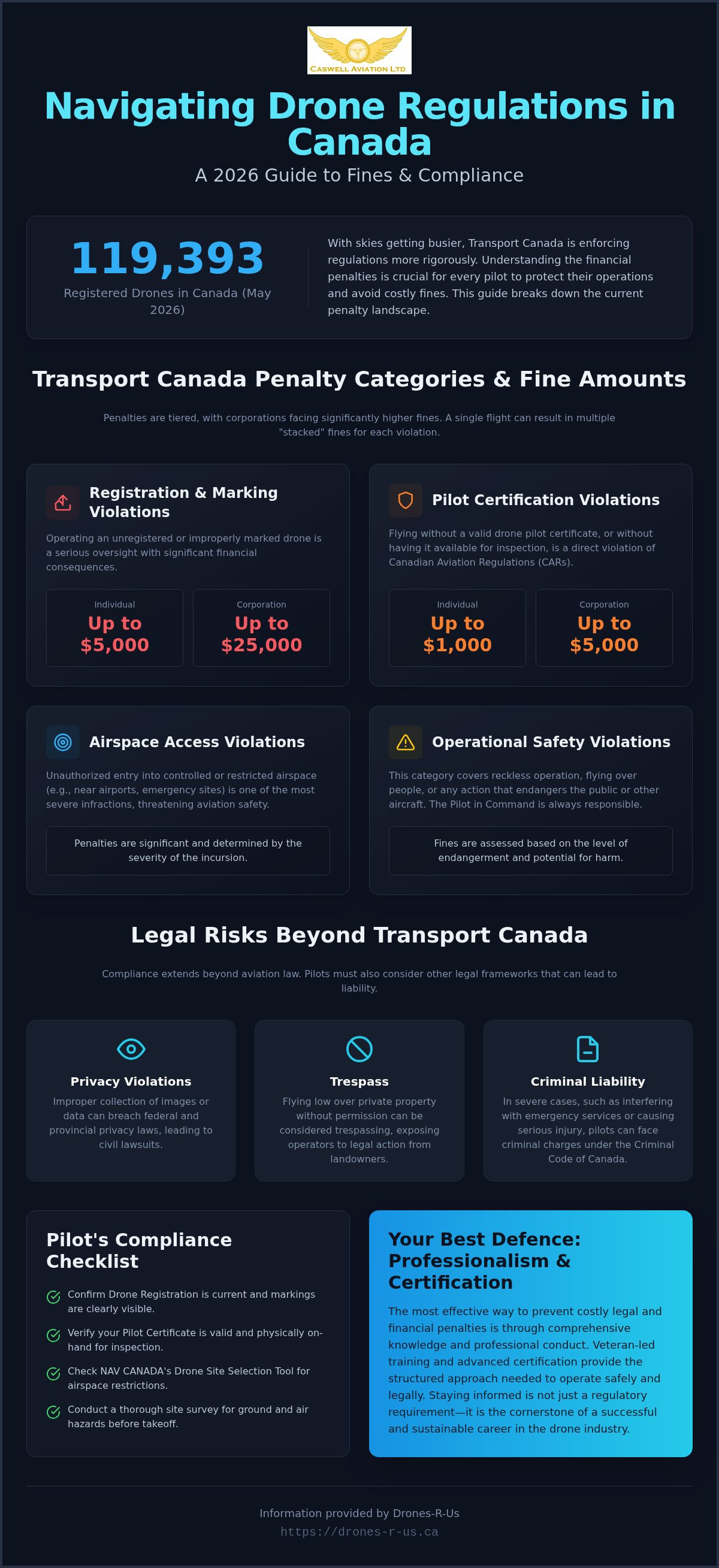
As of May 2026, there are 119,393 registered drones in our skies. This high volume of traffic has led to a more rigorous enforcement environment across the country. Every Remotely Piloted Aircraft System (RPAS) in Canada falls under the authority of the Canadian Aviation Regulations (CARs). Transport Canada acts as the lead regulator, focusing on safety through both education and financial deterrents. Staying current with drone fines Canada has established for this year is a necessity for any serious operator. Regulators now use a mix of administrative penalties for minor clerical errors and more severe fines for actions that threaten the safety of the national airspace system.
Enforcement has scaled significantly this year. High drone density in urban centres has forced regulators to prioritize safety in populated areas. Transport Canada distinguishes between minor administrative penalties, such as paperwork errors, and serious regulatory infractions that jeopardize public safety. While a small oversight might lead to a warning, a deliberate violation of airspace often results in a substantial fine.
The Responsibility of the Pilot in Command
The moment you power up your controller, you're the Pilot in Command (PIC). This designation applies to all operators, regardless of the drone's weight or its intended use. You are the sole individual responsible for the safety of the flight and any damage or injury that might occur. Under Canadian drone regulations, you must have your pilot certificate available for inspection during every mission. Whether you're conducting a complex survey or a simple site inspection, your ability to prove your credentials is your first line of defence against a fine. Failing to produce this document during a field inspection is a quick way to incur a penalty.
Why Transport Canada Issues Fines
Safety is the primary driver behind every penalty issued. Transport Canada focuses on protecting people on the ground and other aircraft in the sky. Unauthorized flights near airports or during active wildfire operations can have catastrophic consequences. These fines serve as a deterrent against reckless behaviour that compromises emergency services. Beyond the financial cost, a fine can damage your standing within the aviation community. If you plan to build a career in this sector, maintaining a professional, compliant flight history is essential. For those looking to avoid these pitfalls, seeking expert guidance through professional training at drones-r-us.ca provides the necessary foundation for legal operations. Compliance isn't just about following rules; it's the only reliable way to prevent the drone fines Canada has implemented to keep our skies safe.
Transport Canada Penalty Categories and Fine Amounts
Understanding the structure of drone fines Canada has established is the first step toward effective risk management. Transport Canada organizes infractions into four primary categories: registration and marking, pilot certification, airspace access, and operational safety. Penalties are tiered based on the status of the operator. Corporations typically face fines five times higher than those issued to individuals, as businesses are expected to maintain more rigorous compliance systems and internal safety oversight. This distinction ensures that commercial entities are held to a standard that reflects their professional standing in the aviation industry.
A single flight incident often results in multiple stacked fines that can quickly escalate into a significant financial burden. If a pilot operates an unregistered drone without a certificate in restricted airspace, Transport Canada can issue a separate penalty for each violation within that single mission. A serious infraction is defined as any act that knowingly endangers the safety of the aviation system or the public, often triggering the maximum allowable penalty under the law. You can review the full breakdown of these requirements in the Transport Canada Drone Rules to ensure your operations remain within the legal framework.
Fines for Operating Without Registration or Certification
Flying an unregistered or unmarked drone is a significant violation that regulators monitor closely. For an individual, this can result in a fine of up to $5,000, while a corporation may face up to $25,000 for the same oversight. Additionally, operating without a valid drone pilot certificate carries a penalty of up to $1,000 for individuals and $5,000 for corporations. These costs increase if you enter controlled airspace without an Advanced certificate, as you are operating beyond the privileges of a Basic licence. Keeping your documentation current and clearly visible on the aircraft is a fundamental requirement for every mission.
Penalties for Reckless Operations and Safety Violations
Transport Canada takes a zero-tolerance approach to operations that endanger people or other aircraft. Putting the public or the aviation community at risk can lead to fines of up to $3,000 for individuals and $15,000 for corporations. Similar penalties apply to those who fly in restricted areas, such as near airports or active forest fires, without explicit authorization. Whether you are conducting Basic or Advanced operations, failing to follow specific safety rules can lead to immediate enforcement action. Investing in professional certification training is a proactive way to ensure your flight team understands how to navigate these regulatory boundaries and avoid the high cost of non-compliance.
Beyond Fines: Privacy, Trespass, and Criminal Liability
While the administrative penalties issued by Transport Canada are the most common financial risk, they aren't the only legal hurdles for drone pilots. Operating a Remotely Piloted Aircraft System (RPAS) involves navigating a complex web of privacy laws, civil liability, and even the Criminal Code of Canada. Understanding the full scope of your legal exposure is vital for protecting your professional reputation and your business assets. While Transport Canada drone fines focus primarily on aviation safety, other authorities focus on how your flight impacts the rights of individuals on the ground.
Extreme negligence or intentional misuse of a drone can lead to criminal charges. For example, using a drone for voyeurism or interfering with the lawful use of property can result in a criminal record. This carries far more weight than a standard fine. Additionally, while Transport Canada regulates the "sky," local municipalities often control the ground. Many cities have bylaws that restrict where you can take off or land, particularly in public parks or near sensitive infrastructure. Ignoring these local rules can lead to provincial or municipal citations that add to the total cost of non-compliance.
Privacy Concerns in Aerial Imagery
The intersection of drone technology and the Privacy Act creates unique challenges for commercial operators. There is a significant legal distinction between capturing imagery in a public space and invading the private property of an individual. When conducting commercial work, you are responsible for the data you collect. This includes ensuring that you don't inadvertently record identifiable personal information without a clear operational requirement. For those looking to refine their approach, our guide on Mastering Professional Drone Photography and Video provides ethical frameworks for capturing high-quality imagery while respecting privacy boundaries.
Trespass and Nuisance Claims
Property rights in Canada don't extend indefinitely into the atmosphere, yet the concept of "navigable airspace" doesn't give pilots a free pass to fly low over private residences. Persistent low-altitude flight can lead to civil litigation under the categories of trespass or nuisance. To avoid disgruntled property owners and potential lawsuits, plan your flight paths to minimize time spent over sensitive or residential areas. A methodical pre-flight assessment helps identify these zones before you ever leave the ground. By maintaining a professional distance and communicating with stakeholders, you reduce the likelihood of the complaints that often lead to the drone fines Canada enforces to maintain public order.
A Pilot’s Checklist for Avoiding Regulatory Penalties
Professionalism in aviation is defined by consistency. A methodical approach to every mission eliminates the variables that lead to errors. To avoid the drone fines Canada has established for non-compliance, you must implement a rigorous pre-flight workflow. This includes utilizing authorized mobile applications to verify airspace status and ensuring all hardware meets current NAV CANADA requirements. Relying on memory or outdated maps is a high-risk strategy that often leads to unauthorized incursions into controlled zones.
Physical comfort is a critical safety factor that is often overlooked. High-stakes operations require sustained focus, and pilot fatigue is a common cause of the small regulatory slips that result in penalties. Using a professional drone harness for smart controllers allows you to maintain precise control over longer durations. By distributing the weight of the equipment, you reduce the physical strain that leads to lapses in judgment. This ensures you remain alert to your surroundings and the data on your screen, preventing the operational errors that could trigger a safety inspection.
Pre-Flight Compliance Verification
Establishing a repeatable checklist is the most effective way to ensure 100% compliance before take-off. Before every mission, follow these three essential steps:
- Step 1: Verify drone registration and marking. Every aircraft weighing between 250g and 25kg must display its unique registration number. Failing to mark your drone clearly is a primary reason for administrative penalties.
- Step 2: Confirm pilot certification. Ensure your certificate category matches the complexity of your intended flight. Operating in controlled airspace with only a Basic certificate is a major violation.
- Step 3: Check NOTAMs and airspace. Use tools like the NAV Canada RPAS Wilco app to identify active restrictions or Notices to Airmen (NOTAMs) for your specific flight time. Airspace status can change rapidly, and real-time verification is a legal necessity.
Operational Safety and Record Keeping
Keeping detailed logs is a legal requirement under the Canadian Aviation Regulations. You must document every flight and maintenance event to prove your aircraft is airworthy and your skills are current. These logs serve as your primary evidence of compliance during a Transport Canada audit. You also need to manage your recency requirements to keep your licence valid. Every 24 months, pilots must complete a recurrent training activity to maintain their privileges. For a deeper look at these specific obligations, see our Drone Regulations in Canada guide. Maintaining a disciplined record-keeping system provides the peace of mind that you are always ready for an inspection. Ensure your team is ready for the field by booking an advanced flight review to validate your operational standards.
Professional Certification: Your Best Defence Against Fines
Investing in professional training is the most effective way to mitigate the financial risks associated with drone operations. While a single corporate penalty can reach $25,000, the cost of a comprehensive certification course is a small fraction of that amount. Professional education provides more than just the answers to an exam; it offers access to a veteran mentor who understands the nuances of the Canadian Aviation Regulations (CARs). This expertise helps you navigate the grey areas of flight operations that automated apps might miss. By choosing a structured learning path, you ensure that your team operates with the discipline required in a regulated aviation environment.
Caswell Aviation stands as a premier resource for pilots seeking this level of mastery. Whether you require online drone courses for scheduling flexibility or in-person training for hands-on technical instruction, our programs are designed to eliminate the uncertainty that leads to drone fines Canada enforces. Our instructors bring years of industry experience, transitioning from high-stakes aviation into modern RPAS technology to provide a culture of thoroughness and safety. Understanding the specific drone fines Canada utilizes for enforcement is only half the battle; the other half is obtaining the credentials to avoid them entirely.
Why Advanced Certification Changes the Risk Profile
Holding an Advanced certificate significantly expands your operational capabilities while lowering your legal risk. This certification allows you to fly in controlled airspace and within 30 metres of bystanders legally, provided you use an appropriately declared drone. Beyond the operational freedom, an Advanced certificate serves as a clear demonstration of due diligence. In the event of an incident, regulators and insurers look for evidence that the pilot has met the highest possible standards of training. The process involves passing the Transport Canada Advanced exam and successfully completing a professional flight review to validate your practical skills in the field.
Choosing the Right Training Path
The best training format depends on your specific operational goals and learning style. Online courses offer the flexibility to study complex regulatory frameworks at your own pace, which is ideal for busy professionals. In-person training provides the benefit of direct feedback from an expert, ensuring you master the technical skills required for complex missions. Caswell Aviation prepares you for every aspect of the certification process, from the initial ground school to the final flight review. Protect your career by booking your Advanced Drone Training or Flight Review today. This proactive step is your most reliable insurance against the high cost of non-compliance and the long-term impact of regulatory penalties.
Secure Your Future in the Canadian Airspace
Mastering the regulatory framework of the Canadian Aviation Regulations requires a commitment to safety and continuous education. By implementing a disciplined pre-flight checklist and staying alert to the specific drone fines Canada enforces, you protect your career from avoidable financial setbacks. Compliance isn't a one-time event; it's a professional standard that involves maintaining accurate logs and respecting the privacy of those on the ground. The cost of a single administrative penalty far outweighs the investment in high-quality training.
As specialists in Transport Canada Advanced and Level 1 Complex certifications, we provide the technical mentorship needed to fly with absolute confidence. Our professional flight reviewers bring industry-leading experience to every session, offering comprehensive online and in-person training options tailored to your operational needs. Invest in your compliance with Caswell Aviation Drone Training to secure your standing as a master practitioner in the aviation industry. Safe, legal, and efficient flight operations are always within your reach when you prioritize professional standards.
Frequently Asked Questions
How much are drone fines in Canada for 2026?
In 2026, penalties depend on the severity of the infraction and the status of the operator. Flying an unregistered drone can cost an individual up to $5,000, while corporations face up to $25,000. Operating without a valid pilot certificate carries a maximum fine of $1,000 for individuals. More serious violations, such as entering restricted airspace or endangering other aircraft, result in penalties of $3,000 for individuals and $15,000 for corporations.
Can I get a fine for flying a drone under 250 grams?
Yes, you can still receive a fine when operating a microdrone under 250 grams. While these aircraft don't require registration for basic use, you must never fly in a reckless or negligent manner. As of 2026, flying a microdrone at an advertised event without a Special Flight Operations Certificate (SFOC) can result in a fine of up to $1,000 for individuals and $15,000 for corporations. Safety remains the priority regardless of aircraft weight.
What happens if I fly my drone in a National Park without a permit?
Flying in a National Park without a permit is illegal and subject to significant penalties. Parks Canada enforces strict regulations to protect wildlife and visitors, often resulting in fines that exceed standard Transport Canada amounts. You must obtain a permit from the park superintendent before any take-off or landing. Enforcement officers have the authority to seize equipment and issue citations on the spot. Always check local park boundaries before planning your mission.
How does Transport Canada catch people flying drones illegally?
Transport Canada utilizes a multi-faceted approach to identify non-compliant operators. Enforcement officers collaborate with local law enforcement and NAV CANADA to monitor restricted airspace. They investigate reports from the public and review footage on social media that shows clear regulatory violations. Many modern drones utilize technology that allows authorities to track flight paths and pilot locations in real-time. Maintaining a professional, recorded flight history is your best defence during a regulatory inquiry.
Do I need insurance to avoid fines when flying a drone commercially?
While the Canadian Aviation Regulations don't mandate liability insurance for all small drone operations, it's a professional necessity. Most commercial contracts and Special Flight Operations Certificates require proof of insurance to proceed. Lacking insurance won't result in a Transport Canada fine, but it leaves you personally liable for third-party damages. Professional pilots treat insurance as a standard cost to protect their business from civil litigation and potential financial ruin.
Can I appeal a drone fine from Transport Canada?
You have the right to request a review of any administrative monetary penalty issued by Transport Canada. This process is handled through the Transportation Appeal Tribunal of Canada (TATC). You must file your request within the timeframe specified on your notice of violation. The tribunal provides an independent forum to determine if the infraction occurred and if the fine amount is appropriate. It's advisable to have detailed flight logs and compliance records ready to support your case.
What is the difference between a fine for an individual and a corporation?
The primary difference lies in the maximum penalty amount, which is significantly higher for commercial entities. Transport Canada applies a corporate multiplier, often resulting in fines that are five times larger than those issued to individuals. For example, flying an unmarked drone costs an individual up to $5,000, while a corporation faces up to $25,000. Understanding these drone fines Canada enforces helps businesses budget for the cost of professional training and certification.
Is it illegal to fly a drone over private property in Canada?
Flying over private property isn't strictly illegal under federal aviation law, as Transport Canada regulates all navigable airspace. However, you must respect provincial privacy laws and avoid creating a nuisance. If your flight interferes with a resident's enjoyment of their property or captures private imagery without consent, you may face civil lawsuits or criminal voyeurism charges. Professional pilots plan paths that avoid residential areas to prevent the complaints that lead to a drone fines Canada investigation.
Leave a comment