

Controlled Airspace Drone Photography in Calgary: A Professional Guide (2026)
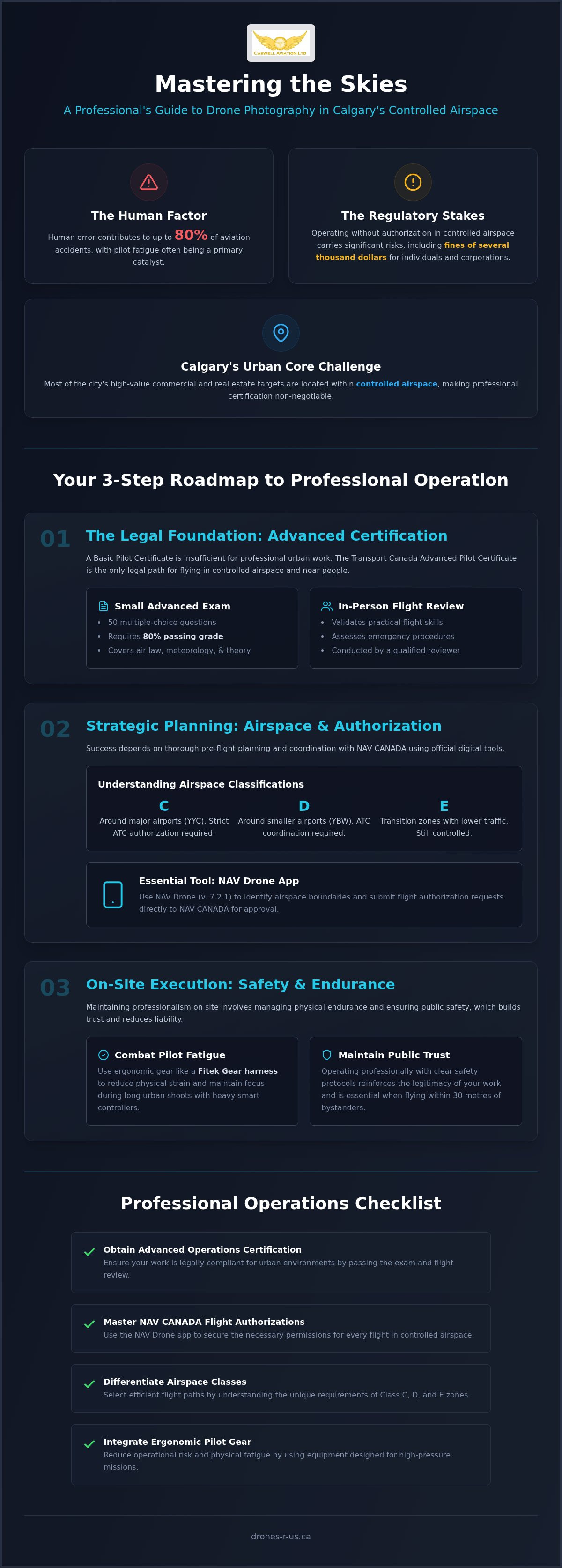
Did you know that human error contributes to up to 80% of aviation accidents, with pilot fatigue often serving as the primary catalyst? In the high-stakes environment of controlled airspace drone photography Calgary, the difference between a professional result and a heavy fine depends on your ability to manage both regulatory complexity and physical endurance. It is a demanding field where precision is non-negotiable.
You likely recognize the frustration of deciphering NAV CANADA requirements or the physical strain that sets in during a long urban shoot. It's a common challenge for professionals who want to deliver exceptional results without the constant worry of legal liability. This guide will help you master the regulatory and technical requirements for conducting professional drone photography within controlled airspace across Canada.
We'll walk through the process of obtaining your Advanced Pilot Certificate, the critical steps for coordinating with Air Traffic Control via the NAV Drone app version 7.2.1, and the importance of using ergonomic tools like a Fitek Gear harness to combat fatigue. By the end, you'll have a clear roadmap to operate safely and legally in Canada's most restricted skies.
Key Takeaways
- Identify the specific requirements for Advanced Operations certification to ensure your work remains legally compliant in urban environments.
- Master the process of obtaining NAV CANADA flight authorizations for controlled airspace drone photography Calgary using the latest digital tools.
- Differentiate between Class C, D, and E airspace to select the most efficient flight paths and coordination methods for your project.
- Reduce operational risk and physical fatigue by integrating ergonomic pilot gear designed for high-pressure smart controller use.
- Finalize your professional credentials by completing a comprehensive flight review to unlock complex mission capabilities.
Navigating Controlled Airspace for Drone Photography in Calgary
Calgary's skyline is a prime target for high-value imagery, but most of the city's urban core sits within restricted zones. Operating a Remotely Piloted Aircraft System (RPAS) for controlled airspace drone photography Calgary requires a thorough understanding of how Transport Canada and NAV CANADA manage the skies. Controlled airspace isn't a "no-fly zone"; rather, it's a regulated environment where drone pilots must coordinate with Air Traffic Control (ATC) to ensure the safety of manned aircraft.
The Canadian model relies on a collaborative approach. You aren't just a hobbyist in these zones; you're a recognized pilot within the aviation system. Operating without authorization in 2026 carries significant risks, including fines that can exceed several thousand dollars for individuals and even more for corporations. Staying compliant isn't just about avoiding penalties; it's about maintaining the integrity of the industry.
Understanding Airspace Classifications
Airspace is categorized to manage traffic density and safety. In Calgary, Class C airspace surrounds the International Airport (YYC), requiring strict ATC authorization for any flight. Class D airspace, like that around Springbank Airport (YBW), also requires coordination but may have different procedural requirements. Class E is often used for transition zones or areas with lower traffic density.
Professional pilots use tools like the NAV Drone app to identify these boundaries. While "micro" drones (under 250g) have fewer restrictions under certain Canadian drone regulations, they're still subject to Section 900.06 of the CARs regarding reckless or negligent operation. For professional work, these smaller units often lack the sensor quality or wind resistance needed for high-end photography, making Advanced Operations status for larger drones a necessity.
Why Professional Photography Requires Controlled Access
The most desirable shots of Calgary usually occur within the city centre, which is entirely controlled. High-value real estate and commercial developments are frequently located in Class C zones. To capture these assets, you must have the credentials to operate where others can't.
Maintaining public trust is essential for the long-term viability of your business. When bystanders see a professional pilot using proper safety protocols and visible markings, it reinforces the legitimacy of the operation. This level of professionalism is what separates a veteran practitioner from a casual user. Working within the system allows you to deliver high-quality imagery while eliminating the legal liability that comes with unauthorized flights.
Transport Canada Advanced Certification: The Legal Foundation
To perform controlled airspace drone photography Calgary, you cannot rely on a Basic Pilot Certificate. Transport Canada strictly separates Basic and Advanced operations based on the complexity of the mission. While a Basic certificate allows for flight in uncontrolled airspace and requires a 30-metre distance from bystanders, the Advanced certificate is the only legal path for urban professionals. It grants the authority to fly in controlled zones and allows you to operate much closer to the public.
Obtaining Transport Canada Advanced Certification involves a two-stage process. First, you must pass the Small Advanced Exam. This is a rigorous 50-question test covering meteorology, air law, and flight theory. Unlike the Basic exam, it requires an 80% passing grade to succeed. Second, you must complete an in-person flight review with a qualified reviewer. This ensures you can apply theoretical knowledge to real-world flight scenarios safely.
The Path to an Advanced Pilot Certificate
Success begins with preparation. Most candidates find that a structured online drone course provides the necessary depth to navigate the exam's complexities. After passing the online test, you have 12 months to complete your flight review. This practical assessment validates your ability to manage emergency procedures and site surveys. Once both steps are complete, you can apply for your certificate through the Drone Management Portal after paying the regulatory issuance fee.
Advanced Operations and Bystander Safety
Urban photography often places you near the public. To fly within 30 metres of people, your drone must have a manufacturer's Safety Assurance declaration. This document confirms the aircraft meets specific safety standards for advanced operations. You must also maintain a comprehensive Pilot Operating Manual (POM). This manual outlines your specific operational limits and maintenance schedules.
Realizing a safe flight path in Calgary's dense core requires more than just technical skill. It requires a commitment to documentation and risk mitigation. When executing controlled airspace drone photography Calgary, your flight plan must account for every variable from wind shear to pedestrian traffic. If you're ready to transition into professional operations, consider booking one of our Advanced & Level 1 Complex Flight Reviews to finalize your certification.
Strategic Planning: Coordinating with NAV CANADA and the NAV Drone App
Successful controlled airspace drone photography Calgary missions depend on precise coordination with NAV CANADA. The NAV Drone app serves as your primary interface for digital flight authorization, replacing older, paper-based systems. It allows you to visualize airspace boundaries and submit flight plans directly to Air Traffic Control (ATC) with high efficiency.
There are two types of approvals within the app: automated and manual. Automated approvals occur instantly when your flight plan meets pre-set safety criteria for specific zones. However, missions near high-traffic areas or those requiring higher altitudes often trigger a manual review. In these cases, a NAV CANADA specialist reviews your request, which can take several business days. Planning your shoot well in advance is essential to avoid project delays.
Communication is a two-way street. If ATC needs to contact you during a flight, they'll use the phone number provided in your NAV Drone profile. You must be prepared to land immediately if instructed. Maintaining an active communication link is a hallmark of a professional pilot who respects the shared nature of Canadian airspace.
The Step-by-Step NAV Drone Authorization Process
To submit a flight plan, you draw your operational area on the map and enter your flight details into the NAV Drone interface. You must set an operational floor and ceiling height that balances your creative needs with aviation safety. For most urban photography, a ceiling of 200 feet AGL (Above Ground Level) is often sufficient and more likely to receive automated approval. If the app shows an "Approved" status, you're clear to fly within the specified time. An "Action Required" status means you must wait for manual intervention or adjust your parameters to meet safety requirements.
Site Surveys and Risk Mitigation
A digital authorization doesn't replace a physical site survey. You need to identify local hazards such as power lines, tall structures, and active helipads near hospitals. Calgary's downtown core has several hospital helipads that require constant vigilance. Your survey should also include a plan for lost-link scenarios. If your drone loses connection in a controlled zone, your pre-programmed "Return to Home" altitude must clear all obstacles while staying within your authorized ceiling.
Documenting this entire process is vital for Transport Canada audit trails. Keep a log of your site survey, authorization numbers, and any ATC communications. This discipline proves you're operating with the thoroughness of a veteran practitioner, ensuring that your controlled airspace drone photography Calgary remains both productive and legally sound.
Ergonomics and Safety: Using Drone Harnesses in Complex Airspace
Maintaining focus during controlled airspace drone photography Calgary is as much a physical challenge as it is a mental one. When you're operating in Class C or D zones, your attention must remain divided between the aircraft, the surrounding airspace, and your controller. Pilot fatigue is a documented safety risk; research indicates that human error, often catalyzed by exhaustion, contributes to up to 80% of aviation accidents. For the professional photographer, physical strain leads to degraded control precision and slower reaction times, which are unacceptable in high-stakes environments.
Ergonomic gear is not a luxury; it's a safety requirement for commercial pilots who spend hours in the field. Carrying a heavy smart controller for a full day of urban shooting places significant stress on the neck and upper back. This discomfort eventually distracts the pilot from their primary task: safe navigation and high-quality image capture. Transitioning to a professional support system allows you to realize better results while maintaining the strict safety standards required for advanced operations.
The Role of Ergonomics in Aviation Safety
Professional pilots prioritize equipment that mitigates physical stress to ensure they remain sharp throughout the mission. Constant neck strain from looking between the sky and a handheld controller can lead to reduced situational awareness. Using a drone harness for smart controller systems allows you to maintain Visual Line of Sight (VLOS) more comfortably. By keeping the remote in a stabilized, fixed position, you improve your control precision. This steady base is critical when you're executing the fine movements needed for architectural photography in Calgary's urban centre.
Furthermore, a harness provides essential hands-free moments. Whether you need to adjust your site survey documentation or check a secondary weather app, you can do so without the risk of dropping your primary control link. This level of organization is what separates a veteran practitioner from a novice.
Choosing the Right Fitek Gear for Your Controller
Fitek Gear has established itself as the professional standard for smart controller users in Canada. These harnesses are specifically engineered for compatibility with DJI Smart Controllers and other high-end RPAS remotes. They feature multiple points of adjustability to ensure a perfect fit for every pilot, distributing the controller's weight across the shoulders and back rather than the cervical spine. This distribution is vital for preventing the long-term injuries associated with repetitive commercial flight operations.
A well-fitted harness also helps organize your field operations. It keeps your controller exactly where you need it, allowing for consistent muscle memory during flight. If you're ready to upgrade your operational safety, you can buy Fitek Gear harnesses directly from our shop to ensure your equipment matches your professional credentials.
Professional Flight Reviews and Training for Advanced Operations
A professional flight review is the definitive benchmark for any pilot aiming to master controlled airspace drone photography Calgary. It transitions you from a theoretical student to a verified operator capable of managing complex urban missions with a steady, professional confidence. This in-person assessment is the final legal requirement before Transport Canada issues your Advanced Pilot Certificate, serving as the gold standard for those working in safety-critical environments.
Success in the field requires more than just passing a test; it requires a deep-rooted understanding of aviation discipline. While ground school provides the foundation, the flight review is where you demonstrate your ability to apply those rules under pressure. It's a chance to prove that your operational standards align with the rigorous expectations of NAV CANADA and Transport Canada.
What to Expect During a Flight Review
During the review, you must demonstrate a comprehensive site survey and a rigorous pre-flight checklist. The reviewer evaluates your ability to handle emergency procedures, such as a sudden loss of link or an unexpected airspace intrusion. You'll need to prove technical mastery of your RPAS in a controlled environment, showing that you can execute precise manoeuvres while maintaining situational awareness. Receiving expert feedback from a qualified flight reviewer is invaluable. It identifies subtle operational gaps that could lead to liability issues in the field, ensuring you're fully prepared for the realities of urban flight.
Customized Training for Corporate Teams
For construction firms or real estate agencies, scaling drone operations requires more than just buying hardware. In-person training ensures that every member of your team understands the nuances of controlled airspace drone photography Calgary. This collective knowledge builds a culture of safety and professionalism within your organization, reducing the risk of regulatory non-compliance. Caswell Aviation Ltd specializes in bridging the gap between basic flight skills and the high-end technical requirements of professional imagery, positioning itself as a veteran mentor for your entire staff.
Navigating the regulatory environment of 2026 requires a partner who understands the weight of aviation standards. Whether you're an individual pilot or managing a corporate fleet, the right preparation ensures your projects proceed without delay or legal complication. We encourage you to book Advanced & Level 1 Complex Flight Reviews to finalize your certification and elevate your operational standards. By choosing Caswell Aviation Ltd for your training, you ensure that every mission is conducted with discipline, precision, and absolute compliance.
Elevating Your Professional Flight Standards
Mastering controlled airspace drone photography Calgary is a significant milestone that separates the enthusiast from the elite professional. By integrating the regulatory requirements of the Advanced Certificate with the technical coordination of the NAV Drone app, you build a resilient operational foundation. These steps are essential for ensuring that your flights remain legally compliant and consistently safe within Canada's complex urban environments.
Beyond the paperwork, your success relies on the quality of your equipment and the depth of your training. Utilizing ergonomic tools like a Fitek Gear harness ensures you remain focused during long missions, while advanced training prepares you for the unpredictable nature of urban skies. This holistic approach to flight operations allows you to deliver exceptional imagery without compromising the high safety standards expected of a veteran practitioner.
If you're ready to finalize your credentials for 2026, our team is prepared to guide you through every regulatory and technical hurdle. Book your Advanced Flight Review or Drone Training with Caswell Aviation Ltd today. As a specialized Fitek Gear retailer with Advanced and Level 1 Complex certification expertise, Caswell Aviation Ltd provides the veteran mentorship needed to navigate restricted airspace with confidence and precision. We look forward to helping you reach new professional heights.
Frequently Asked Questions
Do I need a special licence for drone photography in Calgary?
Yes, you need a Pilot Certificate - Advanced Operations to fly in the majority of Calgary's urban areas. Because Calgary's city centre and surrounding neighbourhoods fall within controlled airspace, a Basic certificate is insufficient for professional work. You must also register your drone with Transport Canada and ensure the registration number is clearly visible on the aircraft. This process ensures you're recognized as a legitimate operator within the national aviation system.
How do I get permission to fly in controlled airspace in Canada?
Permission is obtained by submitting a digital flight plan through the NAV Drone app to receive authorization from NAV CANADA. For controlled airspace drone photography Calgary, the app provides real-time data on airspace classifications and local restrictions. While some areas offer automated approval, missions near major airports like YYC may require a manual review by air traffic controllers. Always ensure your authorization is confirmed before you power up your aircraft on-site.
Can I fly a mini drone in controlled airspace without an Advanced Certificate?
Yes, drones weighing less than 250 grams can fly in controlled airspace without an Advanced Certificate, provided they are operated safely. While micro-drones are exempt from many certification requirements, you're still prohibited from interfering with manned aircraft. Professional photographers often avoid micro-drones for complex urban work because they lack the wind resistance and sensor quality required for high-end results. You must always prioritize safety regardless of the aircraft's weight.
What happens if I fly in controlled airspace without NAV CANADA approval?
Operating without authorization is a serious regulatory offence that can result in substantial fines from Transport Canada. Individual pilots can face penalties of several thousand dollars, while corporations may be fined significantly more for non-compliance. Beyond the financial risk, unauthorized flights jeopardize aviation safety and can lead to the permanent suspension of your pilot certificate. Maintaining a clean record is vital for the long-term viability of any professional drone service.
How long does it take to get Advanced drone certification?
The timeline depends on your preparation, but most pilots complete the process within a few weeks. You must first pass the Small Advanced Exam online, which requires a passing grade of 80%. After passing the exam, you need to schedule and pass an in-person flight review with a qualified reviewer. Once both milestones are achieved, Transport Canada typically issues the certificate through their portal shortly after the application is submitted and the fee is paid.
Is the NAV Drone app free to use for professional pilots?
Yes, the NAV Drone app is currently free to download and use for all RPAS pilots in Canada. It serves as the official tool for checking airspace boundaries and requesting flight authorizations. While the app itself doesn't charge usage fees, you must still maintain your personal pilot certification and drone registration through the Transport Canada portal. These separate regulatory requirements involve their own specific fees that must be kept current.
What is a Level 1 Complex flight review?
A Level 1 Complex flight review is a specialized assessment for advanced operations in more demanding urban environments. It validates a pilot's ability to operate safely in high-traffic or densely populated areas where the stakes are higher. This review is essential for those conducting controlled airspace drone photography Calgary who need to prove they can manage complex mission parameters and emergency protocols with veteran-level discipline. It represents a higher tier of professional validation.
Why should I use a drone harness for professional photography?
Using a drone harness reduces physical fatigue and improves flight precision during long commercial photography shoots. It redistributes the weight of a heavy smart controller from your neck to your shoulders and back. This ergonomic support allows you to maintain a better visual line of sight and focus on your flight path without the distraction of physical strain. It's a critical tool for maintaining the high level of safety required in complex urban environments.
Leave a comment