

Commercial Drone ROI: A Practical Canadian Guide
What if a drone’s purchase price is the least useful figure in your business case? Calculating ROI for a commercial drone means looking beyond the aircraft to the full cost of operating it, including software, staff time, training, maintenance and how often you’ll fly. It also means measuring gains against the work your business does now. A faster inspection or fewer site visits may create value, but only if you can estimate that value credibly.
This guide will help you build a transparent ROI calculation using your own operational figures. You’ll compare drone ownership with outsourcing and existing workflows on a like-for-like basis, then estimate payback using realistic costs and measurable benefits. The goal isn’t to make the numbers look favourable. It’s to give you a sound basis for deciding whether a drone programme fits your workload.
We’ll cover the costs to include, how to document productivity gains and avoided expenses, and what evidence you need to support your assumptions. We’ll also consider how training and consistent operating procedures affect readiness and results, including online and in-person training for Transport Canada Advanced and Level 1 Complex certification. With a clear method, you can assess the opportunity before committing to equipment or building an operating plan.
Key Takeaways
- Start with the business problem and define what the investment must improve before choosing equipment or building a drone programme.
- Use the formula ROI = (measurable benefits − total costs) ÷ total costs × 100, with one currency and evaluation period throughout.
- When calculating ROI for a commercial drone, compare in-house operations, outsourced projects and the current method using the same scope and quality requirements.
- Test your assumptions in five stages: establish a baseline, set the scope, calculate costs, run a pilot and review the results.
- Turn a positive result into an operating plan with clear roles, trained pilots, repeatable workflows and scheduled review checkpoints.
Why calculating ROI for a commercial drone starts with the business problem
A drone is a tool, not a business case. Before comparing aircraft or software, identify the work you need to improve and the decision you’re making. Are you considering buying equipment for recurring work, building an internal drone programme or adding a drone-based service? Each decision has a different cost base and a different benefit to measure.
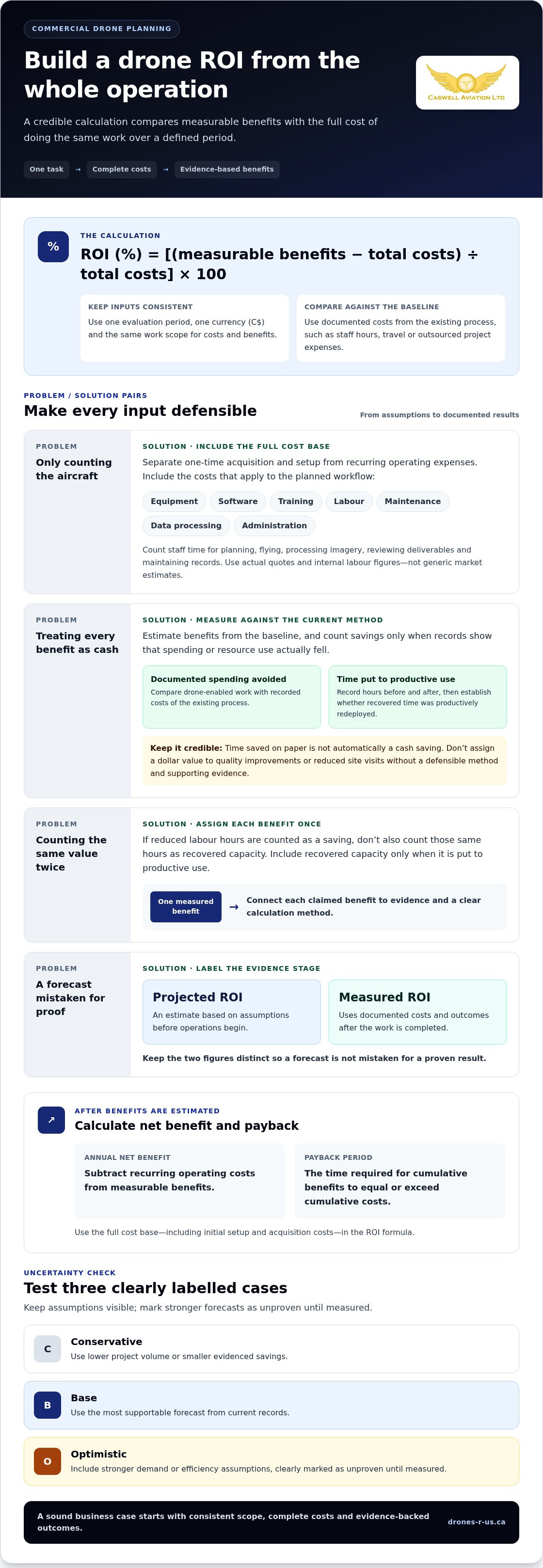
For this analysis, a commercial drone is an unmanned aircraft used to support business work. The broader term Unmanned aerial vehicle (UAV) describes aircraft that operate without a pilot onboard. ROI, or return on investment, compares the financial benefits attributable to an investment with its full costs over a defined period. Projected ROI is an estimate based on assumptions before operations begin; measured ROI uses documented costs and outcomes after the work is completed. Keep the two figures distinct so a forecast isn’t mistaken for a proven result.
Which commercial drone use case should the business assess?
Choose one defined task, such as repeat inspections, construction progress tracking or aerial content production. Record the current method, how often the work occurs and who is involved. Separate recurring work from one-off projects. Equipment used regularly may be assessed differently from equipment needed for a single assignment.
Next, state the expected value. Is the goal to reduce spending, deliver work faster or create new revenue? For example, progress images may help a project team review site conditions more quickly. That benefit matters financially only if it changes labour use, turnaround time or the ability to provide a billable service.
What counts as a credible business benefit?
Use evidence, not the appeal of the technology. Count a saving when records show that spending or resource use actually fell. If drone imagery reduces time spent on a task, record the hours before and after, then determine whether the recovered time can be put to productive use. Time saved on paper isn’t automatically a cash saving.
Apply the same discipline to quality improvements and risk reduction. Better documentation may support decisions, while remote viewing may reduce some site visits, but don’t assign a dollar value without a defensible method and supporting evidence. Treat new revenue as an assumption until demand, pricing and delivery capacity are supported by business records or project results.
For a practical starting point, write a one-sentence business problem: “We need to complete [task] using [current method] at [frequency], and assess whether a drone can improve [specific outcome].” This boundary makes calculating ROI for a commercial drone more credible because it links the investment to a measurable operational need.
How to calculate commercial drone ROI with a complete cost model
Choose one evaluation period, such as a year, and record every cost and benefit in Canadian dollars (C$). Use the core formula:
ROI (%) = [(measurable benefits − total costs) ÷ total costs] × 100
Include costs and benefits that apply to the same work and period. Compare drone-enabled work with the documented cost of the existing process, such as staff hours, travel or outsourced project expenses. Count each benefit only once. If you value reduced labour hours as a saving, don’t also count those hours as recovered capacity unless they’re productively redeployed. A formal ROI analysis for drone applications can provide additional context for structuring an assessment.
Which costs belong in a commercial drone ROI calculation?
Separate one-time acquisition and setup costs from recurring operating expenses. Depending on the planned workflow, include equipment, software, training, labour, maintenance, data processing and administration. Staff time adds up across planning, flying, processing imagery, reviewing deliverables and maintaining records. Use actual quotes and internal labour figures rather than generic market estimates.
For a Canadian operation, record all inputs in C$. Treat training as part of the programme cost, not an optional extra. Online and in-person training for Transport Canada Advanced and Level 1 Complex certification can support the capability required for a defined operation. Explore online and in-person drone training when planning that capability.
How should benefits and payback be calculated?
Estimate measurable benefits against the baseline, such as documented spending avoided or staff capacity recovered and put to productive use. Subtract recurring operating costs to find annual net benefit. Then use the full cost base, including initial setup and acquisition costs, in the ROI formula. The payback period is the time required for cumulative benefits to equal or exceed cumulative costs.
Test uncertainty with three clearly labelled cases:
- Conservative: use lower project volume or smaller evidenced savings.
- Base: use the most supportable forecast from current records.
- Optimistic: include stronger demand or efficiency assumptions, clearly marked as unproven until measured.
Keep the period, currency and project scope consistent across all three cases. A complete cost model makes assumptions visible and shows whether the case depends on repeat work, redeployed staff time or benefits that still need validation.
Commercial drone ownership versus outsourcing: compare value, not just equipment
A fair comparison holds the work constant. Use the same project scope, frequency, deliverable quality and evaluation period for each option. For example, compare the same inspection area and reporting requirements, not a basic internal image set with a detailed outsourced analysis. Caswell Aviation Ltd recommends building this assessment on realistic operational parameters.
Build the comparison using actual internal labour figures and project-specific service quotes, all recorded in C$. Make assumptions visible, including what each option includes and excludes. Use the table as a starting framework, not a verdict:
| Cost category | In-house operations | Outsourced projects | Current non-drone method |
|---|---|---|---|
| Direct inputs | Equipment, software, training and recurring operating costs | Quoted project or service fees | Existing labour, equipment, travel or other documented expenses |
| Staff effort | Planning, flying, management, processing, review and record-keeping time | Time to define the scope, coordinate work and review deliverables | Time spent completing and documenting the task |
| Quality and rework | Processing effort, quality checks and corrections | Specified deliverables, review effort and any rework assumptions | Current output quality and any repeat work required |
| State exclusions | List omitted costs or unpriced internal time | Identify work or expenses outside the quote | Identify costs not captured in current records |
When does in-house drone capability make financial sense?
In-house capability may suit a steady, recurring workload if trained staff can complete the work and use the data promptly. Assess project volume, staff availability and whether faster access changes a decision or reduces a documented delay. Account for peaks and idle periods: equipment and software may still incur costs when demand drops, and pilots need time to maintain operational proficiency. Convenience can be useful, but count it as financial value only when you can connect it to measurable savings, additional productive work or revenue.
When can outsourcing fit the business case better?
Outsourcing can be a stronger fit for infrequent projects or specialised deliverables if project-specific fees compare favourably with the full cost of internal capability. Include internal coordination and review time alongside the service cost. Record quote exclusions and compare like-for-like outputs. The result depends on workload, scope, staffing and the costs included, not on a general rule that ownership or outsourcing is always cheaper.
Use the same assumptions across all three options before calculating ROI for a commercial drone. If an apparent advantage relies on unpriced management time, omitted processing or time savings that haven’t been realised, revise the comparison before treating it as a business case.
A five-step method for testing commercial drone ROI assumptions
A limited, representative project can show whether forecast savings hold up in actual operations. Before the test, define the task and quality criteria so you can compare the drone-enabled workflow fairly with the existing one. Use this five-step process to make the results repeatable.
- 1. Baseline: Record project volume, current labour hours, turnaround time and deliverable quality. Use recent records where available, and note how each measure was collected.
- 2. Scope: Set the test project’s boundaries, including the area or asset covered, required outputs, review standards and evaluation period. Keep the existing and drone-enabled tasks comparable.
- 3. Cost: List the costs that apply to the pilot, including staff time, software, training, processing and administration. Record assumptions and source documents alongside each input.
- 4. Pilot: Complete a representative project and track actual time, outputs, rework and costs. Record planning, fieldwork, processing, review and delivery separately instead of relying on a single total.
- 5. Post-project review: Compare the results with the baseline, investigate differences and update the ROI model. Keep benefits supported by evidence; revise or remove assumptions that weren’t borne out.
What evidence should a pilot project collect?
Document the current workflow using the same task scope and quality criteria as the pilot. Retain time records, project outputs, processing notes, rework details, cost records and the assumptions behind any estimated benefit. A decision-maker should be able to trace each figure to its source and reproduce the calculation. If a drone image set requires extra processing or revisions, include that effort rather than reporting flight time alone.
How should a business account for uncertainty?
Test how changes in project frequency, labour time and operating costs affect payback. If the workload is seasonal or varies by project, don’t treat a busy period as a reliable annual forecast. Use conservative assumptions for unproven benefits, then update the model after representative projects provide stronger evidence.
Measured results should replace untested forecasts because actual project records show whether expected benefits were achieved under real operating conditions. This distinction is central to calculating ROI for a commercial drone responsibly: separate what the pilot demonstrated from what the business still expects.
Consistent execution matters to the test and to the final operation. Structured preparation can help pilots apply repeatable workflows. Explore online and in-person drone training as part of developing that capability.
Turn a positive drone ROI case into a capable Canadian operation
A positive ROI estimate is a reason to plan carefully, not to skip operational readiness. Define who is responsible for planning, flight operations, data processing, quality review and cost tracking. Set out a repeatable workflow, including how project requirements are recorded and completed work is checked. Financial viability depends on competent pilots and reliable processes as well as equipment.
How do training and pilot readiness affect commercial drone ROI?
Include training time and relevant instruction in the programme cost model. Structured preparation can help pilots apply consistent planning and execution, supporting more predictable project delivery. In Canada, certification requirements depend on the operation. Consult Transport Canada’s drone safety guidance for current information on pilot certification and operating rules before setting the operational plan.
Online and in-person training for Transport Canada Advanced and Level 1 Complex certification, along with professional flight reviews, can form part of developing pilot capability. Build applicable training and flight-review steps into the schedule and budget rather than assuming a new aircraft alone makes a programme operationally ready.
What should happen after the ROI calculation?
Assign one person to maintain cost and outcome records, and set a review date that matches the evaluation period. At each checkpoint, compare actual project frequency, staff time, processing effort, rework and deliverable quality with the assumptions in the business case. Update the model when operating conditions change.
Expand the programme only when results from representative work support the original assumptions. If benefits depend on a certain volume of projects, confirm that the workload is recurring before increasing investment. If time savings haven’t translated into reduced costs or productive redeployment, keep them separate from proven financial returns.
Calculating ROI for a commercial drone is most useful when it leads to a practical operating plan: named responsibilities, trained personnel, documented procedures and scheduled reviews. Once you’ve established the business case, explore Caswell Aviation’s online and in-person drone training to develop the capability behind the plan.
Make your next drone investment decision with confidence
A sound drone business case starts with a defined operational need, not an equipment shortlist. Compare ownership, outsourcing and your current method using the same project scope, period and quality requirements. Include the full programme costs, then test projected benefits through a representative project and replace assumptions with measured results.
A positive ROI estimate is only one part of the decision. The operation also needs clear responsibilities, repeatable workflows and pilots with appropriate preparation. These practical factors help determine whether projected value can be delivered consistently.
For Canadian businesses developing pilot capability, Caswell Aviation offers online and in-person training for Transport Canada Advanced and Level 1 Complex certification, as well as professional flight reviews for pilots pursuing advanced drone operating certificates. After calculating ROI for a commercial drone, explore Caswell Aviation drone training as a practical next step in planning a capable operation.
Build the case carefully, validate it with real project evidence and grow at a pace your results support.
Frequently Asked Questions
How do you calculate ROI for a commercial drone?
Calculate ROI for a commercial drone by subtracting total costs from measurable benefits, dividing the result by total costs, then multiplying by 100 for a percentage. Measurable benefits are documented savings or other financial value attributable to the operation. Total costs include the full investment and operating expenses. Use the same evaluation period and currency for every input. Label forecast ROI as projected or estimated until actual operating data is available.
What costs should be included in a commercial drone ROI calculation?
Include equipment, software, training, staff time, maintenance, data processing and administration. Separate one-time acquisition and setup costs from recurring expenses, such as software subscriptions, maintenance and ongoing labour. Count staff effort across planning, flying, processing, reviewing and record-keeping. Use your organization’s actual quotes and labour figures rather than unsupported industry averages. This gives the calculation a cost base that reflects the intended operation instead of a generic estimate.
How long does it take for a commercial drone to pay for itself?
Payback depends on project frequency, verified benefits and the full cost of operating the drone programme. Compare cumulative benefits over time with cumulative costs, including relevant ongoing expenses. The point at which cumulative benefits cover cumulative costs is the payback period. There’s no universal timeline. Use conservative assumptions for benefits that haven’t been proven, then track actual project results and revise the estimate as operating data accumulates.
Is buying a commercial drone more cost-effective than outsourcing?
Neither ownership nor outsourcing is always less expensive. Compare options using the same project scope, frequency, evaluation period and quality requirements. Include internal staff time, training, software and processing in the ownership case, then compare those costs with project-specific service fees and coordination time. A regular workload may strengthen the case for internal capability, while occasional or specialized work may favour outsourcing. Use actual figures and make exclusions clear.
Can a commercial drone generate measurable business savings?
Yes, when a defined workflow improves and the change is documented. Depending on the use case, potential savings might include less field time or fewer repeat visits. Don’t treat these outcomes as guaranteed. Record a baseline for labour, turnaround and existing costs, then compare it with real project records after drone use. Count savings only when evidence shows that spending or resource use fell, or that recovered staff time was productively redeployed.
What information do I need before calculating drone programme ROI?
Gather current workflow costs, project frequency, labour hours, expected equipment and operating expenses, and the outcomes you’ll measure. Tie each input to a defined task and evaluation period, and keep monetary figures in C$. A representative pilot project can replace uncertain assumptions with observed time, output, rework and cost data. Record where each figure comes from so another decision-maker can follow the method and reproduce the calculation.
Does pilot training belong in the commercial drone ROI calculation?
Yes. Include relevant training expenses and staff time in programme costs. Capable personnel and repeatable procedures support dependable operations, but training alone doesn’t guarantee a financial return. Canadian businesses should consult current Transport Canada drone safety guidance for applicable requirements. Caswell Aviation offers online and in-person drone training for Transport Canada Advanced and Level 1 Complex certification, plus professional flight reviews for pilots pursuing advanced certificates.
Leave a comment