
Corporate Drone Pilot Training: A Guide for Organizations
A corporate drone program shouldn’t start with a certificate. It should start with the work pilots will perform. Choosing corporate drone pilot training Canada can feel complicated when job duties differ, flight reviews must fit work schedules and classroom learning may not reflect operating conditions. A certificate alone doesn’t create a consistent, capable team.
This guide explains how to map employee roles and intended operations to appropriate training and Transport Canada certification pathways. You’ll learn how to combine flexible online study with in-person instruction and flight reviews, then establish a repeatable process for practice, competency checks and ongoing readiness. We’ll outline how Basic, Advanced and Level 1 Complex pathways relate to operational needs, while emphasizing the importance of checking current requirements with Transport Canada. Caswell Aviation Ltd provides online drone courses, optional in-person training, and Advanced and Level 1 Complex flight reviews to help organizations build pilot capability around their operating needs. Start with the tasks your team must perform, then build training around them.
Key Takeaways
- Effective corporate drone pilot training Canada begins by connecting each employee’s responsibilities to the work they’ll perform.
- Use a clear planning sequence to assess operations, identify applicable Transport Canada requirements and select training for each role.
- Compare online learning, instructor interaction and practical instruction against your team’s learning needs and scheduling constraints.
- Build a repeatable program with assigned responsibilities for training records, practical coaching and supervised work.
- Caswell Aviation Ltd offers online courses, optional in-person training and Advanced and Level 1 Complex flight reviews to support pilot development.
Why corporate drone pilot training in Canada starts with operational roles
Corporate drone pilot training Canada works best when it prepares people for their assigned tasks, not simply for passing an exam. An organization using drones for infrastructure inspection, site documentation, aerial imaging or surveying needs to define who operates the aircraft, what information the team must capture and how each flight will be managed.
Those tasks shape the operating plan and the skills pilots need to practise. An inspection may require pilots to hold a stable position near a structure. Surveying can call for consistent flight paths and careful data capture. Documentation work may depend on clear image records and repeatable procedures. The aircraft, worksite and operating conditions also affect the practical skills employees need.
A pilot certificate is one part of readiness, not the whole program. It doesn’t replace employer procedures, role-specific practice or familiarity with the aircraft and its equipment. Even employees studying the same material may need different preparation: a remote pilot needs operational practice, while a records coordinator may need to understand how flight plans and records are organized. For a broad overview, see Canadian drone regulations, then use current Transport Canada guidance to plan for actual operations.
Which employees need corporate drone training?
Start by separating responsibilities. Remote pilots operate the aircraft and need training matched to planned flights. Observers support the pilot’s awareness when assigned that function. Supervisors oversee the organization’s process, while planning or records staff may prepare flight information and maintain documentation. Assign learning according to each person’s duties rather than giving every employee an identical course.
Not everyone involved in a drone program needs the same pilot certificate. The applicable certificate depends on the intended operation and current rules. Confirm the pathway using Transport Canada’s Canadian drone certification requirements.
What should an organization define before training begins?
Write down the operating picture before selecting training. This gives the organization a practical basis for assigning roles, identifying risks and deciding what employees need to learn.
- Tasks: Identify whether flights support inspection, imaging, surveying or documentation, and define what the team needs to accomplish.
- Operating environment: Record where flights will take place and which conditions could affect the work.
- Aircraft and equipment: Identify the aircraft and any job-specific equipment employees will use.
- Accountability: Assign who plans each flight, operates the aircraft, supports the pilot and maintains records.
- Practical skills: Identify the handling, communication and task-specific practice needed to manage operational risks.
Then compare the planned operation with current Transport Canada guidance. Certification categories and requirements are tied to how, where and under what conditions a drone will be flown. Revisit the assessment when the aircraft, worksite or mission changes.
Matching Drone Training to Canadian Certifications
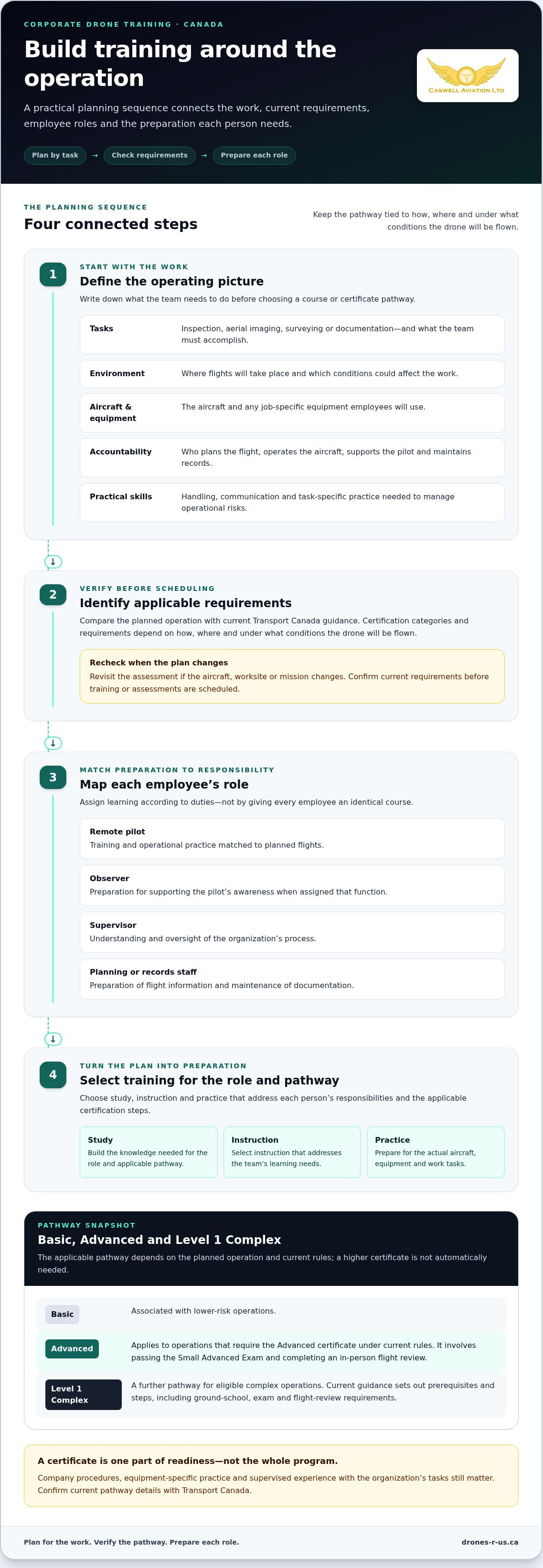
Once your operating plan is defined, use it to choose certification pathways and training for each employee. Keep the decision tied to the work by following this sequence:
- Define operations: Document what the team will do, where flights will take place and which aircraft it will use.
- Identify requirements: Check the current rules that apply to those planned operations.
- Map roles: Match each employee’s duties to the knowledge, assessment and practical skills they need.
- Select training: Choose study, instruction and practice that address the role and applicable certification steps.
This approach makes corporate drone pilot training Canada a workforce planning process, not a one-size-fits-all course assignment. Certificates establish a pilot’s qualification for applicable operations. They don’t replace company procedures, equipment-specific practice or supervised experience with the organization’s tasks. For current pathways and application details, consult Transport Canada’s drone pilot certificate requirements.
How do Basic, Advanced, and Level 1 Complex pathways differ?
At a high level, the Basic pathway is associated with lower-risk operations, while Advanced applies to operations that require the Advanced certificate under current rules. Advanced certification involves passing the Small Advanced Exam and completing an in-person flight review. Level 1 Complex is a further pathway for eligible complex operations. Current guidance sets out its prerequisites and steps, including ground-school, exam and flight-review requirements. Don’t assume a higher certificate is automatically needed or that one pathway covers every corporate mission.
Requirements can change, so use Transport Canada’s current information to confirm the relevant pathway before scheduling training or assessments. Its certificate guide also provides Canadian drone flight review guidance.
How can employers map roles to training requirements?
Build a role-and-competency matrix that connects responsibilities to preparation and evidence of readiness. A pilot, observer, supervisor and program lead may support the same operation, but their duties differ. For each role, record the required learning, applicable certificate or assessment, flight review where needed, task-specific practice and operational responsibilities.
For example, a pilot’s profile might include certification steps and supervised practice with the aircraft used for a work task. An observer’s profile can focus on assigned support duties and communication procedures. A program lead’s profile can cover oversight of training records and internal processes. Review the matrix when operations, equipment or employee responsibilities change. Organizations can also consider online drone training alongside practical instruction suited to their team’s needs.
Online or in-person corporate drone pilot training: how to compare formats
Choose a format based on the skills employees need to develop, then account for team schedules and locations. Online learning can support theory and exam preparation. Live instruction gives employees opportunities to ask questions and clarify difficult material. In-person practice lets them develop practical skills and receive direct feedback. A blended plan can combine these components instead of expecting one format to meet every need.
Use this comparison to match delivery to the learning objective:
| Format | Flexibility | Instructor interaction | Practical assessment | Scheduling considerations |
|---|---|---|---|---|
| Online learning | Employees can study around work commitments. | Interaction depends on the course format. | Supports knowledge development, but doesn’t demonstrate hands-on competence by itself. | Shared target dates can help managers coordinate employees studying at different times. |
| Live instruction | Sessions take place at set times. | Allows direct questions and discussion. | Can clarify procedures and concepts; practical assessment depends on the session. | Set aside time when the required employees can participate together. |
| In-person practice | Requires participants to attend a practical session. | Supports direct coaching and feedback. | Suitable for observing practical skills and completing applicable flight reviews. | Coordinate attendance around work duties and the required review process. |
For Advanced and Level 1 Complex certification, applicable flight reviews are conducted in person. Online study can prepare employees for knowledge requirements, but it doesn’t replace a required flight review or, on its own, grant a Transport Canada certificate. Confirm current certification steps before setting the team’s training sequence.
When does online learning suit a corporate team?
Online study can suit employees who need flexible access to theory and exam preparation, especially if they work across different locations or shifts. Managers can set shared learning milestones while allowing individuals to progress around operational duties. Track course progress separately from certificates, practical assessments and workplace sign-offs. Completing an online course is preparation, not proof that an employee holds a Transport Canada pilot certificate.
When should training include in-person instruction?
Include in-person instruction when employees need practical coaching, instructor feedback or an applicable flight review. This is particularly relevant when pilots must demonstrate skills connected to their aircraft and planned duties. Compare the format with employees’ experience and operational responsibilities, not convenience alone. A blended approach, such as online study followed by in-person practice, can support both flexible learning and practical development within corporate drone pilot training Canada.
How to implement a corporate drone training program step by step
A training program needs clear ownership and a routine that connects learning to actual flight work. Assign a program owner to coordinate requirements, training, records and internal reviews. Then document intended operations and build a sequence that takes each employee from study through applicable certification steps, practical coaching and supervised work.
What belongs in a company drone training plan?
Keep the plan practical and easy to update. For each role, record responsibilities, relevant qualifications, required learning, assessments, flight reviews where applicable, task-specific practice and evidence of completion. Assign someone to maintain the records and track changes to employee responsibilities or training status.
Document company procedures alongside training requirements. They should reflect the organization’s aircraft, tasks and operating environments. Use current Transport Canada guidance to confirm regulatory obligations and operating limits, then translate relevant requirements into steps employees can follow.
- Before flight: Confirm the task, assigned personnel, aircraft condition, flight plan, airspace considerations and weather conditions.
- During operations: Set out communication responsibilities, decision points and the response to an emergency or unexpected change.
- After flight: Record the flight, note any issues or incidents, and complete required post-flight documentation.
Checklists make procedures repeatable, but they don’t replace sound judgement or role-specific competence. Include practice with the actual equipment and tasks employees are expected to handle.
How can managers maintain team readiness?
Schedule practice around the work pilots perform, such as inspection, imaging or surveying tasks. Use internal reviews to identify gaps between written procedures and what employees can demonstrate. Record changes to personnel, aircraft, equipment, procedures or operating environments, then assess whether they call for updated instruction or supervised practice.
Set a regular review process, and verify current Transport Canada requirements before setting any regulatory training interval. Transport Canada states that pilots must complete a recurrent training activity every 24 months to keep their skills up to date; pilot certificates themselves don’t expire. Track that activity separately from company-led practice and competency checks.
A well-maintained program can also support employees developing professional drone pilot roles in Canada by making responsibilities and progression clearer. Organizations can review online drone courses and in-person training when planning development around their operating needs.
Build corporate drone pilot capability with Caswell Aviation training
Once your organization has defined its operations and mapped responsibilities, training can follow a clear purpose. Caswell Aviation Ltd provides online drone courses and optional in-person training for Transport Canada Advanced and Level 1 Complex certification, along with professional flight reviews for both pathways. Organizations can combine knowledge development with practical instruction as part of a role-based plan.
Training is one element of readiness, not a promise of certification or operational competence by itself. Employees still need to meet applicable Transport Canada requirements and practise the tasks, procedures and equipment relevant to their responsibilities. Use your role-and-competency framework to identify what each employee needs to study, demonstrate and maintain.
How can training support different corporate pilot roles?
Start with the planned operation, then consider each employee’s responsibilities. A remote pilot may need certification preparation and practical development aligned with the flights they’ll conduct. A staff member supporting planning or records may need learning focused on their assigned duties rather than pilot exam preparation. Observers and supervisors also benefit from training that clarifies their roles in the organization’s procedures.
Online learning can support flexible study, while optional in-person instruction adds a practical component where it fits the learning objective. Caswell Aviation’s Advanced and Level 1 Complex flight reviews provide the review component for employees pursuing those pathways, subject to current Transport Canada requirements. A structured plan can connect these elements without assuming every employee needs the same course or assessment.
What are the next steps for an organization?
Prepare a short outline before selecting training. Include the drone tasks your team expects to perform, the employees assigned to each responsibility and the objectives for their development. Note the relevant certification pathway, practical skills to develop and any applicable flight review. This gives managers a clear basis for coordinating training with work schedules and tracking progress.
For organizations planning corporate drone pilot training Canada, Caswell Aviation’s online courses and optional in-person training can support staff development around operational needs. Review the outline as operations, equipment or responsibilities change, and confirm certification requirements against current Transport Canada guidance.
Explore corporate drone pilot training and plan a learning pathway that fits your team’s roles and intended operations.
Build a training plan around your team’s work
A strong drone program starts with operational needs. Define what the team will do, match employee responsibilities to relevant Transport Canada pathways, and choose learning that combines knowledge development with practical instruction where needed. Keep certification requirements distinct from company procedures and task-specific competency.
Make the plan repeatable by assigning responsibility for training records, scheduling practical practice and reviewing procedures as people, equipment or operations change. This helps your organization coordinate development while keeping training connected to the work pilots and support staff actually perform.
Caswell Aviation offers online courses and optional in-person training for Advanced and Level 1 Complex certification, as well as professional flight reviews for both pathways. For corporate drone pilot training Canada, these options can form part of a structured plan shaped around your employees’ roles and operating needs. Explore corporate drone pilot training and take the next step towards building a capable, prepared team.
Frequently Asked Questions
How does a company start a drone pilot training program in Canada?
Start by documenting the drone tasks, operating environments, aircraft and employee responsibilities. Use that information to identify applicable Transport Canada requirements, then assign learning, practical coaching and assessment by role. Set a program owner to coordinate training records and review procedures as operations change. A structured corporate drone pilot training Canada plan can combine online courses, optional in-person instruction and applicable flight reviews.
Does every employee who works with a drone need a pilot certificate?
No, not every employee involved in a drone program needs a pilot certificate. Certificate requirements depend on the operation and the person’s duties. Identify who will operate the aircraft and check which certificate applies to the planned flight. Observers, supervisors and staff handling planning or records may have different responsibilities, but they still need preparation for their assigned tasks and company procedures.
Can corporate drone pilot training be completed online?
Some learning can be completed online, making it useful for theory and exam preparation when employees need flexibility. However, an online course by itself doesn’t issue a Transport Canada certificate or replace a required in-person flight review. Caswell Aviation Ltd offers online drone courses and optional in-person training for Advanced and Level 1 Complex certification. Choose the learning format according to each employee’s role and practical requirements.
What is the difference between Advanced and Level 1 Complex training?
Advanced preparation supports the pathway that includes the Small Advanced Exam and an in-person flight review. Level 1 Complex is a separate pathway for more complex operations, including qualifying BVLOS operations, and has additional prerequisites, ground-school, exam and flight-review requirements. It isn’t automatically the right choice for every organization. Match the pathway to intended operations and confirm current requirements with Transport Canada before planning staff training.
How long does corporate drone pilot training take?
There isn’t one timeline for every corporate team. The time required depends on employees’ previous knowledge, the certification pathway, learning format, practical development needs and coordination of applicable exams and flight reviews. Level 1 Complex includes mandatory ground school, so include that requirement in planning. Set milestones around work schedules, and allow time for practice and assessment beyond course study.
Do corporate drone pilots need a flight review in Canada?
A flight review is required for the Advanced certification pathway and the Level 1 Complex pathway, subject to current Transport Canada requirements. The Advanced pathway also includes the Small Advanced Exam. A flight review is conducted in person and is distinct from company-specific practice or supervised work. Check official guidance for the requirements that apply to each pilot and planned operation, as rules can change.
Leave a comment