

Commercial Drone Photography: A Canadian Business Buying Guide
The most impressive aerial footage isn’t always the most useful. If you’re considering commercial drone photography Canada businesses can use, start with the business goal, not the camera or sample reel. A polished image may suit a marketing campaign, while an operational decision may call for a different view, format or level of detail.
It’s worth reviewing a provider’s visuals and equipment, but those alone don’t show whether they understand your requirements or have planned for site access, permissions and safety. A clear brief helps you assess capability, confirm what will be delivered and reduce the risk of avoidable delays.
This guide explains how to define your aerial imagery needs, compare providers and prepare for a commercial drone photography project in Canada. You’ll learn what to clarify about photo and video formats, how to discuss the flight plan and site conditions, and what to confirm before work begins. Caswell Aviation Ltd offers aerial photography and video tailored to client requirements, with drone training and professional flight review experience informing its practical understanding of operations.
Key Takeaways
- Start with the decision your imagery needs to support, then identify the views that will help communicate or document it.
- For commercial drone photography Alberta projects, prepare details about the site, access and priority areas before comparing providers.
- Use relevant work samples and clear answers about deliverables to assess whether a provider fits your project.
- Share known site conditions early, and clarify who will assess operational requirements before the flight.
- Confirm the intended use and review process so the finished imagery can serve its communication or operational purpose.
Commercial drone photography: start with the business objective
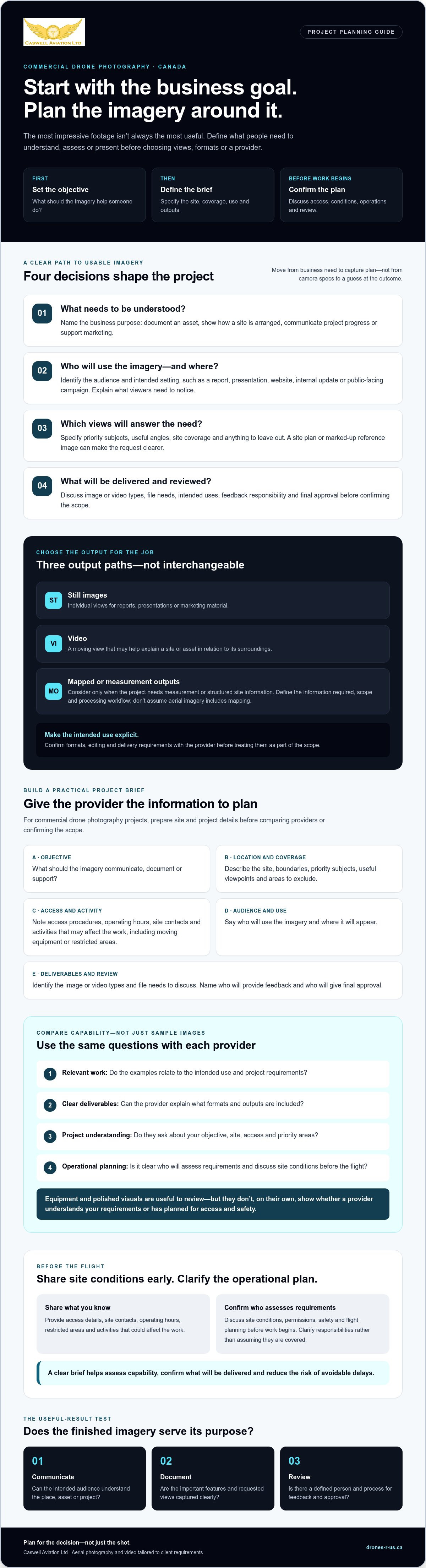
Commercial drone photography is aerial imagery created for a specific business or organisational purpose. A company might use it to document assets, show how a site is arranged, communicate project progress or support marketing. The aircraft is a tool. The useful result is imagery that helps someone understand, assess or present something.
That distinction matters when planning commercial drone photography Alberta businesses can put to work. The objective shapes what the pilot needs to capture, from the area covered and viewing angle to the timing and intended final formats. Attractive footage alone may miss a critical feature, leave out context or arrive in a form that doesn’t suit its audience.
Unmanned aerial vehicles (UAVs) are used across a wide range of applications, including aerial photography. For a business project, start by stating what the imagery needs to accomplish. For example, if the goal is to explain a site layout, request views that show how its key areas relate to one another. If the goal is to document a particular asset, identify the details and angles viewers need to see. Caswell Aviation Ltd offers aerial photography and video tailored to client requirements, so a clear objective can help shape a useful brief.
Match the imagery to its intended business use
Promotional photography is usually intended to present a place, asset or organisation in a compelling way. Project documentation may instead need clear, repeatable views that help people understand visible site conditions. Broader visual communication could combine context and detail for an audience that isn’t familiar with the site.
Before planning a flight, identify who will use the imagery and where it will appear. A website, presentation, internal update and public-facing campaign may call for different framing or selections. Tell the provider what viewers need to notice and what questions the imagery should help answer. If the imagery will support a report, for instance, explain which features readers need to understand without being on site.
Choose between still images, video and mapped outputs
Still images capture individual views for a report, presentation or marketing material. Video records a moving view and may help communicate how a site or asset relates to its surroundings. Confirm the formats, intended use and any editing or delivery requirements with the provider before treating them as part of the scope.
Mapped outputs are a different category. Consider them only when the project needs measurement or structured site information, rather than visual communication alone. Such technical outputs require a defined scope and a suitable processing workflow. Ask what information the output is meant to provide, how it will be prepared and whether the provider can support those requirements before including it in the brief. Don’t assume that a request for aerial images also covers mapping or measurement.
With the objective established, turn it into practical instructions: what to capture, where to look and what to leave out.
Build a commercial drone photography brief that produces usable results
A clear brief turns a business objective into instructions a provider can assess and plan around. For commercial drone photography Alberta projects, set out the purpose, site, access arrangements, requested imagery and review process before confirming the scope. The provider can then discuss feasibility and clarify which final outputs are available for the project.
Use this sequence to build the brief:
- Objective: State what the imagery needs to communicate, document or support.
- Location and coverage: Describe the site and define boundaries. List priority subjects, useful viewpoints and areas to exclude. A site plan or marked-up reference image can help make these instructions clear.
- Access and activity: Note access procedures, operating hours, site contacts and any activity that could affect the work, such as moving equipment or restricted areas.
- Audience and use: Identify who will use the imagery and where it will appear, such as in a presentation, on a website or in internal communication.
- Deliverables and review: Specify the image or video types, file needs and intended uses you want to discuss. Name the person responsible for feedback and final approval.
Specify coverage, timing and access requirements
Be precise about what should appear in the frame and what should remain outside it. For example, distinguish between a request to show an entire site and a request to focus on a particular asset or approach. If you have several priorities, identify which views are essential and which are optional. Share known access steps and activity constraints early, and identify a site contact who can answer practical questions.
Include preferred dates or timing considerations, such as a particular stage of work or time of day. Treat these as preferences, not guarantees. Weather and operational feasibility can affect whether the requested plan is suitable, so confirm timing with the provider as the project is scoped.
Agree on deliverables and review steps before booking
Record the expected outputs and how they’ll be used. Clarify who selects images or reviews footage, whether feedback will be consolidated, and who approves the final material. Confirm in writing what is included in the scope, including any editing or processing requirements. If video is part of the brief, review this corporate drone video guidance to help frame your requirements.
Caswell Aviation provides aerial photography and video tailored to client requirements. Once your brief is ready, compare it with the company’s aerial photography and video services and discuss which requested outputs and project details need confirmation.
Compare commercial drone photography providers by capability, not just sample images
A polished portfolio can show visual style, but it doesn’t establish whether a provider can meet your project’s needs. For commercial drone photography Alberta businesses should compare how each provider understands the brief, plans the work and confirms usable deliverables. Relevant examples and clear answers are more useful than a large collection of unrelated images.
| What to assess | What to look for |
|---|---|
| Project fit | Can the provider explain how the proposed approach relates to your objective and priority subjects? |
| Sample relevance | Do examples resemble your subject, requested perspective and intended use? |
| Communication | Are questions answered clearly, with a process for confirming scope and constraints? |
| Deliverables | Are image or video types, file needs, editing and review steps discussed before agreement? |
| Operational planning | Does the provider ask about site access, activity and other conditions that may affect the plan? |
A portfolio full of attractive but unrelated work may tell you little about how a provider will handle your requirements. Ask to see examples that match the type of subject, viewpoint or communication purpose you have in mind. Then ask the provider to explain how those examples relate to your brief. A similar-looking result is not a guarantee that the same approach will suit your site or deliverables.
Questions to ask before selecting a provider
Ask how the provider turns your brief into a proposed flight and capture plan. Clarify who will coordinate site access, permissions and communication with relevant stakeholders. Also ask how weather or operational restrictions could change the timing, coverage or feasibility of the plan. These questions help reveal whether project constraints are being considered early, rather than left until the scheduled work.
Assess image quality and delivery suitability
Review samples for more than appearance. Consider whether the subject is easy to understand, the perspective suits your intended use and the framing includes the context your audience needs. For video, consider whether the movement and sequence help viewers follow the subject rather than distract from it. Confirm in writing whether editing, revisions and file preparation are included in the agreed scope. If the provider uses certification terms to describe operational capability, ask what they mean for your project. For background, see this guide to Transport Canada drone certification.
Caswell Aviation offers aerial photography and video tailored to client requirements. Its drone training and professional flight review experience also provides relevant operational context, but the proposed scope, deliverables and project constraints should always be confirmed directly with the provider.
Plan commercial drone photography around site conditions and safe operations
A workable plan depends on more than the images requested. Site access, people, nearby activity and changing conditions can affect where and when a flight is feasible. For commercial drone photography Alberta projects, share known site information early so the provider can consider it during planning. Clear communication helps identify issues before they disrupt the project.
Review site access, stakeholders and changing conditions
Start by identifying who controls access to the site and who needs to be informed about the proposed work. Tell the provider about access procedures, active work areas, sensitive locations, people on site and any client-specific restrictions. Identify a site contact who can answer questions and help coordinate with relevant stakeholders.
Separate what you know from what needs assessment. The client can provide site plans, access details and information about scheduled activity. The pilot must assess operational conditions and decide whether the proposed flight can proceed as planned. Weather, visibility and activity near the site can change, so a preferred date or capture plan should not be treated as a certainty.
A brief supports planning, but it cannot replace the pilot’s safety and compliance decisions. If conditions or restrictions make the proposed operation unsuitable, the plan may need to change. Confirm how the provider will communicate a change and who on the client side can respond.
Verify aviation requirements without overpromising
Applicable requirements can depend on the operation and its circumstances. Don’t assume that certification or airspace requirements are identical for every project. Check current Transport Canada drone safety information and discuss the proposed operation with the provider. The client’s site details are useful planning inputs, but they don’t determine the pilot’s regulatory assessment.
For additional background, consult this guide to Canadian drone regulations. Use it as context, then verify applicable requirements through current official information rather than relying on a general summary alone.
Before confirming a project, ask how site access, stakeholder coordination and changing conditions will be addressed, and make sure the proposed scope remains subject to the pilot’s operational assessment. Caswell Aviation provides aerial photography and video tailored to client requirements. Discuss your aerial photography and video requirements with the provider as part of planning.
Choose a commercial drone photography partner and take the next step
A sound choice follows a clear sequence: define the business outcome, brief the work, assess provider capability and confirm operational planning. This keeps the decision focused on what the imagery needs to do, rather than on visuals or technical claims alone. For commercial drone photography Alberta projects, a concise enquiry gives a provider a useful starting point and helps identify what still needs to be confirmed.
Prepare a clear enquiry for an aerial imagery project
Before contacting a provider, gather the details that shape the proposed work. Include the project objective, the subject or site, known access arrangements, preferred timing and intended use. Note any priority areas, restrictions or stakeholders who need to be informed. You don’t need to have every technical detail settled, but clear site and business information makes it easier to discuss feasibility.
Also list the outputs you want to discuss and name the person who will review them. Ask the provider to clarify the proposed scope, what may affect feasibility and what additional information they need. Treat this conversation as a way to refine the brief, not as confirmation that every requested view or format can be provided.
Connect the brief with Caswell Aviation’s imagery service
Caswell Aviation offers tailored aerial photography and video solutions based on client requirements. Share your intended use and project details, then confirm directly which specific deliverables and operational arrangements are suitable. The company also provides drone training and professional flight reviews, offering relevant operational context without replacing the project-specific assessment.
A useful enquiry can be straightforward: explain what you need the imagery to communicate, describe the subject and site, and ask what details are needed to assess the request. Confirm any proposed scope and outputs with the provider before proceeding.
If you’re ready to discuss your project, contact Caswell Aviation about aerial imagery services. A clear brief can help start a practical conversation about your requirements and the next steps.
Turn your aerial imagery plan into a clear next step
Useful commercial drone photography Alberta projects begin with a defined business outcome. A focused brief connects that goal to the site, priority views, intended audience and deliverables. Comparing providers by relevant capability and communication, then confirming site conditions and operational requirements, gives you a clearer basis for moving forward.
Before making an enquiry, gather the key details: what you need to communicate or document, where the work would take place, access information, preferred timing, intended use and who will review the results. You don’t need to resolve every technical question in advance. A direct conversation can help identify what’s feasible and what needs clarification.
Caswell Aviation offers aerial photography and video tailored to client requirements, alongside drone training and professional flight review services. If you’re ready to discuss your project, Discuss your aerial imagery project with Caswell Aviation. A clear starting brief can help you take the next step with confidence.
Frequently Asked Questions
What is commercial drone photography?
Commercial drone photography is aerial imagery created for a business or organizational purpose. A project might document an asset, show the layout of a site or support marketing. The intended use shapes what should be captured and how the imagery will be prepared. For commercial drone photography Alberta businesses can use, begin by identifying the audience and the decision or message the images should support.
How do I choose a commercial drone photography provider?
Choose a provider whose capabilities and planning approach fit your brief, not just one with attractive sample images. Ask for examples relevant to your subject and intended use, then discuss scope, access, operational constraints, deliverables and review steps. Confirm what’s included and what still needs assessment. Caswell Aviation offers aerial photography and video tailored to client requirements, as well as drone training and professional flight reviews.
Do commercial drone photographers need certification in Canada?
Certification requirements depend on the drone and operation, not simply whether the flight is commercial. Under Transport Canada rules, pilots generally need at least a Basic Operations Certificate to fly a drone weighing 250 grams or more. Certain operations require an Advanced Operations Certificate and may need additional authorization. Requirements can vary with operational conditions, so check current Transport Canada guidance and confirm the applicable requirements with the pilot.
What should I include in a commercial drone photography brief?
Include the business objective, site or subject, coverage boundaries, priority viewpoints and any areas to exclude. Share known access procedures, site contacts, activity constraints and timing preferences. State who will use the imagery, where it will appear and what image or video outputs you want to discuss. Name the person responsible for feedback and approval, then ask the provider to clarify feasibility, scope and any missing information.
Can a drone photography project be delayed by weather or site conditions?
Yes. Weather, visibility, site activity, access issues or other operational restrictions may affect whether a planned flight can proceed as intended. Share known site conditions early, including active work areas and access procedures, and ask how changes will be communicated. A preferred date isn’t a guarantee. The pilot must assess conditions and make the operational decision, even if the project brief requests a particular view or schedule.
What deliverables can I request from a commercial drone photography service?
You can discuss still photography or video, along with intended use, file needs and any editing or review expectations. Confirm the specific formats, specifications and preparation with the provider before treating them as part of the scope. Caswell Aviation offers aerial photography and video tailored to client requirements. If you need measurement or structured site information, describe that goal and confirm whether it can be accommodated.
Leave a comment