

Agricultural Drone Pilot Training in Canada: A Practical 2026 Guide
A drone certificate can establish your flying credentials, but it won’t teach you to interpret crop data or manage every field task. If you’re researching agricultural drone pilot training Canada, start by separating three things: pilot competence, knowledge of the agricultural task, and the field procedures needed to carry it out safely.
It’s reasonable to wonder which certificate fits your plans, whether you need more flying practice or agricultural expertise, and whether a course alone will prepare you for field work. These are separate parts of the pathway. Transport Canada RPAS training builds a foundation in safe operations, while crop-focused skills depend on the work you intend to do, from aerial imaging to application operations.
This guide outlines the competencies agricultural drone work can require, how pilot certification relates to specialized agricultural knowledge, and what experience to build next. You’ll also find ways to use online study, in-person training, and flight-review preparation as part of a development plan, so you can identify what you’re ready to do and what you still need to learn.
Key Takeaways
- Assess the agricultural task first, then identify the flying and planning skills it requires.
- Compare observation, mapping, and application work by objective, equipment needs, and pilot considerations.
- Build repeatable habits with checklists, accurate records, and deliberate practice.
- Use agricultural drone pilot training Canada as a foundation for RPAS competence, then develop task-specific knowledge separately.
- Plan your learning in stages, using online study, in-person training, and flight-review preparation to support your intended operations.
What agricultural drone pilot training in Canada needs to prepare you for
Agricultural readiness means more than launching, steering, and landing an aircraft. It combines safe RPAS operation with planning for a defined field task: understanding the site, selecting suitable equipment, setting a workable flight plan, and recognizing when conditions call for a change or cancellation. The right agricultural drone pilot training Canada pathway starts with the work you intend to do, not just the aircraft you hope to fly.
Farm-related operations can include field observation, crop scouting, mapping, and collecting imagery or other data. As the overview of an agricultural drone illustrates, these applications can involve different technologies and payloads. Aircraft capability, sensor choice, and the task all shape the skills a pilot needs. A platform suited to collecting imagery may not suit another operation.
What agricultural drone pilots may do in the field
Scouting involves checking a defined area for signs that may need closer attention. Field observation gives a farm team a broader view of crop or site conditions. Mapping focuses on producing spatial information, while imagery records visual details for later review. These tasks can overlap, but they don’t have identical flight plans or equipment needs.
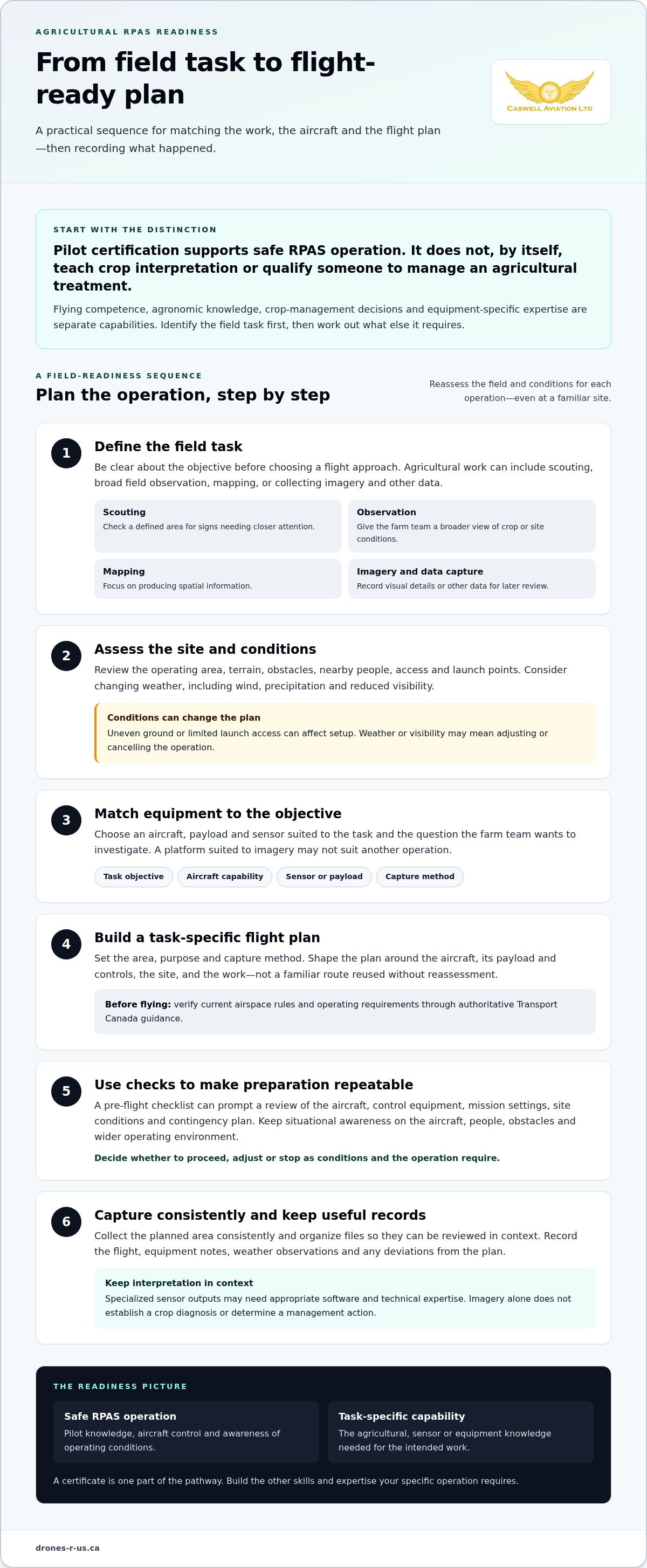
Before flight, assess terrain, obstacles, access points, and changing weather. Uneven ground or limited launch access can affect where you set up and how you plan the flight. Wind, precipitation, or reduced visibility may change whether the operation is suitable. Build these factors into the plan rather than reusing a familiar route without reassessing the field.
What a pilot certificate does, and does not, establish
Transport Canada certification concerns a pilot’s knowledge and the operating privileges associated with a certificate under applicable Canadian rules. The right pathway depends on the intended operation and the rules that apply. For a broader overview of certificate categories and their framework, see this Transport Canada drone certification guide.
A pilot certificate establishes aviation knowledge and operating privileges; it does not, by itself, qualify someone to interpret crop conditions or manage an agricultural treatment. Flying competence is distinct from agronomic knowledge, crop-management decisions, pesticide knowledge, and equipment-specific expertise. Those capabilities may require separate learning or collaboration with people qualified in the relevant field.
Make this distinction practical. A pilot preparing for mapping may need to practise careful mission planning and consistent image collection. Someone observing a field needs to fly safely while capturing useful views for the intended review. Application work brings different equipment and operating considerations, as well as requirements that can extend beyond pilot certification. Identify the task first, then determine which flight skills, technical knowledge, and applicable guidance your plan requires.
Core RPAS skills agricultural drone pilots need to develop
Agricultural RPAS work depends on several skills working together. Aircraft control helps a pilot follow a planned path and respond calmly when conditions change. Situational awareness means monitoring the aircraft, people, obstacles, and wider operating environment rather than focusing only on the screen. Mission planning connects those skills to a defined objective, while sound decision-making helps determine whether to proceed, adjust, or stop.
Field readiness means planning the task, controlling the aircraft, noticing changing conditions, and documenting what happened. Accurate records make the process repeatable. A flight log, equipment notes, weather observations, and records of deviations from the plan can help identify what to improve before the next operation.
Flight planning and safety in working landscapes
Start with a site assessment. Identify the operating area, access and launch points, nearby people, obstacles, and features that could affect flight or recovery. Consider how weather may change during the operation, not just at take-off. Shape the plan around the specific aircraft, its payload and controls, and the task. Verify current airspace rules and operating requirements through authoritative Transport Canada guidance before flying.
Checklists turn that assessment into consistent action. A pre-flight checklist can prompt you to review the aircraft, control equipment, mission settings, site conditions, and contingency plan. A post-flight record can capture issues or changes. This is useful even at familiar sites, since field conditions and operating constraints can differ from one visit to the next.
Data capture, sensors, and agricultural context
Ordinary visual imagery records visible features, while specialized sensors collect different kinds of data. Choose based on the question the farm team wants to investigate and the capabilities of the aircraft and sensor. Before take-off, define the area, purpose, and capture method so the resulting material is consistent enough for its intended review.
Data collection is a workflow, not simply a camera flight. Capture the planned area consistently, keep notes about the operation, and organize the resulting files so they can be reviewed in context. Specialized sensor outputs may require appropriate software and technical expertise to interpret. Imagery alone doesn’t establish a crop diagnosis or tell a farm team what management action to take. Pilot certification and sensor operation also don’t replace agronomic or crop-management knowledge.
Use a simple review cycle to improve the work: compare the flight plan with what you captured, record gaps or interruptions, and adjust the next plan where needed. This turns practice into useful experience rather than simply accumulating flight time. For agricultural drone pilot training Canada, make sure your learning plan develops operational discipline as well as certificate knowledge.
Structured study can support that foundation. Caswell Aviation Ltd offers online courses and optional in-person training for Advanced and Level 1 Complex certification. Explore its RPAS training options as part of your development plan.
How agricultural drone operations differ by task and aircraft
The same pilot may face very different demands across agricultural assignments. A visual field check, a mapping flight, and an operation carrying an application payload each have distinct objectives, equipment considerations, and planning needs. For agricultural drone pilot training Canada, develop skills for the intended task rather than assuming one aircraft setup or certificate covers every situation.
| Task | Objective | Pilot considerations |
|---|---|---|
| Observation | View a field or area for visible features | Choose a safe route and capture clear, useful visual imagery |
| Mapping | Collect consistent data across a defined area | Plan coverage, image overlap, sensor use, and repeatable capture |
| Application | Carry out a task using an application payload | Account for payload effects, operating procedures, and current rules |
This is a planning framework, not a universal equipment prescription. Payload capacity, endurance, and sensor compatibility vary by aircraft. A configuration suitable for imagery may not suit an application task. Match the aircraft and payload to the objective, then build the flight plan around that setup and the site.
Observation and mapping missions
Observation flights focus on seeing a location clearly. Mapping missions need deliberate, consistent coverage, which may include planning image overlap and following a repeatable capture pattern. The right approach depends on the goal and equipment. Lighting, altitude, and weather can affect image quality or data consistency, so account for them in planning and review. Capturing imagery is not the same as interpreting it for farm-management decisions.
Application missions and additional considerations
Spraying and other payload-based work introduce different handling and planning demands from observation or mapping. A payload can affect aircraft performance and the way an operation is prepared. Before undertaking this work, verify current federal and provincial requirements, product directions, and applicable environmental considerations through authoritative sources. Pilot certification alone doesn’t establish pesticide knowledge, agronomic competence, or permission to conduct every type of application.
Operating context matters as much as task type. Site conditions, airspace, people nearby, aircraft configuration, and the scope of the operation can all change the checks a pilot needs to complete. Confirm the current Transport Canada rules and operating requirements for the specific aircraft, location, and operation. Don’t infer that a certificate automatically authorizes every flight. Treat each assignment as its own planning exercise, document the configuration and objective, and adjust training priorities to the work being considered.
A practical training plan for building agricultural drone readiness
A course can build your understanding of RPAS rules and procedures, but field readiness develops through deliberate practice and review. Before choosing study priorities, define the agricultural task you’re preparing for. The pilot skills, aircraft knowledge, and technical learning needed for visual observation may differ from those involved in mapping or working with a specialized payload. A clear target makes your training more relevant and helps expose gaps early.
Set learning objectives around real agricultural tasks
Write down the job, aircraft class, expected data output, and operating environment. Then separate your learning into distinct goals: certificate knowledge, aircraft handling, sensor or software use, and agricultural context. Keep a skills log to record practice, decisions, recurring issues, and questions for further study. This makes progress easier to assess than relying on flight time alone.
Use this progression to turn those objectives into a practical development plan:
- Define the task. Describe what the operation is meant to accomplish and what information or result it should produce.
- Identify the operating context. Note the aircraft and payload, site conditions, people or obstacles nearby, and the airspace and operating requirements that apply. Verify current rules through authoritative Canadian sources.
- Set learning priorities. Match certificate study and flight practice to the operation. Add separate objectives for equipment, data handling, software, or agricultural knowledge where needed.
- Practise scenarios. Rehearse planning and aircraft handling within applicable operating rules. Include realistic changes, such as shifting weather, unavailable access, or a capture area that needs revision. Practise deciding whether to continue, adjust, or stop.
- Review and document. Use pre-flight and post-flight reviews to record the plan, decisions, results, and lessons. Update your skills log and choose the next practice objective based on what the review reveals.
Build experience through structured practice
Progress from ground-based planning exercises to controlled practice appropriate to your experience and the applicable rules. Start with a manageable scenario, then add complexity as your planning, aircraft handling, and decision-making become more consistent. Review each exercise against its original objective: Was the plan suitable? Were conditions monitored? Was the result captured and recorded as intended?
This approach can also place agricultural work within a broader professional pathway. The Canadian drone pilot career guide offers context for considering how specialized agricultural skills may complement other professional RPAS work.
Agricultural drone pilot training Canada is a development pathway, not a single course or flight. Caswell Aviation’s online courses and optional in-person training for Advanced and Level 1 Complex certification, along with professional flight reviews, can support the pilot-training part of that pathway. Explore structured drone training and flight reviews as you plan your next learning steps.
How Caswell Aviation training supports your Canadian pilot pathway
Building agricultural RPAS readiness involves several kinds of learning. Certification study develops knowledge of Canadian aviation rules and operating procedures. Practical flight experience builds handling and decision-making. Agricultural work may also call for separate knowledge of sensors, data workflows, crop context, or application requirements. Keeping these areas distinct helps you choose relevant training without assuming that a pilot certificate covers every aspect of a field assignment.
Caswell Aviation offers online courses and optional in-person training for Transport Canada Advanced and Level 1 Complex certification. These options support the pilot-training part of your development plan. Choose a starting point based on your current certification stage, the operation you have in mind, and the skills you still need to build.
Online courses, in-person training, and flight reviews
Online learning can help you work through certification material in a structured way. Optional in-person training provides another format for pilot development. Professional flight reviews are required for pilots pursuing advanced operating certificates and support preparation for the practical review process. Course study and a flight review address pilot readiness, but they don’t replace field practice or crop-specific learning.
Before selecting a course or review, write down what you’ve already completed and what you’re working towards. Check current certificate names, eligibility, and privileges against Transport Canada information. Then identify whether your immediate priority is certificate knowledge, practical flight preparation, or a separate agricultural skill such as sensor operation or data handling.
Choose a clear next step for your training
Make your next decision specific. Define the agricultural task you’re preparing for, identify the pilot and technical skills it calls for, and select training that addresses the gaps you’ve found. Keep agricultural or agronomic learning separate from RPAS certificate preparation, then plan practice that develops the operational skills needed for your intended work.
- Record your current certificate stage and the operation you’re preparing for.
- List the gaps in pilot knowledge, practical handling, and task-specific expertise.
- Choose a study or practice objective, then review your progress before adding complexity.
This measured approach keeps certification, flight competence, and agricultural specialization in view without treating them as interchangeable. It also gives you a practical basis for progressing towards professional operations while staying attentive to current requirements and the limits of your experience.
If structured pilot learning is your next step, Explore Canadian drone courses and training through Caswell Aviation. Choose a pathway that fits your certification goals, then continue building safe, job-relevant experience through focused practice and review.
Take the next step towards field-ready flying
Your next step doesn’t need to be a major commitment. Choose one agricultural task you want to prepare for, then identify the knowledge and practice that would make you safer and more capable in that setting. This turns agricultural drone pilot training Canada from a broad search into a focused development plan. Keep your goals realistic, build experience progressively, and revisit them as your intended operations become clearer.
Certification is one part of that progression. Caswell Aviation’s online courses and optional in-person training support pilots working towards Advanced and Level 1 Complex certification, while professional flight reviews serve pilots pursuing advanced operating certificates. These pilot-development options provide a foundation; crop, sensor, and application expertise must be developed for the specific work you intend to undertake.
Explore Canadian drone courses and training and choose a learning step that matches your current stage. With a clear objective and a steady approach to practice, you can build confidence and move towards agricultural operations responsibly.
Frequently Asked Questions
Can agricultural drone training qualify me to fly any drone operation in Canada?
No. Training and holding a pilot certificate don’t automatically authorize every aircraft, location, or operation. Before a flight, check current Transport Canada requirements for the aircraft and planned activity, including the applicable operating category and airspace conditions. A certificate addresses defined pilot privileges; it doesn’t replace task-specific instruction or other permissions that may apply. For example, a planned flight near controlled airspace needs a different review from a routine operation elsewhere.
Do I need an Advanced certificate for agricultural drone work in Canada?
Not necessarily. The right certificate depends on the aircraft, location, and operation, so there isn’t one answer for every farm-related flight. Review current Transport Canada guidance to determine which certificate’s privileges apply to your plan. As a practical first step, write down where you’ll fly and what you intend to do, then compare those details with the official requirements. Don’t assume that a commercial purpose alone determines the certificate level.
Can I use a drone to spray crops in Canada after taking pilot training?
Not on pilot training alone. Spraying may involve requirements beyond flight certification, including rules related to the aircraft, pesticide use, and environmental protection. These can depend on the intended product and operation, so check current federal and provincial guidance before planning the work. Also distinguish the ability to control the aircraft from the knowledge needed to handle an application task safely and appropriately. Don’t treat a pilot course as pesticide or agronomic qualification.
What should agricultural drone pilot training teach besides flying?
Useful training should develop planning and decision-making alongside aircraft control. Look for learning objectives that include assessing a site, maintaining awareness of people and obstacles, following aircraft-specific procedures, capturing data consistently, and recording flight details. For example, a pilot collecting imagery should know how to follow the planned capture method and review whether the material is complete. Sensor operation and agricultural interpretation may require additional study beyond certificate preparation.
How do I choose between online and in-person drone training?
Choose based on what you need to learn next. Online study can support structured certificate knowledge, while in-person instruction supports practical development. Consider your experience, the certificate objective, and whether you need hands-on practice with flight procedures. Caswell Aviation offers online and in-person drone training for Advanced and Level 1 Complex certification, giving learners formats to consider as they plan their pilot development.
How long does it take to become an agricultural drone pilot in Canada?
There’s no single timeline. It depends on your prior experience, the certificate pathway, your study pace, practical preparation, and the agricultural operation you’re pursuing. Allow for learning beyond the certification stage: operating an aircraft for a defined task can involve practice with equipment, data workflows, and relevant agricultural context. Set a realistic study plan, check current certificate requirements, and track your progress rather than relying on a promised completion date.
Do I need agricultural experience to work with drone data on a farm?
It depends on your role. A pilot may collect imagery to a defined plan, while another person reviews the data and considers its agricultural meaning. Familiarity with farming can help connect collected information to the questions a farm team needs answered, but a pilot credential covers a different area of competence. Imagery alone shouldn’t be treated as a definitive crop diagnosis or a recommendation for crop-management decisions.
Leave a comment