

Drone Services Agreement Template Canada: Clauses to Include
What if an aerial photo project goes smoothly on site, but the client and operator later disagree about which images were included? Unclear scope can turn a straightforward flight into mismatched expectations. A search for a “drone services agreement template Canada” is often the first step towards preventing that problem.
Before work begins, both parties need a shared record of the services, site access and permissions, operating responsibilities, deliverables, schedule, fees and risk controls. For aerial photography or video, describe the planned capture, file formats and delivery expectations. Also account for how weather, site conditions and aviation requirements can affect operations.
This guide provides a clause-by-clause framework for a Canadian drone services agreement, with practical points for clients and service providers to address before a project starts. You’ll learn what to document, where project-specific details matter and why a generic template isn’t legal advice or regulatory approval. The article also covers privacy, safety and compliance considerations that may need current verification or review by a qualified Canadian lawyer.
Key Takeaways
- Use a drone services agreement template Canada as a starting framework, then adapt its clauses to the project and seek Canadian legal review before signing.
- Make aerial-image deliverables measurable by specifying the intended content, file formats, delivery expectations and schedule.
- Separate client-provided information and site permissions from flight decisions controlled by the drone operator.
- Follow a five-step preparation process: identify the parties, define the scope, allocate responsibilities, review the clauses, then sign and retain the agreement.
- Keep the signed agreement, project brief and flight-planning documents aligned, while recognizing that each serves a different purpose.
What a drone services agreement in Canada should accomplish
A drone services agreement is the working record of a commercial project. It identifies the client and service provider, describes the work, sets out deliverables and schedule, and assigns responsibilities. For a Canadian commercial project, a drone services agreement is a written contract that records who is hiring whom, what drone services will be provided, what will be delivered, and how each party’s responsibilities are allocated.
That record gives both parties a shared reference before work begins. For an aerial photography or video project, the agreement can distinguish the requested capture from the final edited content, state when delivery is expected, and explain how approved changes will be handled. Details vary by assignment. Clear wording helps avoid disputes over assumptions, such as whether the fee includes additional filming or a different file format.
A contract does not authorize a flight. Drone operations in Canada are subject to Transport Canada requirements, and an agreement cannot replace applicable aviation rules or the pilot-in-command’s safety obligations. The Regulation of UAVs in Canada overview provides background on the regulatory framework. Verify current operational requirements with Transport Canada.
Keep the agreement distinct from related documents. A flight plan addresses operational planning; site permission records access or consent from the relevant landholder; insurance documents coverage; and a permit or authorization addresses a specific approval where one is required. These documents may support a project, but they serve different purposes and aren’t interchangeable. Contract wording alone does not provide site access, insurance coverage or flight authorization.
Who the agreement is for and when to use it
The agreement is between the client and the service provider. Record each party’s legal name and contact details, and identify who can approve project changes or receive the deliverables. Use it before committing to a commercial flight, especially when several people are coordinating access, capture requirements or delivery. A written record helps prevent disagreements about what was requested and who was expected to provide information or approvals.
For aerial imagery, one client may want still photographs for a property listing, while another may need video for a project update. These are examples, not standard packages. Describe the actual assignment rather than relying on a broad phrase such as “drone footage.”
What a template can and cannot do
A drone services agreement template Canada is a starting framework, not jurisdiction-specific legal advice. Adapt it to the project, applicable provincial or territorial requirements, and the parties’ circumstances. A generic form may not address relevant privacy, liability or intellectual property issues.
Seek review from a qualified Canadian lawyer when terms affect liability, ownership or permitted use of images, privacy, or complex operations. Confirm current Transport Canada requirements separately, and document site permissions through the appropriate process. A signed contract can clarify the parties’ arrangement, but it cannot make an otherwise unauthorized operation permissible.
Core clauses for a Canadian drone services agreement
A useful agreement makes the commercial arrangement specific enough that both parties can tell what has been agreed, what remains conditional and how changes will be handled. For an aerial photography or video assignment, “capture imagery” leaves important questions open: which locations, what kind of content, and what files will the client receive?
Precise scope and deliverables give both parties the same measure of what the drone project includes and when the work is complete. A drone services agreement template Canada can help organize the terms, but sample wording needs to be adapted to the project and reviewed by a qualified Canadian lawyer before signing.
- Parties and authority: Identify the client and service provider by legal name and contact details. Name the representatives who can approve instructions or changes.
- Scope and exclusions: Describe the work, locations, intended use and agreed limits. State what is outside the assignment, such as additional capture or editing not described in the scope.
- Schedule and dependencies: Record project dates or a scheduling window, along with dependencies such as site access, client-supplied information or approvals.
- Fees and payment: Set out the agreed fee, payment milestones, invoicing terms and process for approving additional work. Don’t leave payment timing or change charges to assumption.
- Deliverables and acceptance: Specify the agreed content, file formats, delivery method and review process. Clarify how the client can identify a technical issue or request a revision.
Scope, schedule, and deliverables
Make the brief concrete without promising a flight regardless of conditions. Identify the locations to be captured, the intended use of the imagery, the agreed file formats and how files will be delivered. Explain how weather, site access or other delays affect scheduling, and set a process for rescheduling. Require written approval for material changes so both parties can track the revised scope and any effect on timing or fees.
Keep flight decisions distinct from these commercial terms. The agreement can allocate who supplies site information or coordinates access, but it must not require an operation that conflicts with applicable aviation rules. Verify current requirements using Transport Canada’s drone safety guidance. Contract language does not replace regulatory compliance or the pilot-in-command’s safety responsibilities.
Payment, rights, confidentiality, and cancellation
Use plain, explicit wording about rights. State whether the client receives ownership or a licence to use the imagery, the permitted uses, any limits on sharing or editing, and whether credit is required. Include confidentiality terms where appropriate. For payment, cancellation, termination and dispute resolution, define the process and consequences rather than relying on generic phrases.
These provisions can have legal and commercial consequences, particularly for intellectual property, privacy and liability. Have a qualified Canadian lawyer review the completed agreement and any sample clauses before signing. For a real imagery brief, aerial photography and video projects provide a practical context for defining the work and expected content.
How to document flight responsibilities, site permissions, and risk
A responsibility matrix turns broad promises into practical project tasks. In a drone services agreement template Canada, distinguish what the client must supply or coordinate from decisions that remain with the operator. For an aerial imagery project, the client might provide accurate site details and a site contact, while the operator assesses whether and how a flight can proceed.
This allocation supports coordination, but it doesn’t transfer the pilot-in-command’s applicable safety obligations. No clause should require a flight when the pilot determines it can’t be conducted safely or in compliance with applicable requirements. A contract also shouldn’t promise that no loss or damage can occur. Have a qualified Canadian lawyer review liability language for the particular project.
- Client-provided: Site information, project objectives, access coordination and relevant restrictions known to the client.
- Operator-controlled: Flight decisions, operational assessment and whether conditions allow the planned work to proceed.
- Shared coordination: Points of contact, timing updates and communication about changes that could affect the assignment.
Flight operations and changing conditions
Record who coordinates site access, who will be present and how the parties will communicate on the project day. Identify information the client must provide, such as the correct location and known access constraints. These details help the operator plan, but they don’t replace an operational assessment.
Set a process for postponing, rescheduling or changing work if conditions affect safe operations. Specify how the operator will notify the client, who can approve a revised schedule and how any effect on scope or fees will be handled. Have a lawyer review operational terms to ensure they don’t conflict with the pilot-in-command’s obligations or current Transport Canada requirements.
Permissions, privacy, and insurance responsibilities
State which party is responsible for arranging site access or other project permissions, and identify any approvals or evidence that must be available before work begins. Don’t assume that permission from one party covers every relevant location or activity. The contract should record the project’s agreed process without suggesting that a private agreement grants aviation authorization.
Privacy also needs project-specific attention. Aerial images may capture identifiable people or other personal information. Identify the intended collection and use of imagery, who handles the files, how they may be shared, and any agreed retention or deletion process. Have the relevant wording reviewed against applicable federal and provincial privacy rules, including PIPEDA where it applies.
Address insurance responsibilities only as the parties have agreed, and have the wording reviewed for the project. A contract itself does not create coverage or guarantee compensation. Liability limits, indemnities, insurance terms and privacy obligations can have significant consequences, so don’t treat any sample clause as a blanket solution. A qualified Canadian lawyer can assess how these provisions work together in the specific agreement.
How to adapt a drone services agreement template before signing
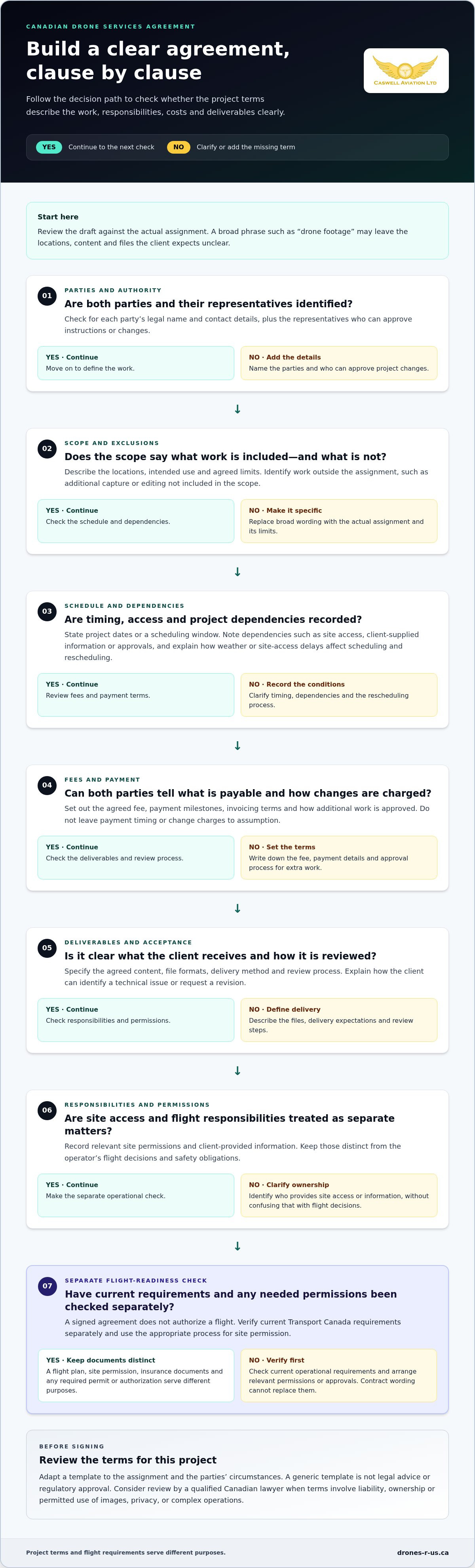
A template is useful only after it reflects the actual assignment. Work through the agreement in order, then compare it with the project plan and current operating requirements. For an aerial imagery job, replace broad language such as “provide drone footage” with a description the client and operator can both use to confirm what was commissioned.
A practical five-step completion workflow
- Identify the parties. Enter each party’s legal name and contact details, and identify the people authorized to approve instructions or changes.
- Define the scope. Record the project purpose, locations, schedule or scheduling window, intended use and expected outputs. For example, specify whether the assignment calls for still images, video or both, plus the agreed file formats and delivery method.
- Allocate responsibilities. State who coordinates site access, supplies project information, obtains agreed permissions, communicates schedule changes and retains relevant documents.
- Review the terms. Check that payment, privacy, intellectual property, cancellation, termination and liability clauses fit the project. Have a qualified Canadian lawyer review wording with legal or financial consequences.
- Sign and retain. Make sure all parties approve the same final version. Keep the signed agreement with the project brief and related planning records, and document later amendments in writing.
A measurable deliverable might say that the provider will capture agreed aerial photographs of identified locations and deliver the selected files in specified formats through an agreed method. That is more useful than “all required work,” which doesn’t define what’s included or how completion will be assessed. A drone services agreement template Canada is a framework to adapt, not a substitute for project-specific detail or legal advice.
Red flags that deserve clarification
Pause before signing if key terms are broad, inconsistent or open to interpretation. “As needed” may create uncertainty about extra capture, while “client may use the images” doesn’t clearly explain permitted uses, ownership or licensing. Compare the scope, delivery, payment and cancellation clauses so one provision doesn’t undermine another.
- Replace “all required work” with defined tasks and a written approval process for changes.
- Clarify conflicting terms about who owns or may use imagery, when files are due, and what payment is tied to.
- Confirm that permission, access and schedule assumptions in the agreement match the project plan.
- Review pilot qualifications and operational context against current Transport Canada information, including its drone safety guidance. Contract language cannot authorize a flight or override applicable safety obligations.
For context on pilot preparation, drone training and flight reviews can help explain the role of qualifications in planning an operation. Before signing, compare the agreement, project plan and current requirements. If you’re planning aerial photography or video, discuss your aerial imagery project with Caswell Aviation Ltd.
Putting the agreement into practice for an aerial imagery project
A clear agreement works best alongside a useful project brief. Consider a client commissioning aerial photography or video to show a property or work site. The brief explains the communication goal and visual priorities; the agreement records the parties’ commitments, commercial terms and deliverables; flight-planning documents address operational preparation. Each document has a distinct job. Keeping them aligned helps prevent a creative request from being mistaken for flight authorization or an operational plan.
From project brief to documented deliverables
Start with the intended audience and purpose. Is the imagery for a public-facing presentation, an internal update or another use? Identify the locations, views or features that matter, then describe the expected outputs, such as still images, video or both. Record the agreed formats, delivery method and approval process. These details turn a broad request into a shared project reference without assuming every aerial assignment follows the same approach.
Make assumptions and exclusions visible. The brief might identify a particular area as the focus while noting that additional locations, extra capture or editing are outside the agreed scope unless approved. If the client requests a change, document it before work proceeds. A written change record can describe the revised output, any effect on timing or fees, and who approved the update. The agreement should explain how that approval is made.
A drone services agreement template Canada can help organize this information, but the completed documents should tell a consistent story. If the brief calls for video while the agreement lists still photographs only, resolve the mismatch before signing. Likewise, confirm that delivery expectations and use of the imagery agree across the relevant records.
Next steps for clients and drone service providers
Before the project begins, finalize and sign the agreement, then retain the signed version with the current brief and relevant approvals. Keep project communications and operational records organized so the parties can refer to the same instructions and decisions. If the scope changes, preserve the updated approval with the project file rather than relying on an informal conversation alone.
Remember the documents’ different purposes: the agreement records the business arrangement, the brief describes the desired content, and flight-planning documents support operational preparation. None should replace another or applicable aviation requirements. For contract language involving liability, privacy or rights to imagery, seek review from a qualified Canadian lawyer.
Caswell Aviation provides aerial photography and video tailored to client requirements. If you’re planning an aerial content project, discuss your aerial imagery project with the team.
Set your next project up for clear decisions
A signed agreement should support good project decisions, not sit untouched in a folder. Before work begins, make sure the final document reflects the current brief and that both parties understand how updates will be approved. If the project or operating conditions change, pause and document the adjustment before proceeding. For any clause that could affect liability, privacy or image rights, seek qualified Canadian legal review.
A drone services agreement template Canada gives you a practical place to start, but the real value comes from tailoring it to the assignment. Clear expectations make it easier to focus on the intended outcome and keep the working relationship professional. Caswell Aviation provides aerial photography and video tailored to client requirements, alongside professional drone training and flight reviews.
Planning an aerial content project? Discuss your aerial imagery project with Caswell Aviation and take the next step with a clear project brief.
Frequently Asked Questions
Is a drone services agreement legally required in Canada?
There isn’t a general requirement for every commercial drone project to use a written service agreement. However, written terms help document what the client and provider have agreed to, including responsibilities if plans change. The agreement is separate from aviation compliance, which still applies whether or not a contract is signed. For legal advice about enforceability or a particular project, consult a qualified Canadian lawyer.
What should a drone services agreement include?
Include the parties’ legal names, a description of the project, schedule, deliverables, payment terms and a process for approving changes. Identify who will coordinate access and communication, and address image rights, confidentiality, cancellation and termination where relevant. For example, specify whether the client expects original files, edited content or both. Detail helps prevent different interpretations of what completion means.
Can I use a generic drone services agreement template in Canada?
A generic form can provide a starting structure, but it may not fit your project or legal circumstances. Adapt a drone services agreement template Canada to the actual work, applicable provincial or territorial considerations, privacy needs and intended use of the imagery. Don’t assume downloaded wording is current or complete. Have a qualified Canadian lawyer review terms that affect liability, intellectual property or privacy before signing.
Does a signed drone services agreement authorize a flight?
No. A signed agreement records a commercial arrangement, but it doesn’t grant aviation authorization or make a flight permissible. The operator must assess the proposed operation against current Transport Canada requirements and applicable conditions. For instance, the client’s approval to capture images at a site doesn’t by itself establish that the planned flight can proceed. Confirm operational requirements separately before the work is scheduled.
Who is responsible for obtaining site permission for drone work?
The agreement should assign responsibility for arranging access and any project-specific permissions, rather than leave the task implied. Identify the person responsible, what approval or evidence is needed, and when it must be available. Site access and aviation authorization are distinct matters. A client’s permission to enter or work at a location doesn’t automatically resolve every approval relevant to the flight.
Should a drone services agreement address ownership of photos and video?
Yes. State clearly whether the client receives ownership or a licence, and define permitted uses. For example, clarify whether the client may publish images on its website, share them with partners, edit them or use them in advertising. Address original and edited files separately if their treatment differs. Include any credit, duration or usage limits the parties agree to, and seek legal review if rights are important to the project.
Does a drone services agreement replace insurance?
No. A contract doesn’t create an insurance policy or guarantee that a loss will be covered. If the parties have agreed to insurance-related responsibilities, record them clearly and keep applicable policy information separate from the service agreement. The wording should reflect the actual arrangement, not assume coverage or promise compensation. Have a qualified Canadian lawyer review insurance and liability terms that could affect either party.
Leave a comment