

Transport Canada Advanced Drone Exam Study Guide: 2026 Professional Edition
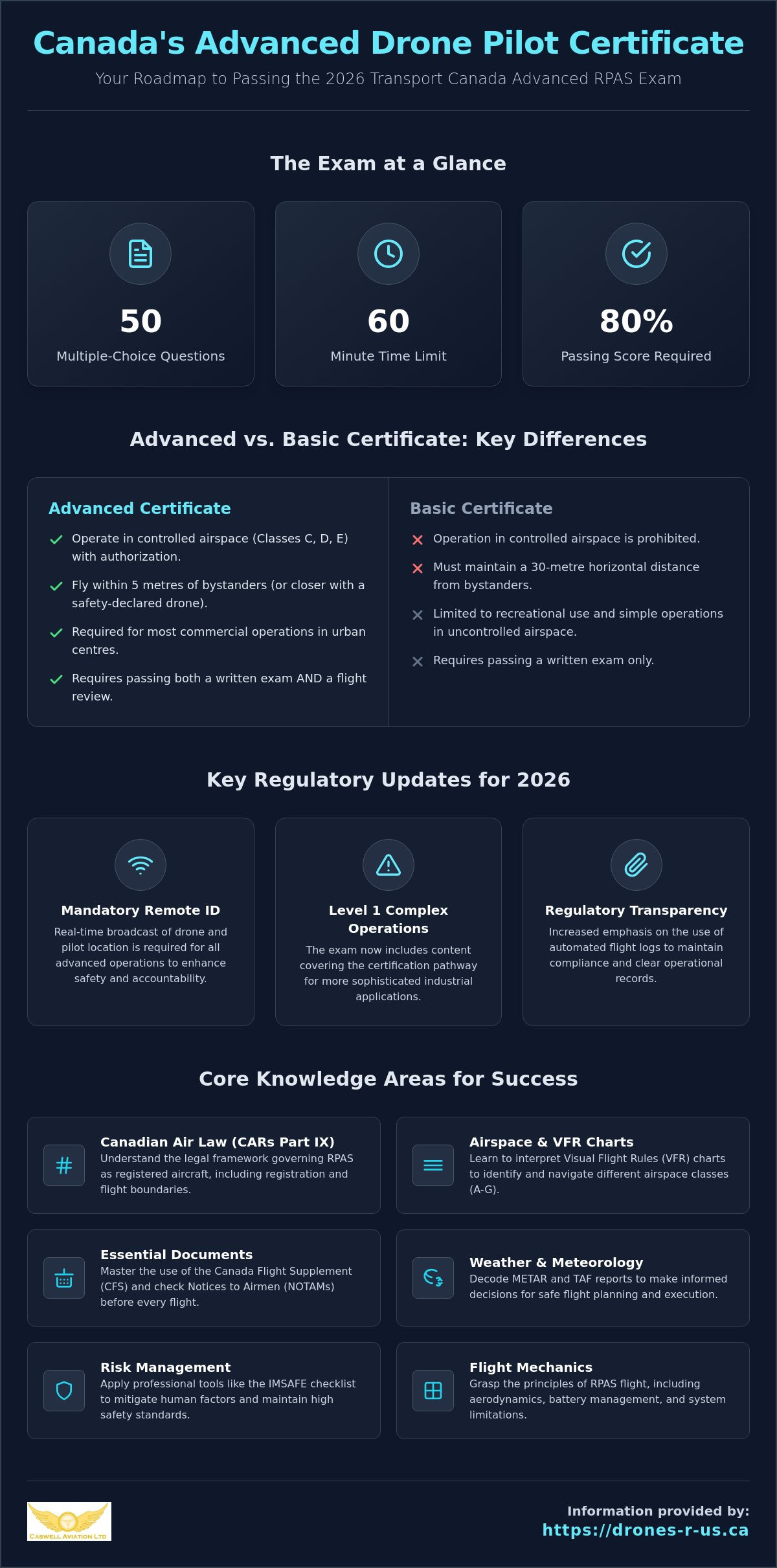
Achieving your Advanced Pilot Certificate is less about flying a drone and more about assuming the responsibilities of a registered aircraft commander within the national airspace. Finding a reliable Transport Canada advanced drone exam study guide is the first step toward managing the transition from casual operator to certified professional. Many candidates feel a natural anxiety when facing the 80% passing threshold, especially with a 60-minute timer ticking down against 50 technical questions. It's easy to feel overwhelmed by the sheer volume of the Aeronautical Information Manual or the intricate nuances of airspace classifications.
We recognize that your goal is more than just a passing grade; it's the professional competence required for safe, complex operations. This guide provides a structured roadmap to help you master the 2026 regulatory updates and the specific knowledge requirements needed to pass your exam with confidence. You'll gain a clear understanding of the latest standards, ensuring you're fully prepared for both the online challenge and the subsequent flight review. By treating your RPAS as a serious aviation tool, you ensure your place in Canada's rapidly growing drone industry.
Key Takeaways
- Understand the specific exam parameters and technical requirements, including the 80% passing threshold and the 60-minute time limit for 50 questions.
- Learn to navigate the nuances of Canadian airspace classifications and the regulatory framework established under the Canadian Aviation Regulations (CARs) Part IX.
- Use this Transport Canada advanced drone exam study guide to master essential weather interpretation skills, such as decoding METAR and TAF reports for safe flight planning.
- Apply professional risk management tools like the IMSAFE checklist to mitigate human factors and maintain high safety standards during complex missions.
- Develop an efficient study routine and organized reference system to confidently transition from the online exam to your professional flight review.
Understanding the 2026 Transport Canada Advanced RPAS Exam Requirements
The Advanced Small Remotely Piloted Aircraft System (RPAS) exam serves as the professional threshold for operators seeking to fly in controlled airspace. Success depends on achieving an 80% score on 50 multiple-choice questions within a strict 60-minute time limit. This high standard ensures that every pilot operating near airports or over bystanders possesses the discipline of a traditional aviator. The current exam fee is $10.17, which grants you access to the test through the Transport Canada Drone Management Portal.
Many candidates find that casual self-study often fails to provide the necessary depth for this specific exam. A comprehensive Transport Canada advanced drone exam study guide must bridge the gap between simple rules and complex operational reality. The 2026 version of the exam emphasizes new technical standards, including Remote ID compliance and the use of automated flight logs to maintain regulatory transparency. Understanding the broader Overview of Unmanned Aerial Vehicles helps candidates grasp how these systems integrate into the national airspace and the technical history behind current regulations.
Advanced vs. Basic: The Regulatory Shift
The primary distinction between the two certificates lies in your operational privileges. An Advanced certificate allows you to request access to Class C, D, and E controlled airspace, which is essential for most commercial work in urban centres. It also changes your proximity limits. While Basic pilots must maintain a 30-metre horizontal distance from bystanders, Advanced pilots can operate within 5 metres; or even closer if using a drone with the appropriate safety declaration. Passing the written exam is only the first step; you must also successfully complete a flight review with a qualified evaluator to finalize your certification.
New for 2026: Remote ID and Complex Operations
The 2026 regulatory landscape introduces mandatory Remote ID broadcast requirements for all advanced operations. This technology allows for real-time identification of the drone and its pilot's location, enhancing safety and accountability. Additionally, the exam now covers the Level 1 Complex certification pathway, which is designed for more sophisticated industrial applications. Caswell Aviation Ltd has updated its training modules to reflect these changes, ensuring our students are prepared for the modern technical demands of the industry. We prioritize precision and compliance, helping you move beyond the exam and into professional flight operations.
Mastering Canadian Air Law and Airspace Classifications
The legal foundation for every professional pilot in Canada is the Canadian Aviation Regulations (CARs) Part IX. This regulatory framework governs everything from registration to flight boundaries. When using a Transport Canada advanced drone exam study guide, you must move beyond memorizing rules to understanding their practical application. The law treats your RPAS as a registered aircraft, meaning compliance is not optional. You are legally responsible for ensuring your flight does not interfere with traditional aviation or violate the privacy and safety of people on the ground.
A thorough Transport Canada advanced drone exam study guide must explain how to interpret Visual Flight Rules (VFR) navigation charts. These charts allow you to distinguish between Class A high-altitude airspace and Class G uncontrolled areas. For detailed procedures on requesting access to these zones, refer to NAV CANADA Airspace and Flight Planning resources. Understanding these boundaries is a primary requirement for the exam. You must also learn to navigate the Canada Flight Supplement (CFS). This document provides essential data on aerodromes, including frequencies and runway patterns. Finally, you must check Notices to Airmen (NOTAMs) before every flight. These notices provide time-sensitive information about temporary flight restrictions or hazards that could impact your mission.
Navigating Controlled Airspace (Classes C, D, and E)
Operating in Classes C, D, and E requires explicit authorization from NAV CANADA. You must understand the communication protocols for each class, as some require two-way radio contact while others allow for digital coordination. Tools like RPAS Wilco help streamline this process, but the pilot remains responsible for the final authorization. It's also vital to distinguish between "controlled" airspace and "restricted" or "prohibited" zones, often categorized as Class F. While you can request access to controlled areas, restricted zones are typically off-limits due to military activity or high-security operations.
Understanding CARs Part IX Compliance
Maintaining your certificate requires adhering to recency requirements. You must complete a recurrent training activity every 24 months to keep your advanced privileges valid. This discipline extends to your record-keeping. You are mandated to maintain detailed logs for both your aircraft maintenance and your individual flight hours. If an incident occurs, such as a fly-away or a collision, you are legally required to notify Transport Canada immediately. If you find the technical language of the CARs difficult to digest, our Online Drone Courses provide a simplified breakdown of these complex regulations to help you stay compliant.
Weather, Meteorology, and Flight Mechanics for Professional Pilots
Professional drone operations require a firm grasp of meteorology and aerodynamics. While the Basic exam touches on these topics, the Advanced version demands precise interpretation of aviation weather products. A reliable Transport Canada advanced drone exam study guide provides the tools to decode METAR and TAF reports under the pressure of the 60-minute time limit. These reports communicate wind speed, visibility, and sky conditions using standardized codes that every professional pilot must recognize instantly.
Understanding the atmosphere is also about recognizing hazards like wind shear and microbursts. These sudden changes in wind direction and speed can easily overwhelm a small RPAS, leading to a loss of control. Similarly, density altitude plays a critical role in your drone's performance. High temperatures and high humidity reduce air density, which means your propellers produce less lift. Your drone will perform differently on a hot July afternoon in Ontario compared to a crisp January morning in Alberta. Pilots must realize that as air density decreases, the aircraft must work harder to maintain the same level of performance.
Aerodynamics for multi-rotor systems revolve around the balance of four forces: lift, weight, thrust, and drag. When these forces are in equilibrium, the aircraft maintains steady flight. Any change, such as adding a heavy payload, shifts this balance and affects your power consumption and stability. Mastery of these principles ensures you can predict how your aircraft will behave in various environmental conditions.
Aviation Weather Reports and Forecasts
Decoding METAR strings is a core skill for the exam. You must identify the station identifier, date/time, wind direction in degrees true, and visibility in statute miles. For example, a "04015G25KT" string indicates wind from 040 degrees at 15 knots, gusting to 25. Cold weather operations bring additional risks, particularly icing and reduced LiPo battery efficiency. Using a Graphical Area Forecast (GFA) allows you to plan for regional weather trends, such as approaching fronts or low-pressure systems, before you even arrive at the site.
RPAS Flight Mechanics and Safety
Maintaining the correct centre of gravity (CG) is essential when attaching specialized sensors or cameras. If the CG is outside the manufacturer's limits, the flight controller may struggle to maintain level flight, leading to motor burnout. You must also understand Vortex Ring State (VRS). This condition occurs during a steep, vertical descent where the drone sinks into its own downwash. Recognizing the "power settle" and moving horizontally to find clean air is a vital recovery technique. Always consult your aircraft's Flight Manual to determine the specific operational limits for wind resistance and maximum takeoff weight. If you need hands-on guidance for these maneuvers, our In-Person Training sessions provide practical experience with complex flight mechanics.
Human Factors and Operational Risk Management
Professional aviation recognizes that the human element is often the most complex variable in any flight operation. A comprehensive Transport Canada advanced drone exam study guide must emphasize the IMSAFE checklist as a foundational tool for self-assessment. This acronym stands for Illness, Medication, Stress, Alcohol, Fatigue, and Emotion. Before every mission, advanced pilots must honestly evaluate these six factors to ensure they are fit for duty. Operating a high-performance RPAS requires total cognitive focus, and any impairment in these areas significantly increases the risk of an incident.
Visual illusions and spatial disorientation are critical topics for the Advanced exam, particularly during night flights or complex operations. Pilots may experience the "autokinetic effect," where a stationary light appears to move, or "false horizons" caused by sloping terrain or city lights. These illusions can lead to incorrect control inputs. Effective Crew Resource Management (CRM) helps mitigate these risks by utilizing Visual Observers (VOs). A VO provides a second set of eyes to maintain a clear line of sight and monitor for conflicting traffic, allowing the pilot to focus on the telemetry and flight path.
Managing Pilot Fatigue and Ergonomics
Commercial drone operations often involve long durations in the field, which can lead to significant physical and mental exhaustion. Fatigue reduces reaction times and impairs decision-making capabilities. Maintaining a professional ergonomic setup is essential for sustaining situational awareness over several hours. Using a Fitek Gear drone harness improves control precision by stabilizing the smart controller and reducing the neck strain associated with traditional neck straps. This simple adjustment allows you to remain comfortable and focused, ensuring that physical discomfort does not distract you from critical flight data.
Emergency Procedures and Risk Mitigation
Every professional mission must begin with a robust Pre-Flight Action Plan (PFAP). This plan outlines your site-specific risks and the steps required to mitigate them. You must clearly distinguish between a "Lost Link" event, where the drone follows its pre-programmed fail-safe, and a "Flyaway," which indicates a total loss of control. Your Transport Canada advanced drone exam study guide should detail the specific reporting requirements for these events. On-site safety is further reinforced by strict battery fire protocols. You must have appropriate safety equipment, such as a fire-resistant LiPo bag and a Class D fire extinguisher, readily available to manage thermal runaway events. If you are looking to formalize your safety protocols, we recommend reviewing our In-Person Training programs for hands-on emergency drill practice.
Final Exam Preparation and Booking Your Flight Review
Final preparation for the Advanced exam involves a shift from passive reading to active simulation. Utilizing practice exams is the most effective way to identify knowledge gaps before the official clock starts. A professional Transport Canada advanced drone exam study guide should emphasize an "Open Book" strategy. While you are permitted to reference materials during the test, the 60-minute time limit for 50 questions allows only about 70 seconds per response. You must organize your reference documents, such as the Aeronautical Information Manual (TC AIM) and CARs Part IX, with clear tabs or searchable digital indexes to ensure speed and accuracy.
Once you submit your exam, you'll receive your "Passed" status immediately within the Drone Management Portal. This result is the essential prerequisite for the practical stage of your certification. Passing the written test proves your theoretical grasp of the regulations, but the flight review confirms your ability to apply them in a real-world environment. Preparing for this transition with Caswell Aviation training ensures that your theoretical knowledge translates into the high-level discipline required for professional flight operations.
A 7-Day Advanced Exam Study Schedule
A structured approach prevents the feeling of being overwhelmed by the breadth of the material. We recommend a modular 7-day schedule to ensure comprehensive coverage:
- Day 1-3: Air Law and Airspace: Focus on these sections first, as they are the most heavily weighted. Master the differences between Class C, D, and E airspace and the specific requirements of CARs Part IX.
- Day 4-5: Meteorology and Flight Mechanics: Practice decoding METAR and TAF strings. Review how density altitude and centre of gravity impact your specific aircraft's performance.
- Day 6-7: Human Factors and Practice Exams: Review the IMSAFE checklist and spatial disorientation. Spend the final 48 hours taking timed practice exams to build your testing stamina and refine your "Open Book" navigation speed.
Transitioning to the Advanced Flight Review
The flight review is the final hurdle for your Advanced certificate. It is a practical evaluation where a qualified reviewer observes your ability to conduct a safe mission from start to finish. Your reviewer will expect to see professional documentation, including your site-specific Standard Operating Procedures (SOPs), maintenance logs, and a completed Pre-Flight Action Plan. They are looking for a pilot who treats the drone as a serious aircraft. When you are ready to demonstrate your skills, booking your Advanced & Level 1 Complex Flight Review with a veteran mentor ensures you receive a fair, thorough, and professional assessment of your capabilities.
Advancing Your Professional Aviation Career
Transitioning from a basic operator to an advanced pilot requires a commitment to aviation discipline and technical precision. Success requires more than simple memorization. It depends on your ability to navigate complex airspace classifications and interpret critical weather data under pressure. This Transport Canada advanced drone exam study guide provides the foundational framework, but achieving true operational excellence often requires mentorship from seasoned professionals. Your focus must remain on safety and regulatory compliance at all times.
Caswell Aviation supports your journey with veteran-led online and in-person instruction tailored to modern industry standards. We're here to help you navigate the latest regulatory updates and prepare for the technical rigour of your flight review. We offer professional flight reviews for both Advanced and Level 1 Complex certifications and provide ergonomic Fitek Gear harnesses to manage pilot fatigue. Master the Advanced Exam with Caswell Aviation Training and take the final step toward your professional certification. We look forward to seeing you in the controlled airspace.
Frequently Asked Questions
What is the passing grade for the Transport Canada Advanced drone exam?
The passing grade is 80%. You must correctly answer at least 40 out of the 50 multiple-choice questions to succeed. Because the threshold is significantly higher than the Basic exam, using a structured Transport Canada advanced drone exam study guide is essential to ensure you are prepared for the technical depth of the questions.
How much does it cost to take the Advanced RPAS exam in 2026?
The fee to take the online Small Advanced Exam is $10.17 per attempt. This fee is paid directly through the Transport Canada Drone Management Portal. After passing the exam and your subsequent flight review, there is an additional fee of $25.43 to have your official Pilot Certificate – Advanced Operations issued.
Can I retake the Advanced drone exam if I fail?
Yes, you can retake the exam if you don't achieve the 80% passing score. However, you must wait 24 hours before making another attempt. Each attempt requires a new $10.17 fee. If you fail multiple times, we recommend reviewing your knowledge gaps thoroughly rather than rushing into another attempt.
Is the Advanced drone exam open-book?
Transport Canada allows the exam to be open-book, but the 60-minute time limit makes it difficult to look up every answer. You have approximately 72 seconds per question. Success depends on knowing where to find information quickly in the TC AIM or your Transport Canada advanced drone exam study guide rather than learning the material during the test.
Do I need a flight school to pass the Advanced RPAS exam?
You aren't legally required to attend a flight school to take the written exam, but self-study often proves insufficient for the 80% threshold. Professional training provides the aviation-based curriculum needed to understand complex topics like meteorology and air law. Most candidates find that structured courses significantly increase their chances of passing on the first attempt.
How long is the Transport Canada Advanced drone certificate valid for?
The Pilot Certificate – Advanced Operations does not have an expiry date. However, you must meet a recency requirement every 24 months to keep your certificate valid. This involves completing a recurrent training activity, such as a self-paced study program or a professional seminar, to ensure your knowledge remains current with evolving regulations.
What is a Level 1 Complex drone certification?
Level 1 Complex certification is a specialized designation for advanced operations involving more sophisticated aircraft and mission profiles. It often relates to specific safety declarations for flying over people or in challenging environments. Caswell Aviation Ltd provides specialized flight reviews for those seeking this higher tier of professional certification and operational capability.
Do I need a radio licence (ROC-A) for the Advanced exam?
You don't need a Restricted Operator Certificate-Aeronautical (ROC-A) to take the exam itself. However, you will need this licence to legally operate a radiotelephone in controlled airspace. Since most advanced operations involve coordination with Air Traffic Control, obtaining your ROC-A is a practical necessity for professional pilots working in urban environments.
Leave a comment