

Privacy concerns with drone photography in Canada and your rights
A drone photograph may contain personal information if it identifies someone through their face, name or licence plate. In Canada, privacy concerns with drone photography are governed by laws such as PIPEDA and substantially similar provincial legislation. Which rules apply depends on the organization and activity. The Office of the Privacy Commissioner of Canada says valid consent means people understand why their information is collected, used or disclosed, and the possible consequences.
A camera pointed into a private space warrants more scrutiny than a wide aerial view that does not identify anyone. Consider what the drone records, why the information is needed, who can access it and whether it will be shared.
This guide explains what may count as personal information, how privacy expectations apply to recreational and commercial flights, and how to request access to information or make a complaint. It also covers how provincial differences can affect the rules, helping you understand your rights and the practical steps available if a drone captures you or your property.
Key Takeaways
- Learn when a person or vehicle may be identifiable in drone footage, and why that matters for privacy.
- Understand how consent depends on the information collected, people’s expectations and the potential risk of harm.
- See how privacy-conscious flight and recording practices can reduce unnecessary collection and exposure.
- Find out how provincial privacy laws may affect your rights, including access to information and complaint options.
- Recognize when recording or sharing footage could intrude on someone’s private life, even if the flight itself seems routine.
What constitutes “personal information”?
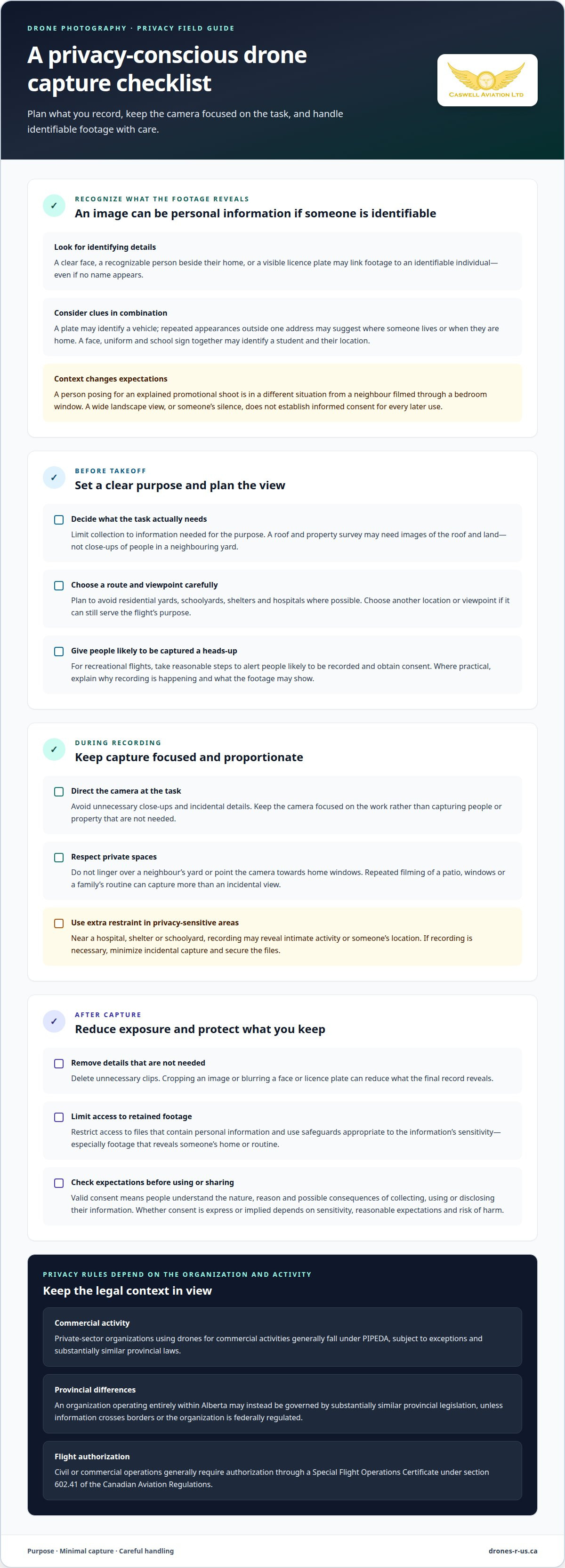
A drone image may contain personal information if it identifies someone, even without recording their name. A clear face, a recognizable person beside their home or a visible licence plate can link an image to an identifiable individual. Whether a photo is personal information depends on what it reveals and whether someone could reasonably identify the person.
Can drone photos of identifiable people be posted or shared without their consent in Canada? Not automatically. The answer depends on the purpose, context, applicable privacy law and whether the person’s information is disclosed in a way they could reasonably expect. Under PIPEDA, valid consent requires people to understand the nature, reason and consequences of collecting, using or disclosing their personal information, according to the Office of the Privacy Commissioner of Canada.
Consent may be express or implied. The appropriate form depends on the information’s sensitivity, the person’s reasonable expectations and the risk of harm. Someone posing for a clearly explained promotional shoot may understand that their image will be published. A neighbour photographed through a bedroom window has very different expectations. Silence or simply appearing in a wide landscape shot does not, by itself, establish informed consent for every later use.
Purpose matters both when information is collected and when it is shared. PIPEDA requires organizations to limit collection to personal information needed to provide their goods or services. A property survey may need images of a roof and land, for instance, but not close-ups of people in a neighbouring yard. Cropping images, avoiding unnecessary shots or blurring a face or licence plate can reduce what the final record reveals. The same principle applies to retaining footage: recording more than the task requires creates additional information to protect and manage.
Images can also reveal personal details when combined. A licence plate may identify a vehicle, while the vehicle’s repeated presence outside one address can suggest where someone lives or when they are home. A face, uniform and school sign in one frame may identify a student and their location. Information can become personal through these connections, even when no single image includes a name.
Private-sector organizations using drones for commercial activities generally fall under PIPEDA, subject to exceptions and substantially similar provincial laws. Recreational operators should also take reasonable steps to alert people likely to be captured and obtain consent. A neighbour’s personal drone does not make persistent recording harmless: repeated filming of a patio, windows or a family’s routine may capture more than an incidental view. Keep the camera focused on the task, explain the purpose before recording where practical, and avoid collecting identifiable details that are not needed.
Drones are on the rise: What are the privacy concerns?
Privacy duties apply before a recreational or commercial flight, not just after footage is shared. Operators should consider what they will record, where they will fly and how they will protect saved material.
Recreational Drone Privacy Practices
For recreational operators, good privacy practice includes taking reasonable steps to alert people likely to be captured and obtain their consent. A flight over a public field may still record identifiable people nearby, so consider the camera’s purpose and view. Avoid lingering over a neighbour’s yard or pointing the camera towards home windows. A brief notice can explain why recording is taking place and what the footage may show.
Privacy Best Practices for Operators
Good privacy practice means limiting recording to what a legitimate task requires and protecting footage that contains personal information. Before takeoff, operators can plan a route that avoids residential yards, schoolyards, shelters and hospitals. After capture, delete unnecessary clips, blur identifiable faces or licence plates, and restrict access to retained files. PIPEDA requires safeguards appropriate to the sensitivity of personal information, including footage that reveals someone’s home or routine.
Commercial Operations and PIPEDA
Commercial organizations must consider privacy obligations when collecting, using or disclosing identifiable footage. PIPEDA generally governs private-sector commercial activity, subject to exceptions; an organization operating entirely within Alberta may instead be governed by substantially similar provincial legislation, unless information crosses borders or it is federally regulated. The purpose should be clear, and collection should be limited to what the service needs. Civil or commercial operations generally require authorization through a Special Flight Operations Certificate under section 602.41 of the Canadian Aviation Regulations.
Privacy-Sensitive Operating Areas
Privacy-sensitive areas call for greater restraint because a camera can reveal intimate activity or someone’s location. A drone near a hospital, shelter or schoolyard may capture people with strong reasons to avoid public identification. Choose another location or viewpoint if it can serve the flight’s purpose. If recording is necessary, keep the camera directed at the task, minimize incidental capture and secure the resulting files.
These steps reduce unnecessary collection, but they also help operators explain why a recording was made and how it will be handled. Practical drone operator training can support sound decisions about flight planning and camera use alongside privacy considerations.
Individual access and complaints
If a drone captures you, first identify who operated it and who holds the recording. A private business, federal institution and neighbour may be subject to different privacy rules. That distinction helps determine where to direct an access request or complaint. Note the location, approximate date, drone markings and what the camera appeared to record.
For a commercial recording, write to the organization that operated the drone. Describe the image or video you are seeking, when and where it was captured, and how it relates to you. Ask whether the organization holds footage that identifies you, how it uses that footage and whether it has disclosed it. Keep a copy of your request and any reply. These details can help clarify whether the organization recorded the event you mean and whether the material is still available.
Federal institutions are subject to the federal Privacy Act, including parent Crown corporations and their wholly owned subsidiaries. The Act permits collection when personal information relates directly to an institution’s programs or activities and the person is told the reason. If a federal body used cameras near a public facility, identify the institution and the program involved in your request. Do not assume a municipal or provincial agency follows the same federal rules.
Quebec’s surveillance-camera rules recognize access and correction rights for people captured by recordings. A person who appears in footage can ask the organization responsible for the camera about access or correction. If a recorded image was posted online, note where it appeared and when you saw it. In Quebec, posting a picture online is considered publication, and recorded information should not be posted without consent unless it is of public interest.
If the response does not address your concern, organize the record before escalating it. A concise complaint should explain what was captured, the organization’s response and the outcome you are seeking. Include dates, copies of messages and any relevant image. The appropriate privacy oversight office depends on whether the organization is federal, provincial or private-sector, and on the province involved. This helps distinguish a business’s handling of footage from a dispute with a neighbour.
- British Columbia: An individual has a right to sue for invasion of privacy under the province’s Privacy Act.
- Alberta: Denman v. Jamieson, 2006 ABQB CarswellAlta 354, is cited in discussions of privacy claims between individuals.
These routes address different issues. An access request concerns footage held by an organization; a civil claim concerns an alleged invasion of privacy by another person. Identify which situation applies before deciding what information to gather next.
PIPEDA and substantially similar provincial privacy legislation
For private-sector organizations, the applicable privacy law depends on where they operate and how information moves. PIPEDA governs commercial activities across Canada, while substantially similar provincial legislation applies in British Columbia, Alberta and Quebec. These laws address how organizations collect, use and disclose personal information. For a drone company operating only within Alberta, provincial law generally applies instead of PIPEDA. Cross-border information handling or federal regulation can change that result.
This distinction matters when a drone records someone during a commercial flight. An organization operating within one province must identify the law governing its handling of the footage. If the recording is transferred across provincial or national borders, PIPEDA may apply to that information flow. The organization’s location, regulatory status and handling of the recording all affect which privacy rules apply. A local flight alone does not settle the question.
Organizations subject to PIPEDA must comply with 10 principles. They cover accountability, identifying purposes, consent, limiting collection, limiting use, disclosure and retention, accuracy, safeguards, openness, individual access, and challenging compliance. In practice, a drone operator should be able to explain why a flight records identifiable people, collect only footage needed for that purpose and protect retained files. A roof inspection, for example, should not become an unrelated record of neighbours’ activities.
PIPEDA has exceptions. It does not apply to collecting, using or disclosing personal information for journalistic, artistic, literary or academic purposes. The application of PIPEDA can depend on an organization’s purpose and circumstances. These exceptions concern the purpose or type of organization, not simply whether a drone is flying. A paid commercial photography assignment and an artistic project may therefore require different legal analysis, even if both capture similar aerial views.
Quebec has specific considerations for recorded images. Posting a picture online counts as publishing information; recorded information should not be posted without consent unless it is of public interest. Quebec’s surveillance-camera guidelines also recommend considering less privacy-invasive alternatives, notifying targeted people through an appropriate notice, and avoiding views into windows, showers, bathrooms or dressing rooms. They recommend limiting use to necessary times and occasions, retaining only needed information, and keeping continuously recorded material for a limited period.
If you are concerned about footage, first identify the operator’s province and whether the recording was part of commercial activity. Then consider whether information crossed borders or the organization is federally regulated. These details help distinguish PIPEDA from provincial legislation and clarify which framework may govern an access request or complaint.
Privacy expectations and drone photography
Privacy expectations depend on what a drone records, where it flies and how footage is used. Being in a public place does not automatically remove a person’s privacy rights.
Consent for Photographing People and Property
There is no blanket rule requiring consent for every drone photograph of a person or private property. However, collecting identifiable information, observing private activities or publishing someone’s image can raise legal concerns, depending on the circumstances. Consent matters because a person may reasonably expect to appear in a passing wide-angle image, but not in repeated recordings of their home, yard or private routine.
For commercial activity, applicable privacy law may require meaningful consent to collect, use or disclose personal information. Before recording or sharing, a drone operator should consider the image’s purpose, sensitivity and potential effects. In British Columbia, using someone’s portrait or image commercially without consent is a tort. In Quebec, observing someone’s private life or using their image beyond legitimate public information can invade privacy.
Rules for Public-Property Photography
Public-property photography means capturing images from or of a place accessible to the public, but the setting alone does not determine whether recording is appropriate. A person in a park may be visible to passersby, while a drone’s close view into a home can expose private activity. The camera’s angle, the subject’s reasonable expectations and the later use of the footage all matter.
Canadian privacy laws apply to commercial and recreational drone operators. A public viewpoint does not authorize every use of identifiable footage. For example, sharing a close-up of someone leaving a medical facility may reveal sensitive context, even if the entrance is visible from a public area. In Quebec, posting a recorded picture online is publication; consent is generally needed unless the image is of public interest.
Penalties for Privacy Violations
There is no single national penalty for every privacy concern involving drone photography. Consequences depend on the conduct and applicable law. Voyeurism, mischief, creating a nuisance or violating provincial or municipal laws may lead to charges. A civil privacy claim may also arise when someone intentionally or recklessly intrudes on private affairs without lawful justification, in a way that would highly offend a reasonable person.
Publishing private facts without consent may also support a claim if the disclosure would be highly offensive and lacks legitimate public concern. British Columbia recognizes a right to sue for invasion of privacy, while Quebec’s Civil Code addresses observing private life and misusing someone’s image. No Canadian court cases alleging that a drone operator committed the privacy torts discussed here have been reported, but appropriate conduct remains important.
To reduce risk, operators can avoid privacy-sensitive views, limit footage to a legitimate purpose and avoid sharing identifiable images without appropriate consent. Review responsible drone flight planning before recording people or private spaces.
Caswell Aviation: Drone Aerial Photography and Video
Caswell Aviation Ltd provides drone aerial photography and video for projects that need an aerial perspective. The service can suit assignments where you need aerial imagery and have considered the people, properties and locations that may appear in the frame.
Before a shoot, define the project’s purpose and the images it requires. That helps keep the requested footage focused and supports thoughtful decisions about privacy-sensitive areas and identifiable details. For operators building their knowledge, Caswell Aviation Ltd also offers online drone courses and in-person training, along with Advanced and Level 1 Complex Flight Reviews.
For aerial imagery or training related to your drone needs, contact Caswell Aviation Ltd.
Make privacy part of the flight plan
Privacy planning works best before a drone takes off. Treat it as a project requirement alongside the images, locations and viewpoints the assignment needs. This clarifies the intended scope and helps keep incidental footage out of the final deliverable. For projects raising privacy concerns with drone photography in Canada, identify the images you need and the areas the camera should avoid.
Planning can also guide conversations with people who may appear in the footage. Explain the project’s purpose and intended use in plain language, then adjust the shot plan if a view would unnecessarily capture private activity. Addressing privacy concerns with drone photography in Canada starts with a clear plan that gives everyone involved a practical basis for decisions before recording begins.
For an aerial imagery project, Caswell Aviation Ltd can discuss how its drone photography and video offering fits your needs. Contact Caswell Aviation Ltd about drone privacy to take the next step with a focused plan.
Frequently Asked Questions
What are the Current Rules in Canada Governing Drones?
Canadian drone flights must follow federal aviation legislation, including the Aeronautics Act and the Canadian Aviation Regulations. Privacy obligations can apply alongside flight rules, so a permitted flight does not automatically permit every recording or disclosure. Before flying, identify whether the operation is recreational, commercial or otherwise covered by specific authorization requirements. For example, civil or commercial operations generally require a Special Flight Operations Certificate under section 602.41 of the Canadian Aviation Regulations.
What Canadian privacy laws apply to drone photography?
Several Canadian privacy laws may govern drone photography, depending on who records the footage and why. PIPEDA generally applies to private-sector organizations handling personal information during commercial activities. British Columbia, Alberta and Quebec have substantially similar private-sector privacy legislation for activities within their jurisdictions. The federal Privacy Act applies to federal institutions. Footage recorded by a business, federal agency or neighbour can therefore raise different legal questions.
Does PIPEDA apply to drone photos taken by individuals or businesses in Canada?
PIPEDA generally applies when a private-sector organization collects, uses or discloses personal information during commercial activity. It does not automatically govern every image taken by an individual. Exceptions include certain journalistic, artistic, literary or academic purposes, as well as not-for-profit organizations and charities. A company filming commercial property may therefore face different privacy obligations from an individual making a personal recording. The organization’s location and information flows also matter.
What are the federal drone flight rules for filming people in Canada?
Federal aviation rules govern how drones may operate, while privacy laws address personal information captured during a flight. Civil or commercial operations generally require authorization through a Special Flight Operations Certificate under section 602.41 of the Canadian Aviation Regulations. That certificate concerns flight authorization, not blanket permission to film people. Operators should consider privacy before recording identifiable individuals, especially when footage may be retained, used commercially or shared.
How do provincial and territorial privacy laws differ for drone photography in Canada?
British Columbia, Alberta and Quebec have substantially similar private-sector privacy legislation for relevant commercial activities within each province. PIPEDA may apply when information crosses provincial or national borders, or when an organization is federally regulated. Other provincial and territorial situations can involve different rules and oversight routes. Quebec also treats posting a picture online as publication, with consent generally needed unless the image is of public interest. The province and context help determine which framework applies.
How can someone report or respond to unwanted drone photography in Canada?
Start by documenting what happened: record the date, location, visible drone details, and any repeated flights or apparent filming. If you can identify the operator or organization, make a clear written request describing the footage and your concern. Keep the response and supporting records. The appropriate privacy oversight body for an organization’s handling of personal information depends on its jurisdiction. A dispute involving a neighbour may instead raise a provincial civil privacy issue.
What privacy precautions should Canadian drone photographers take before filming?
Before flying, define the images needed and choose a viewpoint that avoids unnecessarily capturing private activity. Consider whether people, homes, faces or licence plates could be identified in the footage. Where practical, tell people likely to be recorded about the purpose and seek appropriate consent. Limit recordings to the task, restrict access to saved files, and blur identifying details when they are not needed. For example, a property overview can often exclude a neighbour’s yard.
Leave a comment