
Online Drone Course Canada: The Professional Path to Certification in 2026
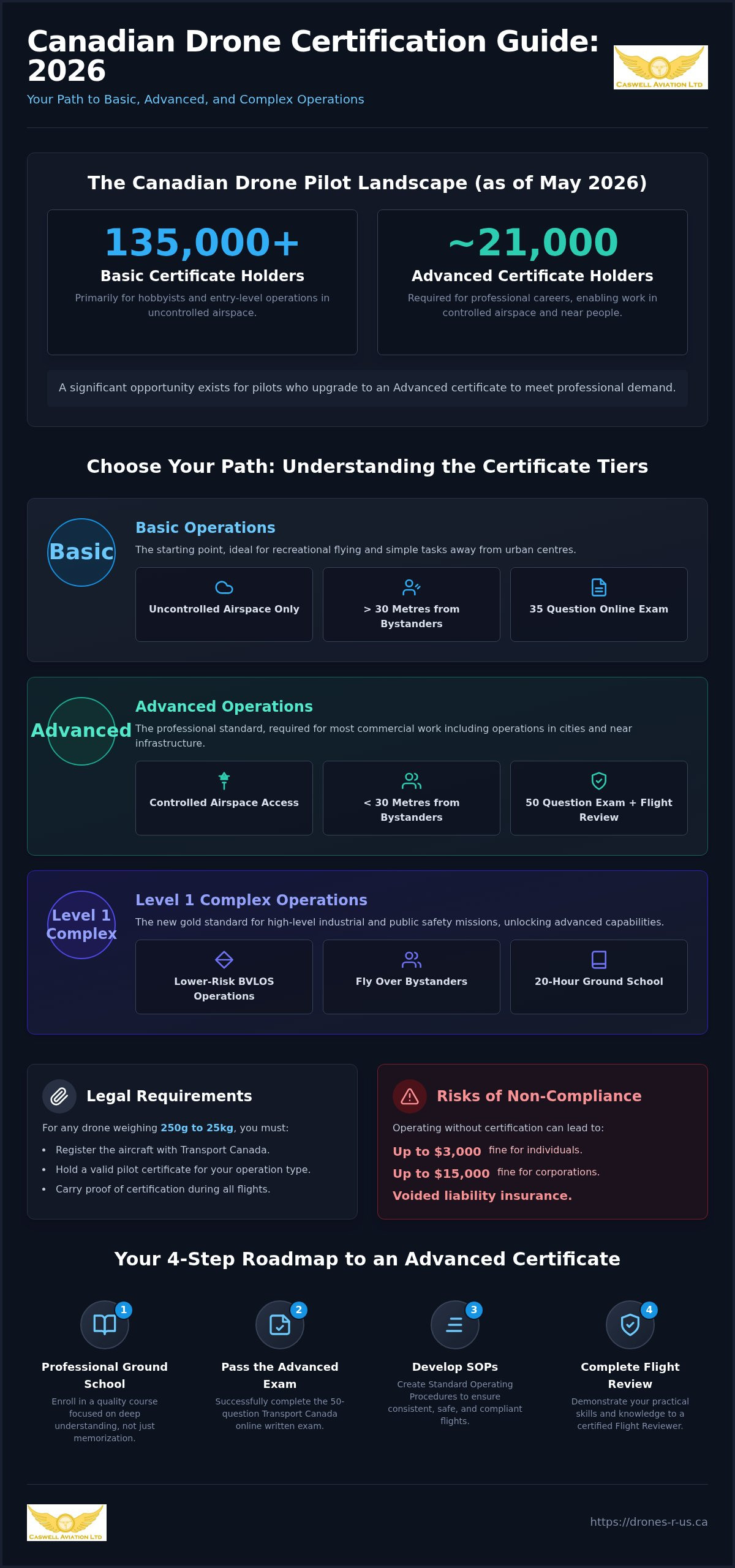
With over 135,000 Basic pilots in Canada but only approximately 21,000 holding an Advanced certificate as of May 2026, the distinction between a hobbyist and a professional has never been more defined. By choosing a professional online drone course Canada offers, you can bridge this gap by turning regulatory confusion into operational confidence. You likely recognize that while a certificate is your legal floor, true airmanship is your ceiling; however, it's common to feel some anxiety regarding the Transport Canada written exam or the jump to Advanced operations.
Our curriculum is designed to replace that uncertainty with the technical authority required for commercial success. We promise to provide the tools you need to master current regulations and pass your Advanced exam on the first attempt. This article previews the essential path to certification in 2026, covering everything from flight review preparation to the specific requirements for the new Level 1 Complex operations.
Key Takeaways
- Understand the updated 2026 Transport Canada framework and why registration is required for all aircraft weighing 250 grams or more.
- Identify which certificate you'll need by comparing the privileges of Basic, Advanced, and Level 1 Complex operations.
- Learn how to select a high-quality online drone course Canada by focusing on professional ground school rather than simple exam memorization.
- Master the preparation process for the Small Advanced Exam and the subsequent flight review by developing robust Standard Operating Procedures.
- Explore how to turn your certificate into a career by building a toolkit that's focused on professional-grade results and safety.
Transport Canada Regulations: Why Every Pilot Needs a Certificate
Operating a Remotely Piloted Aircraft System (RPAS) in Canada is no longer a casual activity. If your drone weighs between 250 grams and 25 kilograms, federal law requires you to register the aircraft and hold a valid pilot certificate. As of 2026, Transport Canada has shifted its focus toward safety-critical operations, reflecting the increased density of our national airspace. This regulatory framework ensures that every pilot, whether flying for recreation or commercial profit, understands the risks associated with shared airspace.
Choosing an online drone course Canada provides is the most efficient way to navigate these requirements. It's not just about avoiding fines; it's about establishing a professional foundation. While "fun" flying might involve a quick flight in a backyard, professional work applications often require operating in controlled airspace or near bystanders. In these scenarios, the Transport Canada regulations for drones are strict. You must carry your pilot certificate at all times, either in digital or physical form. This document is your proof of competency and your legal permission to operate.
The Consequences of Non-Compliance
Operating without the correct certification carries significant risks that extend beyond simple safety concerns. Transport Canada can issue fines of up to $3,000 for individuals and $15,000 for corporations for flying without a certificate or in a reckless manner. Beyond these financial penalties, non-compliance can void your liability insurance, leaving you personally responsible for any property damage or injury. Professional pilots maintain compliance by following Standard Operating Procedures (SOPs), which serve as a structured checklist to ensure every flight meets federal standards and protects their professional reputation.
Aviation Standards in the Drone Industry
The industry has evolved from a hobbyist collective into a formal branch of the Canadian aviation community. Pilots are now expected to adopt a "Master Practitioner" mindset, treating every mission with the same discipline as a crewed aircraft pilot. A hobbyist mindset won't suffice for commercial contracts in 2026. This transition requires a deep understanding of weather patterns, Canadian Domestic Airspace, and emergency protocols. For a more detailed breakdown of these requirements, you can consult The Complete Guide to Transport Canada Drone Certification in 2026. By enrolling in a professional online drone course Canada pilots trust, you ensure your training aligns with these high aviation standards, protecting both your career and the safety of the public.
Basic, Advanced, and Level 1 Complex: Choosing Your Path
Selecting the correct Transport Canada drone pilot certificate depends entirely on your intended operational environment. As of 2026, the Canadian regulatory framework utilizes three distinct tiers to categorize flight risk and pilot competency. While many hobbyists start with a Basic certificate, professional service providers typically progress to Advanced or Level 1 Complex status to unlock commercial opportunities in urban or industrial settings. Each level requires a specific set of technical skills and a deeper understanding of aviation law.
Basic vs. Advanced Operations
The choice between Basic and Advanced certification is determined by where you fly and who is nearby. Basic operations are restricted to uncontrolled airspace and require a minimum horizontal distance of 30 metres from bystanders. If your work involves flying in controlled airspace or within 30 metres of people, you must hold an Advanced certificate. The technical requirements also differ; the Basic exam consists of 35 questions, while the Advanced exam requires answering 50 questions. Additionally, Advanced operations require hardware that has a manufacturer's safety assurance declaration for the specific mission profile, ensuring the aircraft meets rigorous safety standards for flying near the public.
Level 1 Complex: The Professional Frontier
The Level 1 Complex certificate represents the new gold standard for industrial drone applications. It allows for lower-risk beyond-visual-line-of-sight (BVLOS) operations and expanded privileges for flying over bystanders, which are essential for large-scale inspections and public safety missions. Obtaining this certificate requires completing a mandatory 20-hour ground school and passing a specialized written exam. Caswell Aviation Ltd specializes in these high-level certifications, providing the disciplined training necessary to transition from a standard pilot to a Master Practitioner. If you're aiming for these high-stakes industrial roles, enrolling in a comprehensive online drone course Canada professionals trust will ensure you meet the rigorous 20-hour ground school requirement while building the technical confidence needed for professional success.
Choosing the right training partner is vital for these advanced tiers. A professional online drone course Canada provides more than just exam preparation; it builds the operational framework you'll use for every future flight. By matching your certificate to your long-term career goals, you ensure that your investment in training translates directly into operational capability and legal compliance.
Evaluating an Online Drone Course: Beyond the Practice Exam
Selecting an online drone course Canada provides is a strategic investment in your aviation career. While some providers promise quick results through free practice exams, these often lack the technical depth required for commercial decision-making. A professional ground school must adhere to the Transport Canada Knowledge Requirements (TP 15263). This document outlines the mandatory competencies for Remotely Piloted Aircraft Systems (RPAS) pilots, ensuring you don't just memorize answers but actually understand the principles of flight.
The value of a professional curriculum lies in instructor-led insights. Automated slide decks can deliver facts, but they cannot provide the nuanced context needed to manage a complex mission. Access to a veteran mentor allows you to ask specific questions about regional air traffic or equipment limitations. This ongoing support is a hallmark of a high-quality online drone course Canada, as it bridges the gap between digital theory and real-world application.
Curriculum Depth and Aviation Theory
A comprehensive syllabus must cover four critical pillars: Meteorology, Air Law, Navigation, and Human Factors. For those pursuing professional aerial photography, a deep understanding of meteorology is essential to realize how pressure systems and wind shear affect both aircraft stability and image quality. Surface-level knowledge might help you pass a test, but operational mastery ensures you can safely recover an aircraft during a sudden weather shift. By treating these subjects with the discipline they deserve, you transition from a hobbyist to a Master Practitioner capable of handling high-stakes industrial assignments.
Flexible Learning for Busy Professionals
Modern aviation training must accommodate the schedules of working professionals across Canada. On-demand online training allows you to organize your study time around existing commitments without sacrificing the quality of the instruction. However, the most effective path involves balancing this self-paced digital study with structured sessions. This hybrid approach ensures you meet the rigorous 20-hour ground school requirement for Level 1 Complex operations while still gaining practical, hands-on insights. If you're ready to advance your skills, you can Explore our Online Drone Courses and In-Person Training to start your journey toward professional certification.
Mastering the Flight Review and Advanced Written Exam
Achieving an Advanced Pilot Certificate is a milestone that marks your entry into professional aviation. This process is highly structured, moving from theoretical knowledge to practical demonstration. To navigate this successfully, you must follow a logical sequence of steps. Many candidates find that a professional online drone course Canada provides the necessary framework to complete these requirements without unnecessary delays. The path to certification involves five key actions:
- Pass the Small Advanced Exam: This 50-question online test is the prerequisite for your practical assessment.
- Develop Professional Documentation: You must create Standard Operating Procedures (SOPs) and site survey templates that reflect a commitment to safety.
- Book Your Review: Select a certified flight reviewer to evaluate your practical skills in person.
- Demonstrate Proficiency: You'll be asked to manage normal flight manoeuvres and emergency scenarios, such as a lost link or power failure.
- Finalize Certification: After a successful review, you must pay the processing fee on the Transport Canada portal to receive your certificate.
A structured online drone course Canada helps you prepare for these steps by providing templates for your SOPs and clear instructions on how to manage the Drone Management Portal. This ensures that your documentation meets federal standards before you ever arrive at the flight field.
Preparing for Your Flight Review
The practical assessment is where many pilots feel the most pressure. Common errors include neglecting to brief the flight crew or failing to notice local obstacles during the mandatory site safety assessment. A pre-flight checklist is your most valuable tool during this review; it demonstrates that you are a disciplined pilot who values precision over speed. If you want to understand exactly what to expect during the assessment, consult our guide on What is a Drone Flight Review in Canada? A Professional Guide for 2026.
Exam Strategies for the Advanced Written Test
The Transport Canada Small Advanced Exam is an open-book test, but the 60-minute time limit is a significant factor. With 50 questions to answer, you don't have time to look up every regulation. You should organize your study materials by topic, such as "Air Law" or "Navigation," so you can find specific references quickly. Mock exams are an essential tool for identifying knowledge gaps, allowing you to focus your study time on the areas where you feel least confident. When you're prepared for the final step, we offer Advanced & Level 1 Complex Flight Reviews conducted by our staff experts.
From Certification to Career: Building Your Professional Toolkit
Transitioning from a newly licensed pilot to a professional service provider requires a shift in focus from basic compliance to operational excellence. While your online drone course Canada provided the legal foundation, your career success depends on your ability to deliver high-quality aerial photography and video. In the modern Canadian market, clients across construction, real estate, and industrial inspection sectors expect precise cinematic results. Achieving this level of quality requires more than just a certificate; it demands a disciplined approach to every flight mission and a commitment to refining your technical skills.
Continuous education is the hallmark of a Master Practitioner. The drone industry evolves rapidly, with new hardware and software capabilities emerging annually. Staying ahead of these trends ensures you remain competitive. Beyond technical skills, professional pilots must prioritize field efficiency. This involves organizing your workflow to maximize flight time and minimize downtime. Investing in professional-grade accessories and maintaining a rigorous training schedule will help you transition from a hobbyist mindset to a stable, long-term career in aviation.
Ergonomics and Safety in the Field
Professional pilots often underestimate the physical toll of long flight days. Operating a smart controller for several hours can lead to significant strain on your neck, shoulders, and back. This fatigue is not just a comfort issue; it is a safety concern that can lead to decreased focus and slower reaction times. To mitigate these risks, experienced pilots use specialized equipment to improve their ergonomics. Utilizing Fitek Gear drone harnesses allows you to distribute the weight of the controller across your torso, freeing your hands for more precise stick movements. For a deeper look at optimizing your field setup, see our article on Choosing the Best Drone Harness for Smart Controllers: A 2026 Professional Guide.
Maintaining Your Professional Standing
Your pilot certificate is part of a broader commitment to the Canadian aviation community. You must adhere to Transport Canada’s 24-month recency requirements to keep your certificate valid. This involves completing a recognized safety activity, such as a flight review or a recurrent online drone course Canada pilots use for training updates. Additionally, you should maintain a detailed log of your flight hours and training history. This documentation is essential when applying for commercial contracts or insurance renewals, as it provides concrete proof of your experience and reliability. To explore the current market opportunities, read our guide on Drone Pilot Jobs in Canada: A Professional Career Guide for 2026.
Secure Your Professional Future in the Canadian Airspace
Navigating the 2026 regulatory landscape requires more than just passing a test; it demands a commitment to safety and technical precision. You've learned that choosing the correct certification tier, from Advanced to Level 1 Complex, is the foundation of a successful commercial career. By mastering Transport Canada regulations and implementing robust Standard Operating Procedures, you ensure your operations remain compliant and professional. This disciplined approach protects your reputation and ensures long-term viability in a competitive market.
A high-quality online drone course Canada provides the structured ground school necessary to bridge the gap between digital theory and real-world application. Our team of Transport Canada Authorized Flight Reviewers is dedicated to guiding you through this process with expert ground school for Advanced and Level 1 Complex certification. We also provide specialized Fitek Gear ergonomic solutions to ensure you remain comfortable and focused during long flight days. Success in this industry is a result of thorough preparation and the right professional tools.
Enroll in our Professional Online Drone Courses Today to begin your transition from a hobbyist to a Master Practitioner. The Canadian drone industry is expanding, and there's never been a better time to establish your authority in the skies. We look forward to supporting your journey toward professional certification.
Frequently Asked Questions
Do I need a drone license in Canada for a small drone like the DJI Mini?
You don't need a pilot certificate or registration to fly a drone weighing less than 250 grams, such as the DJI Mini series. These aircraft are classified as microdrones and are exempt from most Part IX regulations. However, you must still operate in a manner that isn't reckless or negligent. If you add accessories that push the total takeoff weight over 250 grams, you'll immediately require a Basic certificate.
How much does an online drone course in Canada typically cost?
The price of an online drone course Canada providers offer varies based on the depth of the curriculum and the level of instructor support. Professional ground schools typically reflect the complexity of the certification, with Advanced and Level 1 Complex courses requiring more extensive resources than Basic training. You should prioritize courses that meet the TP 15263 knowledge requirements rather than choosing based solely on the lowest price point.
How hard is the Transport Canada Advanced drone exam?
The Small Advanced Exam is considered challenging because it requires a passing grade of 80% and has a strict 60-minute time limit. While it's an open-book test, the pace of the exam doesn't allow enough time to look up every answer. You must have a strong grasp of air law, navigation, and meteorology to succeed. Professional preparation is essential to ensure you can navigate the questions efficiently.
What is the difference between an online course and a flight review?
An online course provides the theoretical ground school needed to pass the written exam, while a flight review is a mandatory in-person practical assessment. You must pass the Advanced written exam before you can book a flight review with a certified reviewer. The course prepares your mind and documentation; the review validates your flight proficiency and your ability to manage emergency procedures in the field.
Can I take a drone course online if I live in a remote part of Canada?
Yes, you can complete your entire ground school through an online drone course Canada wide. Digital platforms allow pilots in remote regions to access the same high-level technical training as those in urban centres. This on-demand flexibility is ideal for busy professionals who need to study at their own pace. You will only need to travel to a designated location when it's time for your in-person flight review.
How long does it take to get a drone pilot certificate in Canada?
The timeline depends on the certificate level and your study pace. A Basic certificate can often be obtained in a single day by passing the online exam. However, an Advanced certificate typically takes two to four weeks to allow for ground school study and booking a flight review. For the Level 1 Complex certification, you must complete a mandatory 20-hour ground school before you're eligible to take the specialized exam.
Are there specific recency requirements for Canadian drone pilots?
Canadian drone pilots must meet recency requirements every 24 months to keep their certificate valid. You can satisfy this by attending a safety seminar, completing a flight review, or finishing a recurrent training program. It's your responsibility to maintain a logbook that documents your flight hours and any safety activities. Failing to meet these requirements means you're no longer legally permitted to operate your aircraft.
What happens if I fail my Transport Canada drone exam?
If you fail a Transport Canada exam, you must wait 24 hours before making another attempt. Each attempt requires a new exam fee, which is $10 for Basic or Advanced exams and $50.85 for the Level 1 Complex exam. There is no limit on the number of attempts you can make. However, we recommend returning to your study materials to identify knowledge gaps before paying for a retake.
Leave a comment