

In-house Drone Program vs Hiring a Service: Which Costs Less
More drone work doesn’t automatically make owning an aircraft less expensive. Choosing an in-house drone program vs hiring a service depends largely on how often you fly and what each mission requires. Frequent, repeatable work may favour an internal team, while occasional or specialized projects may be more practical to outsource.
It’s easy to focus on the aircraft or the cost of one flight. A fair comparison also accounts for pilot training, equipment, compliance, maintenance, data processing, and the time it takes to organize each mission.
This guide looks at how control, staffing, equipment, scalability, Canadian operating requirements, and flight frequency affect the decision. It also shows how to compare the annual cost of handling the same workload internally or externally, and when a hybrid approach may work. The goal is to base your choice on actual drone needs, not just equipment costs or a single service call.
Key Takeaways
- Compare the annual cost of the same workload, including staffing, training, equipment, maintenance, planning, and data processing.
- Frequent, repeatable missions can favour an in-house team; occasional or specialized work may be better suited to a hired service.
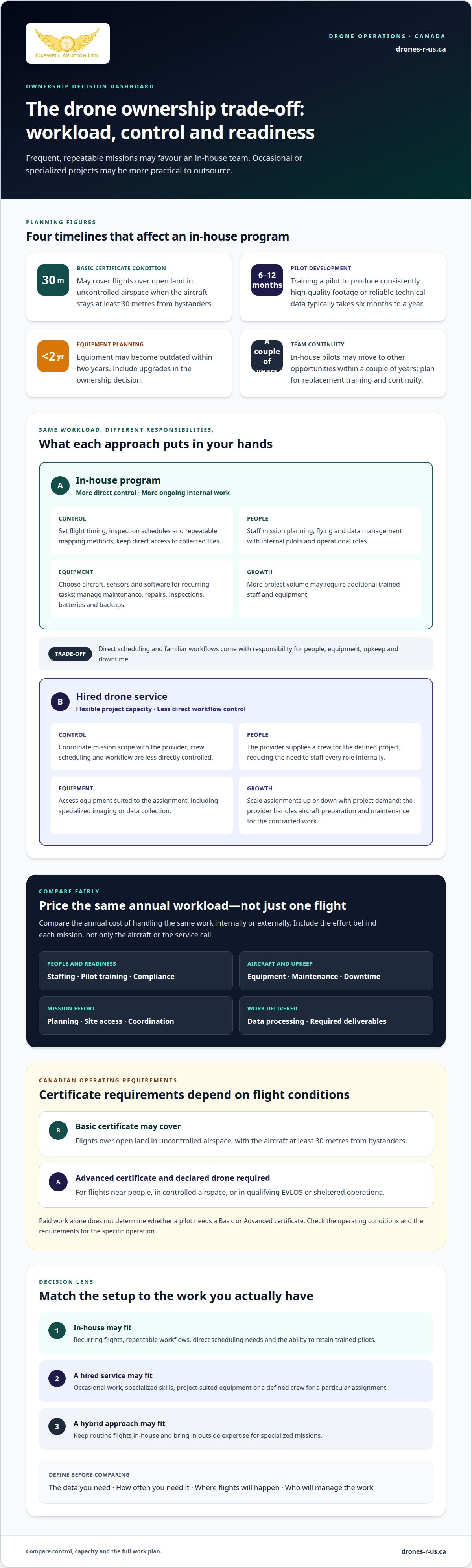
- Before choosing, define the data you need, how often you need it, where flights will happen, and who will manage the work.
- A hybrid approach can keep routine flights in-house while bringing in outside expertise for specialized missions.
- Account for Canadian registration, pilot certification, airspace, and operational requirements when planning your drone work.
Comparison of control, staffing, equipment, and scalability
An in-house drone program gives an organization direct control over flight timing, aircraft, and data handling. Hiring a service shifts more operational work to an external crew, while changing how quickly the organization can adjust each mission.
Control and Staffing
With an in-house team, managers can set inspection schedules, standardize mapping methods, and keep direct access to collected files. They also need people to plan missions, fly the aircraft, and manage the resulting data. For example, a construction team tracking site progress can schedule flights around its own work.
A hired service can provide pilots and equipment for defined projects, reducing the need to staff every operational role internally. The trade-off is less direct control over crew scheduling and the mission workflow. Identify which decisions must remain internal, such as selecting survey areas or controlling access to sensitive data.
Keeping Equipment and Training Current
An in-house program can select aircraft, sensors, and software for recurring tasks, such as roof inspections or site mapping. That flexibility also brings ongoing responsibilities: maintaining equipment and keeping pilots’ skills and operating procedures current as technology changes. Equipment may become outdated within two years, so plan for upgrades as part of the ownership decision.
A service can provide equipment suited to a particular project without requiring the organization to maintain every capability itself. This can help when a job needs specialized imaging or data collection. In-house teams, by contrast, build familiarity with their aircraft and workflows through repeated flights.
Equipment Maintenance and Downtime
Owning equipment also means managing batteries, repairs, inspections, software, and backup aircraft. If an aircraft is unavailable, a scheduled flight may need to move unless another suitable unit is ready. List the maintenance tasks, assign responsibility, and consider how downtime could affect inspection or mapping schedules.
With a hired service, aircraft preparation and maintenance are part of the provider’s work for the contracted assignment. Your organization still needs to coordinate timing, site access, and deliverables. This can reduce internal equipment duties, while an in-house setup offers more control over when aircraft are deployed.
Scalability depends on workload. An internal team may need more trained staff and equipment as project volume grows; external services can scale up or down for individual assignments. Compare both options against the same work plan, including flight frequency, staffing, equipment upkeep, and data processing.
| Option | Control | Staffing | Equipment | Scalability |
|---|---|---|---|---|
| In-house program | Direct scheduling and data workflows | Internal pilots and operational roles | Organization maintains aircraft and training | Growth may require added staff and equipment |
| Hired service | Mission scope coordinated with provider | Provider supplies a crew for the work | Access to project-suited equipment | Scale assignments with project demand |
Choose in-house operations when direct scheduling and repeatable workflows matter most. Choose a service when flexible access to equipment and crew matters more.
Which is better: Owning or hiring a drone service provider?
An in-house team suits organizations with recurring flights and the ability to retain trained pilots. A drone service can be practical for occasional work, specialized skills, or projects requiring a defined crew.
Before choosing, compare pilot qualifications, site experience, data handling, and the work you need completed.
Training, Licensing, and Employee Turnover
In Canada, paid work alone doesn’t decide whether a pilot needs a Basic or Advanced certificate. Flight conditions matter: a Basic certificate can cover flights over open land in uncontrolled airspace when the aircraft stays at least 30 metres from bystanders. Flights near people, in controlled airspace, or in qualifying EVLOS or sheltered operations require an Advanced certificate and a drone declared for that operation.
Ask a drone service provider about the pilot’s certificate, relevant flight experience, and approach to your site. For mining work, pilots need to understand terrain, obstacles, and the challenges of operating safely around active work areas. The site’s topography and mission objectives should inform the flight plan.
Building an in-house team means investing in training and retaining people who can do the work. Training a pilot to produce consistently high-quality footage or reliable technical data typically takes six months to a year. In-house pilots may move to other opportunities within a couple of years, so plan for replacement training and continuity.
- Describe the work, required data, site conditions, and expected flight schedule.
- Share relevant terrain or access constraints, including mine hazards.
- Ask for the pilot’s qualifications, comparable experience, and intended deliverables.
Data Ownership, Privacy, and Security
In-house operations give an organization direct control over where files are stored and who can access them. Hiring a service involves sharing site information or collected data, so the contract should define data ownership and permitted use. Set access, retention, and transfer expectations before the first flight.
For either option, identify sensitive locations, personnel, or infrastructure in the project brief. Specify who receives images, maps, and processed files, and how those materials may be used. This makes privacy and security part of the mission scope, rather than an afterthought.
For Canadian pilots, certificate recency can be demonstrated through a certificate, Transport Canada exam, flight review, or recurrent training completed in the previous 24 months. A structured learning plan can help internal staff maintain practical knowledge; online drone courses and in-person training provide a route for developing that capability.
What Does Outsourcing Drone Operations Mean?
Outsourcing means assigning defined drone work to an external service provider. The provider may handle flight operations, survey planning, data collection, processing, or reporting.
Service Scope and Provider Responsibilities
Set the scope before a survey begins. Specify the site, flight objective, data format, and deliverables, such as mapped construction progress or inspection images. A provider may contribute mission planning, aircraft operation, data acquisition, analysis, and reporting. A clear scope distinguishes image capture from the delivery of usable survey results.
Responsibilities should also cover operational coordination. Identify who provides site access information, communicates ground hazards, reviews the flight plan, and receives the final data. Outsourcing doesn’t automatically remove an organization’s regulatory responsibilities. Define each party’s compliance duties in the operating arrangement and contract, alongside data ownership and permitted use.
Outsourcing and Internal Competencies
Outsourcing can reduce the staff time needed to build survey capability. Drone survey work involves mission planning, data acquisition, fleet management, and processing. A service provider can handle these tasks for a project, allowing site staff to focus on construction or inspection decisions instead of learning every operational step.
A hybrid approach preserves internal knowledge. Employees can document routine site conditions, while a provider handles specialized work such as LiDAR mapping, thermal inspections, or large-area surveys. Internal staff should still define the information they need and how teams will use the results, keeping project decisions connected to the organization’s expertise.
For example, a construction team might document visible progress internally, then outsource a detailed survey for a complex phase. The right split depends on the required data, equipment, and staff capacity. Basic drone knowledge also helps employees describe site conditions clearly when planning an external flight.
Flexibility, Scaling, and Suitability
External services can scale with project demand. An organization can arrange work for a single site or bring in additional capability for a larger survey, rather than maintaining every specialized aircraft and skill internally. This suits occasional assignments, unpredictable demand, or tasks requiring equipment the organization doesn’t use routinely.
Outsourcing also involves trade-offs. A provider’s schedule can limit when a survey takes place, and communication delays can affect project timing. Some drone-as-a-service arrangements use rigid platform pricing. Before committing, define the required output and how it will be delivered; don’t treat flight time alone as the finished service.
A practical split is to outsource specialized or irregular work and develop internal skills for repeatable tasks. This can scale services up or down while building organizational capability. It works best when staff can explain the project objective and apply the provider’s findings to operational decisions.
Commercial licensing and regulatory compliance
Transport Canada doesn’t require insurance for a Canadian drone pilot certificate, although most clients and sites require insurance. Contract terms and site requirements determine the liability coverage needed for a particular operation.
Regulatory Responsibilities
In Canada, drones weighing 250 grams or more must be registered with Transport Canada, and their registration number must be marked on the aircraft. Registration is one part of an operating plan; airspace, location, aircraft, and mission type also affect requirements.
Before each flight, Transport Canada requires the pilot to survey the site for obstacles, people, take-off and landing locations, airspace, and weather. Flights in controlled airspace also require authorization from NAV CANADA. These checks apply to the operation itself, not just the organization’s annual drone workload.
For operations beyond visual line of sight, lower-risk flights such as pipeline work require a Level 1 Complex certificate and an RPAS operator certificate. Since November 2025, a Level 1 Complex Operations certificate allows BVLOS flight in uncontrolled airspace away from populated areas without a special permit, subject to stated operator requirements. Flying at an advertised event requires a special flight operations certificate from Transport Canada, regardless of drone size.
Insurance and Liability Coverage
Insurance requirements differ from pilot certification requirements. Transport Canada doesn’t require insurance for a Canadian drone pilot certificate, but most clients and sites require it. Contract terms and site rules determine coverage conditions, so assign responsibility for meeting them before scheduling the flight.
For an in-house program, document who handles coverage requirements and keeps the relevant records for each operation. For outsourced work, define insurance responsibilities in the contract alongside each party’s compliance duties. Hiring a service provider doesn’t automatically transfer every regulatory responsibility to that provider.
Keep compliance tasks tied to the flight plan, whether your staff or a contracted crew will fly. A practical review sequence is:
- Identify the aircraft and confirm registration and marking requirements.
- Assess the site, airspace, people, weather, and planned operation.
- Confirm the pilot certificate and any required authorization or certificate.
- Record which party manages compliance and site insurance conditions.
A change in site, airspace, or operation can change the checks required before take-off. For example, a routine site survey and a pipeline BVLOS mission involve different operational requirements. Assigning someone to review each flight plan helps keep those distinctions visible as drone operations expand.
In-house program versus occasional service hiring
Flight frequency is a useful starting point, but it isn’t the only consideration. Compare how often your team needs aerial data with the mission’s accuracy, timing, and airspace requirements. Daily inspections create a different workload from a one-off site record, even when both use similar aircraft.
For repeatable work, an in-house program can build a consistent workflow around familiar sites and internal schedules. A company with daily inspection needs can deploy trained staff as tasks arise and keep operational knowledge within the team. This becomes more compelling when projects continue over time, as they may for an architecture, engineering, and construction firm.
Occasional assignments often favour hiring. A commercial real estate firm commissioning aerial shoots for six to ten properties a year has distinct projects, not necessarily continuous flight work. Small, short-duration construction projects without regular surveys may also suit professional help on an hourly basis. The key question is whether internal staff would have enough recurring work to use and maintain their capability.
Accuracy requirements can change the decision. Construction projects needing higher absolute or global accuracy may call for professional services and specialized equipment. In-house staff can still manage routine site documentation while an external crew handles a demanding mapping task. This approach matches pilot skills to the required result instead of treating every flight as the same.
Use these steps to test the fit:
- List each use case, such as daily inspection, monthly progress records, or occasional aerial imagery.
- Record the data required, including whether standard images or higher-accuracy mapping are needed.
- Map each site and planned operation against its airspace and response needs.
- Compare recurring internal workload with the individual projects that could be outsourced.
A site needing surveys weekly or monthly may fall between the two models. Keep repeatable, routine work internal if trained staff and operational capacity are available, and outsource peak demand or specialist tasks. This hybrid arrangement can also help an organization develop drone skills without asking employees to perform every advanced mission.
Then compare both models over the same planning period. Include the actual work schedule, staff time, equipment readiness, and need for specialist accuracy. A single property shoot and a daily inspection program shouldn’t be judged by the same assumptions. Choose according to the workload, not a general preference for owning or hiring.
For your next planning step, organize your drone operation requirements around mission frequency, data needs, and site conditions.
Caswell Aviation Ltd: Online Drone Courses and InPerson Training
Caswell Aviation Ltd can support the next step, whether you’re building internal skills or need aerial imagery for a project. Online Drone Courses and InPerson Training, along with Advanced & Level 1 Complex Flight Reviews, are relevant when staff need to develop or assess their piloting capability.
If your organization is hiring rather than building a team, Caswell Aviation’s Drone Aerial Photography and Video service can provide imagery for a project without requiring you to develop an in-house workflow. The right fit depends on whether you need trained internal pilots, a flight review, or completed aerial content.
Visit Caswell Aviation Ltd’s website to learn more or get in touch.
Turn your drone plan into a practical next step
Before committing to a long-term model, choose a representative project and define what success looks like. Identify who will use the data, how it will inform a decision, and which parts of the workflow your team can manage consistently. This gives decision-makers a practical basis for shaping an approach around real operational needs, rather than assumptions about future demand.
The choice between an in-house drone program and hiring a service can change as projects evolve. Set a time to review the arrangement after the work is complete. Consider whether the process delivered useful information, matched the team’s capabilities, and supported the next operational decision. A measured review helps you adjust the balance without treating the first choice as permanent.
For guidance on training, flight reviews, or aerial imagery, contact Caswell Aviation Ltd. Take the next step with a clear project in mind and build a drone approach that works for your team.
Frequently Asked Questions
What Is an In-House Drone Program?
An in-house drone program is an organization’s internal capability to plan and conduct its own drone work. It assigns responsibility for flight planning, pilot readiness, equipment, and turning captured information into useful records. For example, a facilities team might use a consistent process to document roof conditions after maintenance. The key distinction is ownership of the workflow, not simply ownership of an aircraft.
How Do You Compare the Total Cost?
Compare both options over the same period and for the same missions. For an internal program, account for staff time beyond piloting, including preparation, travel, file handling, and reporting. For hired work, compare the contracted scope and deliverables with that workload. A spreadsheet organized by mission type can reveal costs hidden by comparing an aircraft purchase with a single service invoice.
So Which Approach Makes Sense?
Choose the model that fits the work your organization can reliably plan and use. A facilities team with recurring, familiar inspections may benefit from internal capability if it can support the full workflow. A project needing specialized data for a one-time decision may be better handled externally. Before deciding, record the mission objective, deadline, output format, and responsible staff.
What are the pros and cons of an in-house drone program versus hiring a drone service?
An internal program offers closer control over scheduling, methods, and information access, but requires the organization to maintain people, equipment, and operating processes. Hiring a service can provide project-specific expertise without building every capability internally, though scheduling and communication become shared responsibilities. Compare a recurring site inspection with a one-off specialized survey, defining the required deliverables for both.
How much does it cost to start and operate an in-house drone program in Canada?
There isn’t one fixed cost for every Canadian organization; the total depends on the mission and the internal capability required. Build an estimate that includes aircraft and accessories, training, staff time, maintenance, software, data storage, and compliance administration. A team doing basic documentation has different needs from one producing specialized survey outputs. Include recurring operating work, not just the initial equipment purchase.
What do Canadian drone service providers charge for common commercial jobs?
Service costs depend on the assignment’s location, flight requirements, equipment, data processing, and final deliverables. A simple aerial image request differs from a survey requiring specialized capture and analysis. The scope, travel, processing, and reporting shape the estimate. Compare service quotes by deliverables, not flight time alone.
What equipment, software, staffing, and training are needed for an in-house drone program?
Start by matching tools and roles to the required output. A mapping workflow may need an aircraft and sensor suited to the data, planning and processing software, spare batteries, and secure file storage. Assign a pilot, a mission coordinator, and a reviewer who can use the results. Training should cover safe operation and the organization’s specific data workflow.
What are the risks and hidden costs of operating an in-house drone program?
Hidden burdens often arise between take-off and the final use of data. Staff must prepare the mission, travel, inspect equipment, transfer files, process results, and communicate findings. Downtime can disrupt an inspection, while staff departures can leave knowledge gaps. Data access also needs deliberate management. Map each task from request to decision, then assign an owner and a continuity plan for every step.
Leave a comment