

How to use a drone program safety manual template
A template is a starting point, not proof that a drone program is safe or compliant. To use a drone program safety manual template in Canada, tailor it to your operations and use Part IX of the Canadian Aviation Regulations as a regulatory reference. Include procedures for Safety Assurance Declarations, incident reporting, privacy and data retention; a declaration can state that a drone is safe for Advanced or Level 1 Complex operations.
It’s understandable to want a ready-made structure when rules and operational details feel like a lot to organize. Make each section practical: staff should be able to find the relevant procedure and understand what to do before, during and after a flight.
This guide explains how to adapt a template to Canadian operations, assign responsibilities, document safety procedures, and manage incident records, privacy and data retention. It also covers how training and flight reviews can support the people responsible for carrying out the program.
Key Takeaways
- Adapt the manual to your actual operations, using Part IX of the Canadian Aviation Regulations as a key reference.
- Set out how Safety Assurance Declarations support Advanced or Level 1 Complex operations, and connect them to pilot training and operating procedures.
- Give staff a clear process for recording incidents, escalating concerns and preserving useful flight records.
- Define what drone data is collected, how it may be used, who can access it and when it should be deleted.
- Make responsibilities, emergency steps and routine checks easy to find so the manual can guide decisions before, during and after a flight.
Safety Assurance Declarations for Advanced or Level 1 Complex operations
Templates for recreational, commercial and enterprise programs differ in scope. A recreational version may focus on an individual’s flight planning, while commercial and enterprise versions should define organizational roles, approvals and record-keeping. In every case, tailor procedures to the operation instead of treating a generic template as a completed manual.
In Canada, a Safety Assurance Declaration can declare a drone safe for Advanced or Level 1 Complex operations. Use the manual to connect that declaration to the intended aircraft, mission and operating procedures. Part IX of the Canadian Aviation Regulations is a key reference for the Canadian rules section of the manual.
Choose an aircraft by matching its documented capabilities and equipment to the planned mission. Record its make and model, configuration, relevant limitations and assigned task. A mapping operation and an inspection near people, for example, may need different risk controls. A mission authorization form can record the selected aircraft, location, purpose, pilot and approving role.
Create a flight risk assessment by identifying site hazards, assessing their potential effects and recording controls before authorization. An emergency response plan should identify who leads the response, how the pilot stops or ends the flight, and how the organization records and escalates an event. Use a site map to mark launch areas, people, obstacles and emergency access points.
Use an aircraft register and pilot credential record as program tools. The register links each RPA to its declaration, inspections and maintenance history; the credential record helps the organization assign pilots to suitable tasks. Record registration details and training status through the manual’s tracking process. For third-party operations, define how the organization reviews the aircraft, pilot credentials, mission plan and reporting process before work begins.
Use a pre-flight checklist to record aircraft condition, control links, battery condition, site hazards and mission authorization. A post-flight checklist can capture defects, unusual events and maintenance actions. Refer to the manufacturer’s operating and maintenance instructions for aircraft-specific inspections and battery handling. A maintenance log tracks findings and corrective work, while a battery log helps identify changes in condition over time. Keep procedures specific to the aircraft and avoid unsupported limits.
Review the manual when the aircraft, mission, operating site, personnel or procedures change, and after an incident reveals a gap. A scheduled review also helps keep responsibilities and forms aligned with current operations. Record the review date, reviewer, changes and approval so staff can identify the version in use.
Accident and incident reporting
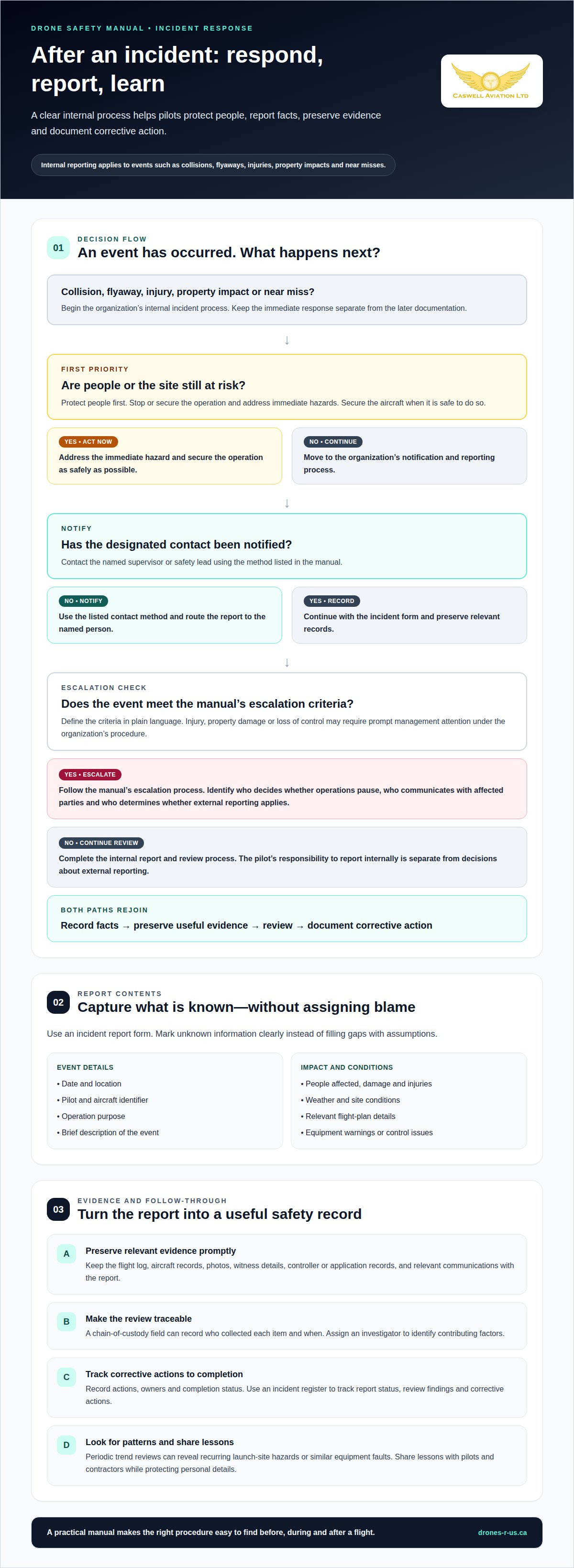
A reporting procedure should tell every pilot what to do after a collision, flyaway, injury, property impact or near miss. Separate the immediate response from documentation: protect people first, secure the aircraft when safe, then notify the designated program contact. Treat this as an internal process and explain how staff identify any separate reporting obligations that apply to the operation.
Use an incident report form to capture facts without assigning blame. Include the date and location, pilot, aircraft identifier, operation purpose, people affected, damage, injuries and a brief description of the event. Record weather and site conditions, relevant flight-plan details, and any equipment warnings or control issues. Mark unknown information clearly rather than filling gaps with assumptions.
The manual should define who receives a report and how it moves through the organization. A practical sequence is:
- Respond: Stop or secure the operation and address immediate hazards.
- Notify: Contact the named supervisor or safety lead using the listed method.
- Record: Complete the incident form and preserve relevant records.
- Review: Assign an investigator to identify contributing factors.
- Act: Document corrective actions, owners and completion status.
Define escalation criteria in plain language. An injury, property damage or loss of control, for example, may require prompt management attention under the organization’s procedure. Identify who decides whether operations pause, who communicates with affected parties, and who determines whether external reporting applies. Keep those decisions separate from the pilot’s responsibility to report the event internally.
Preserve useful evidence promptly. The flight log helps establish the mission sequence, while aircraft records can show maintenance history. Keep photos, witness details, controller or application records, and relevant communications with the report. A chain-of-custody field can record who collected each item and when, supporting a clear review.
Use an incident register to track report status, review findings and corrective actions. A corrective-action tracker helps assign an owner and record evidence of completion. Periodic trend reviews can reveal recurring issues, such as repeated launch-site hazards or similar equipment faults. Share lessons with pilots and contractors while protecting personal details.
Clear reporting depends on pilots understanding the procedure before a flight. Pilot training for safe operations can help reinforce the judgement and communication needed to follow a manual under pressure.
Drone data collection, privacy, and retention
A data-handling procedure should link each drone recording to a defined operational purpose. An infrastructure inspection may capture equipment condition, for example, while a mapping flight may create site imagery. Explain what the organization collects, why it needs each data type and who may use the resulting files.
Start with a data inventory. Record the source, format, intended use, storage location and responsible role for each category. A capture log can document the mission, date, aircraft, collection area and file set. These records help staff distinguish inspection images from incidental footage of nearby people, homes or workplaces.
Before a mission, document collection boundaries and steps to limit unnecessary capture. A flight plan can identify the survey area and camera direction; an operating checklist can remind the pilot to avoid recording unrelated spaces where practical. If footage captures information outside the mission’s purpose, define who reviews it and whether it should be isolated, redacted or deleted.
Privacy procedures should explain how people can raise concerns and who handles them. Name a privacy contact or designated manager, then describe how concerns are received, assessed and documented. A privacy incident log can record the date, data involved, access history, response and follow-up. Apply the relevant Canadian privacy and reporting requirements to the operation.
Set a retention timeframe for each data category based on its purpose and applicable requirements. Keep deliverables needed for an active project separately from temporary working files, for example. A retention schedule identifies the category, purpose, responsible owner, retention period and disposal method. Avoid a single blanket period when operational records and raw imagery serve different needs.
Control access with role-based permissions. A project lead may need final inspection images, while a contractor may need access only to assigned files. An access register records who can view, edit, export or share data. Use approved storage locations and define how staff transfer files, protect portable devices and remove access when assignments end.
Document deletion rather than assuming it has happened. A deletion log can record the file category, disposal date, responsible person and method. Explain how backups and shared copies are handled so deleting a working file does not leave unmanaged duplicates. For retained records, document the reason and review them against the schedule.
Review these controls when a project adds a new sensor, capture purpose, storage system or sharing partner. A data-flow diagram can show how imagery moves from aircraft to processing, delivery and deletion. Pair it with the inventory and retention schedule so each stage has a named owner and a clear handling rule.
UAS policy purpose and definitions
A UAS policy gives an organization a consistent framework for planning, approving and documenting drone work. It helps employees and contractors understand the operating rules that apply to their tasks. A construction company, for example, can use one policy to distinguish site photography from roof inspections and assign approval and record-keeping responsibilities for each activity.
Define the terms used throughout the manual before setting procedures. Consistent wording reduces confusion between the aircraft, the operation and the people involved. A definitions table can identify terms such as:
- Uncrewed aircraft system (UAS): The aircraft and associated components used to conduct an operation.
- Remote pilot: The person responsible for controlling the aircraft during flight.
- Operation: A planned activity, such as surveying a site or capturing inspection imagery.
- Program manager: The role responsible for maintaining policy, records and internal coordination.
- Contract operator: An external person or organization conducting work for the program.
Choose definitions that match the organization’s work, and use each term consistently in forms and checklists. If staff use “flight lead” internally, define whether that person approves a mission, manages the site or performs both functions. Avoid using the same label for different responsibilities.
State the policy’s scope in practical terms. Identify the departments, employees, contractors, aircraft and activities it covers. A scope statement might include company-operated inspection flights and contractor mapping work, while describing activities managed under separate procedures. State who can approve exceptions and how each decision is recorded.
Assign duties by role instead of relying on a general statement that “the team is responsible.” An Executive Sponsor can provide organizational oversight; a Program Manager can maintain the manual and records; pilots can follow approved operating procedures and report issues. A responsibility matrix shows who owns approvals, training records, equipment records and policy updates.
Some organizations use a UAS committee to coordinate decisions across departments. Its terms of reference can define participation and how the committee reviews policy, proposed operating areas, flight plans or internal concerns. A decision log records the issue, decision-maker, rationale and follow-up action. This creates a traceable record without requiring committee approval for every routine flight.
Make the policy usable with a document-control table, role matrix and definitions register. The document-control table identifies the current version and approver; the role matrix clarifies accountability; and the definitions register keeps terminology consistent across forms. Together, these tools turn a general policy into a working reference for employees and contractors.
Canadian drone rules and regulations
Build the manual around Canadian requirements, not a template written for another country. Part IX of the Canadian Aviation Regulations is a key reference for Canadian drone rules. Use it to organize regulatory references, then connect each applicable requirement to an operational procedure, record or responsible role. A drone program safety manual template provides structure, but its references and procedures must fit the program’s operations.
A compliance matrix is a practical tool for this work. Include columns for the regulatory topic, affected operation, internal procedure, responsible role and evidence retained. A row about pilot qualifications, for example, can point to the organization’s credential-record process. The matrix helps staff see how a regulatory topic is addressed without treating the manual as a substitute for regulations.
Separate external requirements from internal controls. Part IX is the regulatory reference; a company approval form, site checklist or contractor review is an internal program tool. Label each clearly. This distinction helps prevent an internal preference, such as requiring an extra review, from being presented as a requirement of Canadian aviation regulations.
Make the manual specific to each operation. A flight-planning worksheet can record the purpose, location, aircraft, pilot and proposed work. Add fields for the applicable operating category, site hazards, required approvals and supporting records. A mapping flight and an inspection flight may need different internal controls, even when they use the same aircraft. Use the drone program safety manual template to organize mission-specific procedures rather than applying identical controls to every task.
Use a pre-mission decision path to connect regulatory references to authorization. First, identify the planned operation and aircraft. Then direct the responsible person to the relevant manual procedure and supporting records. If a requirement or operational condition is unclear, pause internal authorization until the responsible manager resolves it. Record the decision and its basis in the mission file.
A document register can help keep references current. Record the source title, subject, owner, date reviewed and manual sections that rely on it. Assign someone to review affected procedures when the organization changes its aircraft, mission types or operating methods. Avoid copying long regulatory passages into the manual; concise references and clear procedures are easier to maintain.
Training records should connect a pilot’s preparation to assigned duties. The organization can use a credential register to record the qualification relevant to each role, alongside internal training and familiarization. Transport Canada Advanced and Level 1 Complex certification training can help pilots prepare for those operating pathways; match learning to the missions they will perform.
Use the compliance matrix, document register and mission worksheet together. They create a traceable path from Canadian regulatory references to flight-level decisions. Plan your Canadian drone training to strengthen the knowledge behind those decisions.
Caswell Aviation Ltd: Online Drone Courses and InPerson Training
Caswell Aviation Ltd offers Online Drone Courses and InPerson Training for pilots preparing for Transport Canada Advanced and Level 1 Complex certification. This training can support pilots whose manual assigns duties that rely on aviation knowledge and operational judgement. Advanced & Level 1 Complex Flight Reviews provide an opportunity to demonstrate flight skills relevant to those operating pathways.
Use course learning to support the manual’s procedures, then connect each pilot’s assigned duties with suitable training and review. This helps make the safety program a practical reference for flight activity. Caswell Aviation Ltd offers online drone courses, optional in-person training and flight reviews to help pilots build and assess relevant skills.
Put the manual to work in your next operation
A drone program safety manual template is valuable when its procedures guide real decisions, not just document storage. Before the next operation, connect the manual’s responsibilities and approval steps to the planned work. This practical link helps teams use the document consistently and identify where training or clarification could support their duties.
Caswell Aviation Ltd offers Online Drone Courses and InPerson Training, Advanced & Level 1 Complex Flight Reviews, and Drone Aerial Photography and Video. These offerings can support pilot development, flight review preparation and aerial work. Choose the next step that fits your operational needs and the roles your program requires.
For a conversation about training or flight reviews, contact Caswell Aviation Ltd. A clear next step can help turn your manual into a practical part of a well-organized drone program.
Frequently Asked Questions
How Should it be Used?
Use the manual as an operational control document, not a form to complete once and file away. Before assigning a mission, staff can follow its approval path to identify the responsible decision-maker and current procedure version. During onboarding, have pilots acknowledge the applicable procedures and show them where to find forms. After a change, document who approved the revised manual and how affected staff were informed.
Why is it Important?
A written programme reduces the risk of two pilots interpreting the same assignment differently. One employee might assume a contractor handles site coordination, while the contractor expects the organisation to provide it. The manual can clearly assign that responsibility and establish a shared process for employees, contractors and managers. It also gives programme leaders a basis for reviewing whether procedures remain suitable as operations change.
What sections should a drone programme safety manual include?
Include a document-control page, purpose and scope, definitions, roles, regulatory references, mission approval procedures and aircraft records. Add flight preparation, emergency response, incident reporting, maintenance, privacy, data handling and contractor coordination. Use appendices for forms that change more often, such as a site assessment or flight record. For a new operation, map each planned task to the procedure and record it relies on.
What training, pilot certification, and competency records should a drone safety manual require?
Keep a pilot register that connects each person’s assigned tasks with relevant credentials, training and flight review records. Add aircraft familiarisation and site-specific orientation where those are part of the organisation’s programme. A training matrix helps managers identify who is prepared for a planned role, while a sign-off record documents completion. Caswell Aviation Ltd. offers Online Drone Courses and In-Person Training for Transport Canada Advanced and Level 1 Complex certification.
What insurance and incident reporting requirements apply to Canadian drone programmes?
Separate insurance arrangements from incident reporting in the manual. Record the organisation’s applicable coverage information and who is responsible for maintaining those records; the manual itself is not proof of coverage. For incidents, provide an internal reporting route, preserve relevant operational records and assign responsibility for determining whether external reporting applies. Avoid inserting a universal deadline or coverage amount unless it has been established for that operation.
How should a drone manual address privacy, data security, and operating near people or airports?
Set procedures to limit collection to the mission, restrict access to authorised users and handle files through approved storage and transfer methods. For flights near people or airports, require site-specific planning and a documented decision that the proposed operation follows applicable Canadian rules. Part IX of the Canadian Aviation Regulations is a key reference. The manual should also identify who can pause or decline a mission if its planned controls cannot be followed.
Leave a comment