

How to Get Commercial Drone Contracts in Canada: A 2026 Guide
A drone and a pilot certificate won’t, on their own, win a commercial contract. Getting commercial drone contracts in Canada starts with identifying a client problem and showing how your aerial service can solve it safely and reliably.
It’s understandable to wonder where legitimate opportunities are posted, what credentials a project may require, and how to explain the value of your work beyond impressive footage. The key is to define a service clients can use, then make your scope, operational readiness, and deliverables clear from the first conversation.
This guide lays out a practical path from choosing viable commercial use cases and finding prospects to preparing credible proposals, delivering the agreed work, and building repeat relationships. You’ll learn how to present services such as aerial photography and video in terms of client outcomes, and what to consider when reviewing project requirements and current Transport Canada rules. Training and professional flight reviews can support your operational knowledge and readiness, but contracts are earned by matching a real need with a dependable plan.
Key Takeaways
- Getting commercial drone contracts starts with choosing a service niche that addresses a clear business need.
- Prepare a concise record of your credentials, relevant experience, equipment, and sample work to show operational readiness.
- Use a repeatable process to identify likely buyers, assess opportunities, and keep track of follow-ups.
- Build proposals around the client’s objective, defined deliverables, schedule, assumptions, and payment terms.
- Consistent coordination, quality checks, organized files, and clear updates can help turn a completed project into repeat work.
What getting commercial drone contracts actually involves
A commercial drone contract is an agreement to complete defined work under agreed terms. It should set out the client’s objective, the scope of the service, the deliverables, the schedule, and the payment arrangement. A request to “take some drone footage” is only a starting point. The contract clarifies what will be captured, how the files will be delivered, and what falls outside the agreed scope.
For independent pilots, getting commercial drone contracts means presenting a service that solves a practical business need, not simply offering flight time. A certificate can support eligibility for particular operations, but it doesn’t replace sound planning, relevant experience, a clear proposal, or a reason for the client to hire you.
Which commercial drone services can clients hire?
Start with the result the client needs. A construction firm may want visual progress documentation; a property or tourism business may need aerial marketing imagery; an asset owner may need inspection support; and a project team may require mapping deliverables. Aerial photography and video can be scoped around a site, subject, intended use, and agreed file format. Be clear about the specific service you provide and avoid promising technical outputs beyond your experience or equipment.
Each scope depends on site conditions, aircraft capability, the data required, and the permissions needed for the proposed operation. Define those factors before agreeing to a schedule or deliverable. For background on the terminology and history behind the technology, see the overview of the Unmanned Aerial Vehicle.
How contracts differ from drone jobs and one-off missions
Paid drone work can take several forms, and each involves a different relationship:
- Employment: You work in a role for an organization, following its employment terms and responsibilities. For a closer look at this path, see Drone Pilot Jobs in Canada: A Professional Career Guide for 2026.
- Subcontracting: Another company hires you to complete a defined part of its client project. The lead contractor usually coordinates the broader engagement.
- Platform-assigned missions: A platform connects pilots with individual tasks, often with set assignment details and submission requirements.
- Direct business-to-business agreements: You work directly with the client to define the problem, scope, deliverables, schedule, and payment terms.
A one-off mission may involve a single site visit or capture request. If the client finds the work useful and delivery is reliable, further projects may follow, but repeat work isn’t automatic. Treat each assignment as a defined business agreement, document what’s included, and deliver against the client’s intended use.
Build the credentials and operating readiness commercial clients expect
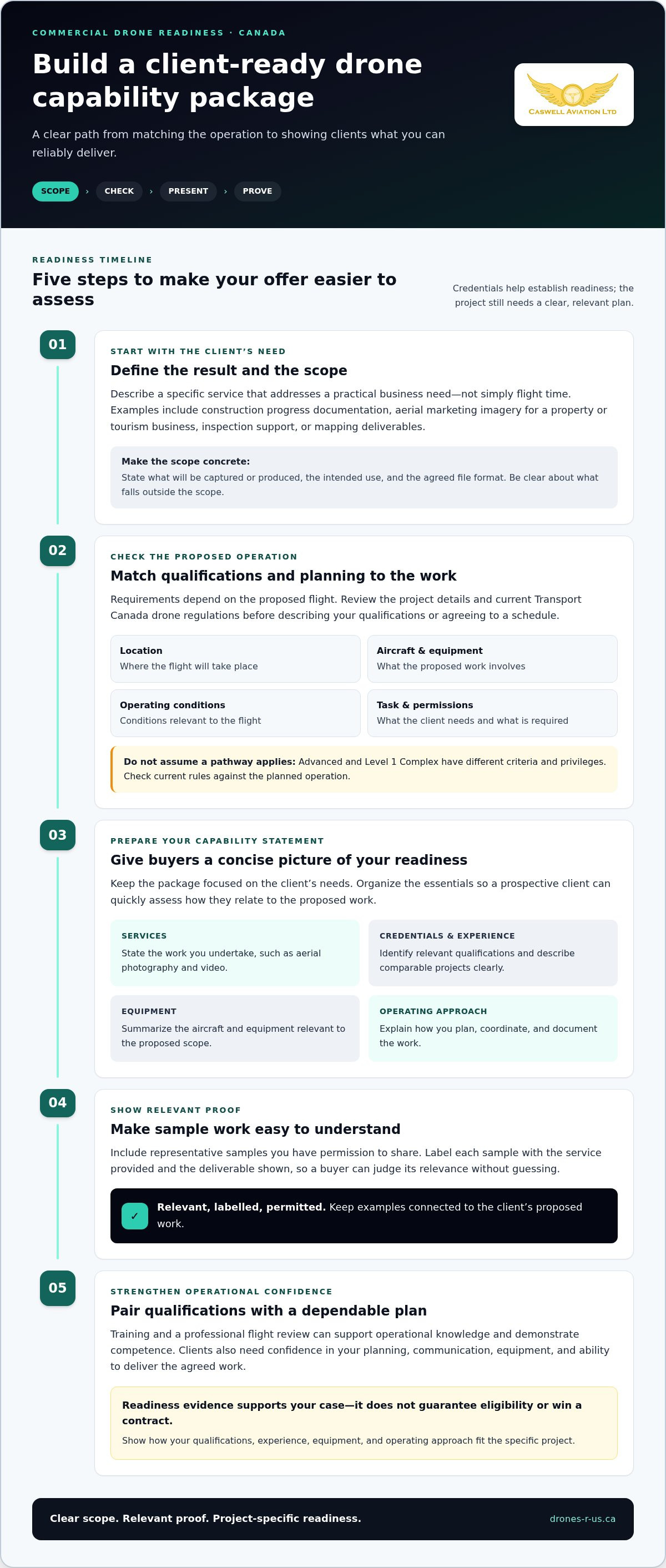
Before pursuing a project, match your qualifications and operating plan to the work being requested. Requirements depend on the proposed flight, including the location, aircraft, operating conditions, and intended task. A commercial purpose alone doesn’t determine which rules apply. Review the current Transport Canada drone regulations before preparing a proposal, and see The Complete Guide to Transport Canada Drone Certification in 2026 for certification context.
Clear compliance evidence helps clients assess operational readiness, but it doesn’t guarantee eligibility or win a contract. Certification supports the operations for which it applies. Clients also need confidence in your planning, communication, equipment, and ability to deliver the agreed work.
Match your qualifications to the proposed operation
Review the project details before describing your credentials. Consider where the flight will take place, the aircraft and equipment involved, the operating conditions, and what the client expects you to capture or produce. Then compare those details with current Transport Canada requirements. Advanced and Level 1 Complex pathways have different criteria and privileges, so don’t assume either applies without checking the current rules against the planned operation.
Prepare a client-ready capability package
Give prospective clients a concise, relevant picture of your readiness. A short capability statement can organize the essentials:
- Services: State the work you undertake, such as aerial photography and video.
- Credentials and experience: Identify relevant qualifications and describe comparable projects clearly.
- Equipment: Summarize the aircraft and equipment relevant to the proposed scope.
- Operating approach: Explain how you plan, coordinate, and document the work.
Include representative samples you have permission to share. Label each with the service provided and the deliverable shown, so a buyer can judge its relevance without guessing. Keep the package focused on the client’s needs rather than adding a long inventory of unrelated skills.
Training and a professional flight review can help strengthen operational knowledge and demonstrate competence, but they don’t promise contract success. Caswell Aviation Ltd offers online and in-person drone training for Transport Canada Advanced and Level 1 Complex certification pathways, along with professional flight reviews. Pair training with a project-specific operating plan and a capability package that makes your experience easy to assess. Together, these give clients useful evidence to consider as they evaluate a proposal.
Find and qualify commercial drone contract opportunities in Canada
A practical prospecting routine helps you focus on work that fits your services instead of sending the same pitch to every organization. Use this workflow to build and manage a focused pipeline:
- Define a service niche. Describe work you can demonstrate, such as aerial photography and video for marketing or visual documentation.
- Identify likely buyers. Research construction, property, infrastructure, environmental, and media organizations. Look for the people responsible for the work your service could support.
- Monitor opportunities. Review company procurement pages and public-opportunity sources such as CanadaBuys and MERX. Listing access, supplier registration, and submission steps can change, so review each platform’s current process before investing time in a bid.
- Qualify the fit. Compare the requested work with your experience, equipment, and ability to plan the operation.
- Track follow-ups. Record who you contacted, what was discussed, and when you’ll take the next step.
Professional networks can also help you learn how organizations describe their needs. The Aerial Evolution Association of Canada is a place to explore the Canadian drone industry community and related resources.
Choose prospects by the problem they need solved
Map each service to the role most likely to use or commission it. A project manager may need progress imagery; a communications team may be looking for aerial content; an asset manager may need visual information to support inspection planning. These are starting points for research, not assumptions about a buyer’s budget or purchasing plans.
Prioritize organizations whose requested imagery or information matches work you can show in your portfolio. A concise, relevant example makes it easier for a prospect to understand how your service could fit their project. When you reach out, refer to the specific need you identified and explain which deliverable you could provide.
Qualify a lead before investing in a proposal
A qualified lead has a defined need, a feasible scope, and operating conditions that can be assessed. Before preparing a detailed proposal, clarify the intended deliverable, decision timeline, site conditions, access arrangements, and how the client plans to use the result.
Flag planning questions early, including airspace, permissions, privacy, weather, and data handling. These factors can affect whether and how the work can proceed. Don’t treat an interesting request as a viable opportunity until you understand its constraints.
A simple spreadsheet or customer relationship management system is enough to start. Log the organization, contact, service need, last interaction, and next step. A consistent record keeps follow-ups professional and helps you distinguish active opportunities from contacts that may be relevant later. This structure makes getting commercial drone contracts a deliberate process of finding, assessing, and pursuing suitable work.
Write a commercial drone proposal that makes scope and value clear
A strong proposal connects the requested flight to what the client needs to decide, document, or communicate. Rather than selling flight hours alone, explain how the work will produce useful, clearly defined deliverables. A construction project manager, for example, may need consistent visual documentation for internal progress reviews. The proposal should describe how the agreed imagery will support that purpose, without promising a business result the imagery itself can’t guarantee.
Include the client objective, scope, deliverables, schedule, assumptions, exclusions, and payment terms. Use a scope-based estimate that reflects the work involved, rather than relying on a universal rate. The client should be able to see what’s included, what’s outside the agreement, and how changes will be handled.
Describe deliverables, schedule, and project boundaries
Be specific about what the client receives. For an aerial photography or video project, state the type of imagery, intended format, delivery stages, and any agreed revision limits. Outline the schedule and identify assumptions about site access, weather, permissions, and information the client must provide.
Clarify exclusions, too. If the client later requests another location, additional capture, or a different deliverable, treat it as a change to the original scope. Explain how you’ll assess the change and agree on any revised schedule or payment terms before additional work proceeds.
| Vague offer | Measurable, bounded scope |
|---|---|
| “Drone photos of the site.” | “Aerial still images of the agreed site areas, delivered in the agreed format for internal progress documentation.” |
| “Video as needed.” | “Aerial video capture of the agreed subjects, with delivery stages and revision boundaries stated in the proposal.” |
Demonstrate value and reduce client uncertainty
Use relevant work samples to show the kind of deliverable you can provide. Share client work only with permission, and add a short description of the project objective and your role. A portfolio should make your capability easy to assess, not imply that one example guarantees the same result in different conditions.
Set expectations by explaining how you’ll communicate, coordinate site activity, and deliver the files. Keep the language plain and practical. A clear process helps the client understand what happens before, during, and after the capture, while a defined scope reduces uncertainty for both parties.
Caswell Aviation Ltd provides drone aerial photography and video services, with aerial content tailored to client requirements.
Deliver reliably, earn repeat work, and strengthen your commercial offer
A completed flight is only one part of the client experience. Clear coordination and dependable delivery show that you can manage the full assignment, from confirming the agreed scope to handing over usable files. For getting commercial drone contracts, that consistency can help build trust and create a sound basis for future work, though repeat projects are never automatic.
Use a straightforward delivery sequence:
- Confirm the scope: Recheck the agreed capture areas, deliverables, formats, schedule, and any project assumptions.
- Coordinate operations: Share relevant updates with the client and align access and site activity with the project plan.
- Capture the work: Complete the planned operation and keep the client informed if a change affects the agreed scope or timing.
- Quality-check the files: Review the imagery or video for completeness, clarity, and alignment with the requested deliverables.
- Deliver and follow up: Organize files clearly, use the agreed formats, confirm delivery, and request feedback.
Use consistent file names and folders so the client can locate and use the deliverables without unnecessary sorting. Timely updates also reduce uncertainty, especially if site conditions or weather affect the plan. Keep communication concise: explain what has been completed, what comes next, and whether the client needs to provide anything.
Turn a completed project into a stronger business relationship
Before requesting feedback, confirm that the delivered work matches the agreed scope. Ask what was useful and what could be clearer next time. Record the feedback alongside lessons about coordination, file organization, and delivery so you can improve future projects.
Ask permission before using client work as a portfolio sample. If the project reveals a genuine follow-on need, suggest a related service that addresses it. For example, a client who needs imagery for another defined communication purpose may benefit from a separately scoped aerial photography or video project. Keep the recommendation relevant, not routine.
Use professional training to support operational readiness
Strong client service starts with sound operational knowledge. Caswell Aviation Ltd provides online and in-person training for Transport Canada Advanced and Level 1 Complex certification pathways, as well as professional flight reviews. Requirements and steps can vary, so consult current Transport Canada guidance for the operation and pathway involved. Training and reviews can support readiness, but they don’t guarantee contract awards.
For pilots strengthening their knowledge or organizations seeking aerial imagery, explore drone training and aerial imagery services.
Turn a clear plan into your next opportunity
Getting commercial drone contracts is a practical business process: identify a client need, match it with a well-defined service, and show that you can plan and deliver the work responsibly. Credentials support readiness, while a focused proposal explains the scope, deliverables, schedule, and value. Consistent communication and organized delivery can help earn client confidence and create the conditions for future work.
Start with one service you can demonstrate, research the organizations that may need it, and qualify each opportunity before investing time in a proposal. After delivery, review the project, learn from client feedback, and suggest follow-on work only when it meets a real need.
Caswell Aviation Ltd offers online and in-person training for Transport Canada certification pathways and professional flight reviews. For organizations seeking aerial imagery, its photography and video services can be tailored to client requirements. Explore professional drone training and aerial imagery services as you plan your next step.
Progress comes from clear planning, dependable work, and steady improvement. Choose a suitable opportunity and put that approach into practice.
Frequently Asked Questions
Can a new drone pilot get commercial contracts in Canada?
Yes, a new pilot can pursue commercial work by starting with a clearly defined service that matches their skills and equipment. Build experience through suitable projects, document your operating approach, and prepare a small set of representative samples. Be transparent about your experience, and assess each project’s requirements before pitching. Getting commercial drone contracts takes more than a certificate: clients also need a clear scope, relevant capability, and confidence in delivery.
Do I need an Advanced certificate to get commercial drone contracts?
Not for every project. In Canada, the required pilot certificate depends on the aircraft and proposed operating conditions, not simply on whether the flight is commercial. Some work may require an Advanced certificate, while other operations may have different requirements. Review current Transport Canada rules against the specific location, aircraft, and flight plan before accepting work. Don’t assume a client’s request or a commercial purpose determines which certificate applies.
Where can I find commercial drone contract opportunities in Canada?
Look for opportunities through direct outreach, company procurement pages, subcontracting relationships, and public procurement listings. CanadaBuys and MERX may be useful places to research public opportunities. Review their current listing, supplier registration, and submission processes before preparing a bid, as these can change. You can also research construction, property, infrastructure, environmental, and media organizations, then identify the teams whose work could benefit from your specific aerial deliverables.
How do I write a proposal for a drone services contract?
Begin with the client’s objective, then explain how your proposed work addresses it. Define the scope, deliverables, schedule, assumptions, exclusions, and payment terms. For example, describe the agreed areas to capture, the type and format of imagery, and how files will be delivered. Use relevant work samples only with permission. A clear proposal connects the flight to the client’s intended decision or communication need without promising results the imagery alone can’t ensure.
What should a commercial drone contract include?
A commercial drone contract should record the agreed scope, deliverables, schedule, and payment arrangement. It should also state assumptions, exclusions, site-access responsibilities, and how requested changes will be handled. Specify the imagery or video formats, delivery stages, and any agreed revision limits. Clear boundaries help both parties understand what the work includes and what requires a separate agreement. Make sure the planned operation can be carried out under applicable requirements before confirming the work.
Can I get drone contracts without a large portfolio?
Yes. A large portfolio isn’t essential if you can show a few relevant examples and explain your role clearly. Use work you have permission to share, label the deliverable, and describe its intended use without overstating results. If you have limited client work, demonstrate your capabilities with suitable practice samples and identify them honestly as such. Pair examples with a concise description of your equipment, experience, and approach to planning and delivery.
Does drone certification guarantee commercial work?
No. Certification supports eligibility for operations where the applicable rules require it, but it doesn’t guarantee a contract. Clients also consider whether your service fits their need, whether the scope is practical, and whether your proposal and delivery plan are clear. Training and professional flight reviews can support operational knowledge and readiness. To improve your prospects, combine the appropriate qualifications with relevant examples, thoughtful prospecting, and reliable communication throughout each project.
Leave a comment