

How to Apply for an SFOC in Canada and What to Expect
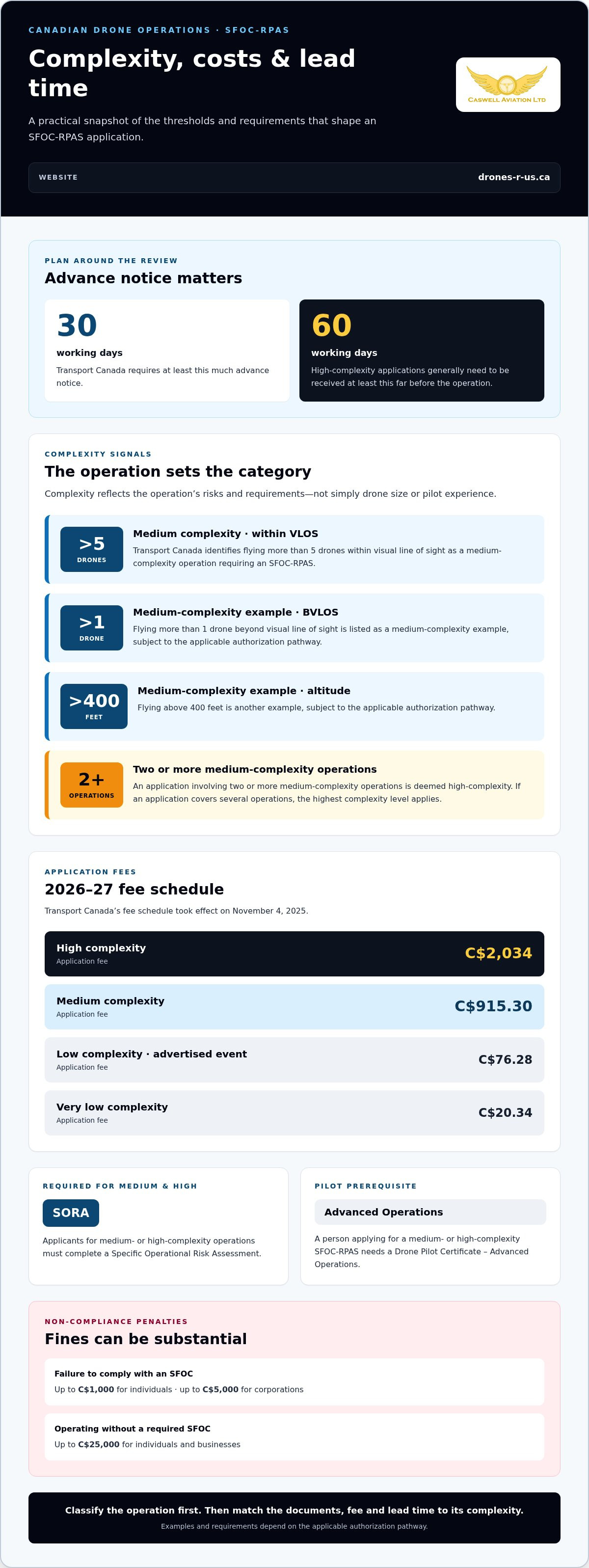
The first SFOC application decision is choosing the right complexity level for the planned operation. This SFOC application guide for Canada explains the core requirements: medium- and high-complexity applicants need a Specific Operational Risk Assessment, and Transport Canada requires at least 30 working days’ advance notice. High-complexity applications generally need to be received at least 60 working days before the operation.
It’s understandable to focus on paperwork, but an SFOC application must also reflect the operation, pilot qualifications and timing requirements. This guide explains how to assess operational complexity, prepare and submit an application, and plan for Transport Canada’s review. It also covers when an SFOC may be required and why review timelines vary by application type. Use these steps to plan around the operation instead of leaving key requirements until the last minute.
Key Takeaways
- Classify the planned operation before preparing an application; the operation’s risk and scope determine its complexity level.
- Transport Canada identifies flying more than 5 drones within VLOS as a medium-complexity operation requiring an SFOC-RPAS.
- Prepare the organization as well as the flight plan, including accountable roles, training, operating procedures and safety-risk management.
- Build a complete application package with the risk assessment and supporting details that explain how the operation will be conducted safely.
- Plan for Transport Canada’s review process and understand how the application type can affect the service standard.
What is the difference between a medium and a high complexity SFOC?
A Special Flight Operations Certificate (SFOC) is Transport Canada’s authorization for a specific operation under special conditions. Its complexity category reflects the operation’s risks and requirements, not simply the drone’s size or the pilot’s experience.
- Check whether the operation needs an SFOC-RPAS. An SFOC-RPAS is generally required when planned flight operations go beyond the rules for basic, advanced or Level 1 Complex operations. Examples include certain BVLOS flights, operations involving several drones, and flights outside Canadian airspace. Some operations may qualify under a specific regulatory pathway instead, so compare the proposed activity with the applicable requirements before choosing an application type.
- Identify medium-complexity operations. Transport Canada identifies flying more than 5 drones within VLOS as a medium-complexity operation requiring an SFOC-RPAS. Other examples include flying more than 1 drone BVLOS or flying above 400 feet, subject to the applicable authorization pathway. If an application covers several operations, the highest complexity level applies. An application involving two or more medium-complexity operations is deemed high-complexity.
- Screen for high-complexity risks. High-complexity examples include BVLOS operations outside listed exceptions, flights with dangerous or hazardous payloads, and medium-sized drones flown in adverse weather or poor visibility. A person on board a drone and BVLOS operations in an aerodrome environment are also identified as high-complexity. These operations need a closer risk assessment because their conditions can increase potential consequences.
- Build the supporting operational documents. Applicants for medium- or high-complexity operations must complete a Specific Operational Risk Assessment (SORA). Use an Operations Manual to organize procedures, roles, training, emergency actions and maintenance responsibilities. A Concept of Operations should explain the mission, operating area, aircraft, people involved and planned controls. Keep the documents consistent with the proposed flight operations and the SORA.
- Budget for the correct application category. For the 2026-27 fee schedule, application fees are C$915.30 for medium complexity and C$2,034 for high complexity. Very-low-complexity applications cost C$20.34, while low-complexity advertised-event applications cost C$76.28. Transport Canada’s fee schedule took effect on November 4, 2025. Failure to comply with an SFOC can result in fines up to C$1,000 for individuals and C$5,000 for corporations; operating without a required SFOC can lead to fines up to C$25,000 for individuals and businesses.
How do you apply for an SFOC?
An SFOC-RPAS authorizes a specific drone operation under special conditions. Other special flight operations have requirements based on the activity and applicable regulatory framework, so don’t assume the drone application process applies to them.
- Confirm whether an SFOC-RPAS is the right route. Compare the planned operation with the permitted basic, advanced and Level 1 Complex pathways. A Canadian BVLOS operation may proceed without a per-job SFOC if it independently meets the Level 1 Complex pathway under CAR 901.87. That pathway involves the applicable pilot and operator requirements, including an RPOC. If the operation falls outside those conditions, determine the appropriate SFOC category before assembling documents.
- Check the pilot qualification. A person applying for a medium- or high-complexity SFOC-RPAS needs a Drone Pilot Certificate - Advanced Operations. This qualification is a prerequisite, not a replacement for an SFOC. Foreign drone operators applying for an SFOC are instructed to pass the Transport Canada Advanced or Basic exam and complete and pass a Flight Review.
- Set up the organization’s accountable roles. Transport Canada requires an applicant organization to appoint an accountable executive and identify a person responsible for maintenance. Put those roles in writing and make sure each person’s duties are clear. The application should show who oversees the operation and who maintains the aircraft, rather than leaving responsibility implicit.
- Establish procedures and safety management. Before applying, implement training, flight operating procedures and a safety-risk management process. Explain how personnel will prepare for the mission, manage changing conditions and respond to an emergency. For medium- and high-complexity applications, complete a Specific Operational Risk Assessment (SORA) that addresses the proposed operation and its controls.
- Match equipment capability to the mission. Describe the RPAS configuration, control arrangements and payload in relation to the planned airspace and operating conditions. For example, explain how the aircraft and operating procedures address the risks of a hazardous payload, if one is involved. Keep equipment details consistent across the SORA, operating procedures and application. These details help Transport Canada assess the proposed operation as a complete system.
- Separate drone rules from other special flight operations. An SFOC-RPAS concerns remotely piloted aircraft systems; another special flight operation may have different application requirements. State the activity precisely, identify whether an RPAS is involved and choose the corresponding application route. If you’re preparing for the Advanced pilot certificate requirement, drone pilot training resources can support your preparation.
How far ahead should I start an SFOC application?
Submit the required information at least 30 working days before the operation; high-complexity applications need 60 working days’ advance notice. Review standards differ by application type, so build preparation, submission and review time into the flight schedule.
-
Compile the SFOC application information
Before submitting, gather the operation details, supporting documents and pilot information. Describe the RPAS operation, location, dates, aircraft, crew roles and procedures consistently in the application and risk assessment. Medium- and high-complexity applications require a Specific Operational Risk Assessment. Check that every document describes the same flight plan and operating conditions. Inconsistencies can make it difficult for reviewers to understand the proposed activity.
-
Plan submission around approval timing
Set the operation date only after accounting for the submission deadline and review standard. Transport Canada will not accept an application received with less than 30 working days’ advance notice; high-complexity applications need 60 working days. Medium-complexity applications have a 60-business-day service standard, while high-risk reviews may take up to 60 working days.
-
Allow time to prepare a complete package.
Transport Canada’s regulatory analysis for the 2025 RPAS rules estimated roughly 20 hours to prepare an SFOC application. Use that estimate to schedule document preparation, internal review and corrections. The actual effort depends on the operation’s complexity and the supporting material required. Avoid treating the submission deadline as a preparation start date.
-
Include applicant, pilot and crew information.
Identify the applicant and the people responsible for conducting and supporting the flight. Include pilot qualifications and crew roles that relate to the proposed operation. Foreign drone operators applying for an SFOC must complete Transport Canada Form 26-0835E. Foreign applicants should also provide relevant pilot qualification details, such as an FAA 107 certificate, where applicable; training providers such as AINautics University can support pilots in building the necessary foundational knowledge and flight proficiency.
-
Submit required information before the deadline.
Under CAR 903.02, an SFOC-RPAS applicant must submit all required additional information to the Minister at least 30 working days before the operation. Send a coherent package, then respond to information requests promptly. A planned operation in NAV Drone under the SFOC category requires a valid SFOC-RPAS issued by Transport Canada; a pending application is not that authorization.
-
Use the review period to protect the schedule.
Very-low- and low-complexity applications have a 30-business-day service standard. Applications for foreign operators and flights within 30 metres of an advertised public event can take up to 30 working days. These review periods differ from minimum advance-notice rules. Keep the operation date flexible enough to accommodate the applicable review and any requested additional information.
Transport Canada review and decision process
Allow time for Transport Canada to assess the application against its service standard and the operation’s details. Track the applicable processing timeline separately from the minimum notice period, and choose a realistic operation date.
-
Track application processing time
Use the service standard for your application type when setting the flight schedule. Transport Canada lists 60 business days for medium-complexity SFOC-RPAS issuance, while very-low- and low-complexity applications have a 30-business-day standard. Foreign-operator applications and advertised-event flights within 30 metres can take up to 30 working days. These are different measures, so don’t treat them as interchangeable.
-
Address delays or refusal risks
Before submission, check for missing details, conflicting documents and unanswered information requests. These issues can complicate the assessment and delay a decision. An application may also be refused if it does not explain how the proposed flight, aircraft and safety controls fit together. Describe the operation’s specific risks rather than relying on generic wording.
-
Keep your submitted details consistent.
Cross-check the operating area, aircraft information, dates, crew roles and procedures across the application and supporting documents. For medium- or high-complexity operations, confirm that the Specific Operational Risk Assessment matches the proposed mission. If details change during review, clearly identify the current information. Consistent documents help Transport Canada assess the same flight plan throughout.
-
Respond clearly to information requests.
If Transport Canada requests more information, answer each point directly and refer to the relevant document or operation detail. A broad explanation may leave the specific question unanswered. Keep copies of your response and revised materials together so you can track what was provided during the review.
-
Distinguish review standards from operating permission.
A service standard is an expected processing period, not permission to fly. A drone operation planned in NAV Drone under the SFOC category requires a valid SFOC-RPAS issued by Transport Canada. Do not proceed until the certificate is issued, then follow its conditions.
-
Build schedule flexibility around the review.
Transport Canada may take up to 60 working days to review and issue an SFOC-RPAS for higher-risk operations. Medium-complexity issuance has a 60-business-day service standard, which uses a different time unit. Plan internal aircraft, crew and site arrangements around the applicable timeline, and avoid commitments that assume approval will arrive earlier.
Submitting an application to Transport Canada
Transport Canada handles SFOC-RPAS applications. Foreign operators complete Form 26-0835E, while the appropriate submission route depends on the application type. This SFOC application guide for Canada focuses on preparing a clear package and sending it through the correct process.
- Identify the application category before sending documents. Match the planned flight to the correct complexity level and SFOC-RPAS requirements. The category affects the application materials, review timeline and fee. For applications covering several operations, use the highest applicable complexity level. An application involving two or more medium-complexity operations is deemed high-complexity, so classify the combined activity rather than treating each flight separately.
- Prepare the operation description as the application’s central reference. Explain the purpose, location, dates, aircraft, crew and flight procedures in clear, consistent terms. Use the same operating details in supporting documents, including the Concept of Operations and Operations Manual, where applicable. A reviewer should be able to understand what the aircraft will do, where it will fly and how the team will manage the operation.
- Attach the risk assessment required for the operation. Applicants for medium- or high-complexity SFOC-RPAS applications must complete a Specific Operational Risk Assessment (SORA). Connect each identified hazard with the mitigation proposed for that flight. Check that the SORA describes the same aircraft, site, crew roles and operational limits as the application. A generic assessment won’t explain the risks of a specific operation.
- Use the correct form and route for a foreign application. Foreign drone operators applying for an SFOC are instructed to complete Transport Canada Form 26-0835E. Include the applicant and pilot details requested by the form, along with supporting information for the proposed flight. Foreign operators must also understand the Canadian Aviation Regulations, Part IX, before planning their RPAS operation in Canadian airspace.
- Submit with the required advance notice. Transport Canada will not accept an SFOC-RPAS application received with less than 30 working days’ advance notice. High-complexity applications require 60 working days. Under CAR 903.02, required additional information must reach the Minister at least 30 working days before the operation. Schedule document preparation and internal review before those deadlines.
- Keep the decision and any later changes on record. A planned NAV Drone flight under the SFOC category requires a valid SFOC-RPAS issued by Transport Canada. After approval, compare the certificate’s conditions with the planned flight before operating. If amendable details such as dates, location or validity period change, a holder may apply to amend the SFOC under CAR 903.02.1, according to the Justice Laws Website. A practical SFOC application guide for Canada should also account for how the issued conditions affect the final flight plan.
Use drone training resources to strengthen your understanding of RPAS operating requirements before planning a special flight.
Caswell Aviation: Online Drone Courses and InPerson Training
Caswell Aviation Ltd offers online drone courses and optional in-person training for Transport Canada Advanced and Level 1 Complex certification. If your planned operation may fit a pilot certification pathway rather than require an SFOC, these courses can help you prepare for the relevant knowledge and flight review requirements. Caswell Aviation Ltd also offers Advanced and Level 1 Complex Flight Reviews for pilots working toward those qualifications.
Training does not replace an SFOC when an operation requires one. It can help pilots build the knowledge and practical skills to understand applicable RPAS rules and operate within their certificate’s privileges. Caswell Aviation Ltd also provides drone aerial photography and video for clients who need aerial imagery.
Contact Caswell Aviation Ltd or visit drones-r-us.ca to explore its drone training and flight reviews.
Prepare your next operation with a clear plan
The next step is to turn the regulatory requirements into a practical plan for the pilot, aircraft and operation. Use this SFOC application guide for Canada as a reference, then identify any knowledge or flight-review preparation that could help you get ready. Caswell Aviation Ltd offers online drone courses, optional in-person training and flight reviews to support pilot training and certification needs.
Caswell Aviation Ltd offers online drone courses and optional in-person training for Transport Canada Advanced and Level 1 Complex certification, along with Advanced and Level 1 Complex Flight Reviews. These options are relevant when you’re building the knowledge or practical skills associated with those certification pathways. For a separate project need, Caswell Aviation Ltd also provides drone aerial photography and video.
For guidance on training options connected to your goals, contact Caswell Aviation Ltd. A well-prepared next step can help you move forward with greater clarity and care.
Frequently Asked Questions
How long is an SFOC valid?
An SFOC is valid for the period stated on the certificate, not automatically for a fixed term. Transport Canada’s preferred SFOC-RPAS issuance period is 1 year, but the certificate’s specific validity dates and operating conditions govern. Before each flight, compare the planned date and activity with those terms. If proposed dates, location or validity period change, a holder may apply to amend the certificate under CAR 903.02.1.
Can I get a standing SFOC for multiple flights?
Yes, an SFOC-RPAS application can request an operating window covering multiple operations, provided the proposed activities and conditions are described. A long-term application may request an operating window covering multiple operations, subject to approval. A standing certificate still applies only within its approved purpose, dates, locations and conditions. A new or changed activity may require an amendment or a separate application.
What are the different types of SFOCs?
SFOC-RPAS applications are grouped by operational complexity: very low, low, medium and high. The category depends on the proposed flight activity and its risks, not on a general pilot licence. For example, an advertised-event application may fall under low complexity, while operations in more complex airspace or with greater operational risk may require a higher category. Several proposed operations can affect the category assigned to an application.
What's the approval timeline for an SFOC?
Transport Canada’s service standard depends on the application category and operation. Very-low- and low-complexity applications have a 30-business-day standard; medium-complexity issuance has a 60-business-day standard. Foreign-operator applications and flights within 30 metres of an advertised public event can take up to 30 working days. High-risk operations may take up to 60 working days. These timelines use different terms and should not be treated as interchangeable.
When is an SFOC required?
An SFOC-RPAS is generally required when a drone operation falls outside the permitted basic, advanced or Level 1 Complex rules. Examples include flying a drone at an advertised event, operating more than 1 drone BVLOS, and flying a drone above 122 metres, subject to applicable authorization pathways. A planned activity’s exact conditions matter, including the airspace, aircraft and operating method. Identify these before selecting an application category.
When do you need an SFOC from Transport Canada?
You need an SFOC-RPAS when a planned operation requires special authorization rather than fitting an applicable standard pathway. Foreign operators flying in Canadian airspace and visitors who want to fly drones in Canada must apply, subject to applicable exceptions. Using a foreign-owned or foreign-registered drone for hire or reward may also trigger an SFOC requirement. Identify the operator, aircraft registration and purpose before planning the flight.
How do you apply for an SFOC in Canada, step by step?
First, classify the operation and confirm that an SFOC-RPAS is required. Next, prepare the operation description, supporting documents and any required risk assessment, then submit the application to Transport Canada with the required advance notice. Foreign drone operators use Form 26-0835E. Respond to requests for additional information, then wait for the certificate before conducting an operation that requires it. Keep the issued conditions available to the flight team.
What rules and safety requirements apply to SFOC operations?
Follow the conditions in the SFOC-RPAS and the applicable Canadian Aviation Regulations. Medium- and high-complexity applications require a Specific Operational Risk Assessment, and the operation must remain within the approved scope. For organizations, Transport Canada requires an accountable executive, a maintenance-responsible person, training, flight operating procedures and a safety-risk management process. Ensure the crew uses current procedures that match the aircraft, mission and approved operating area.
Leave a comment