

Drone Pilot Logbook Requirements in Canada: Transport Canada Compliance Checklist
Your drone's auto-sync flight app is likely failing Transport Canada record-keeping standards right now. Most operators assume their software handles compliance automatically, yet standard flight applications routinely omit mandatory data like crew member names and airframe technical work. Under Part IX of the Canadian Aviation Regulations (CARs), understanding the exact drone pilot logbook requirements Transport Canada enforces is the only way to protect your credentials and avoid statutory penalties that reach up to $1,000 for individuals and $5,000 for corporations.
Keeping up with regulatory paperwork often feels frustrating, especially when trying to separate pilot flight hours from system maintenance records or wondering whether a digital spreadsheet will satisfy an inspector. You shouldn't have to second-guess your records during an unexpected audit or an Advanced flight review. This guide delivers a clear, comprehensive regulatory checklist covering mandatory pilot records, aircraft maintenance logs, and 24-month recency compliance under Transport Canada rules. We will walk through every required field step by step so you can standardize your operational logs with complete confidence.
Key Takeaways
- Understand the dual-stream record mandate that separates individual pilot flight time from airframe technical history under CARs Part IX.
- Master every mandatory data field needed to satisfy drone pilot logbook requirements Transport Canada inspectors scrutinize during compliance audits.
- Discover why RPAS maintenance logs stay permanently with the aircraft rather than the operator, including key transfer rules when equipment changes hands.
- Identify the critical data gaps common to automated flight apps and learn how to configure digital or paper records for complete regulatory compliance.
- Establish a reliable record-keeping rhythm to track 24-month recency activities effortlessly before taking your next professional flight review.
The Transport Canada Regulatory Framework for RPAS Record-Keeping
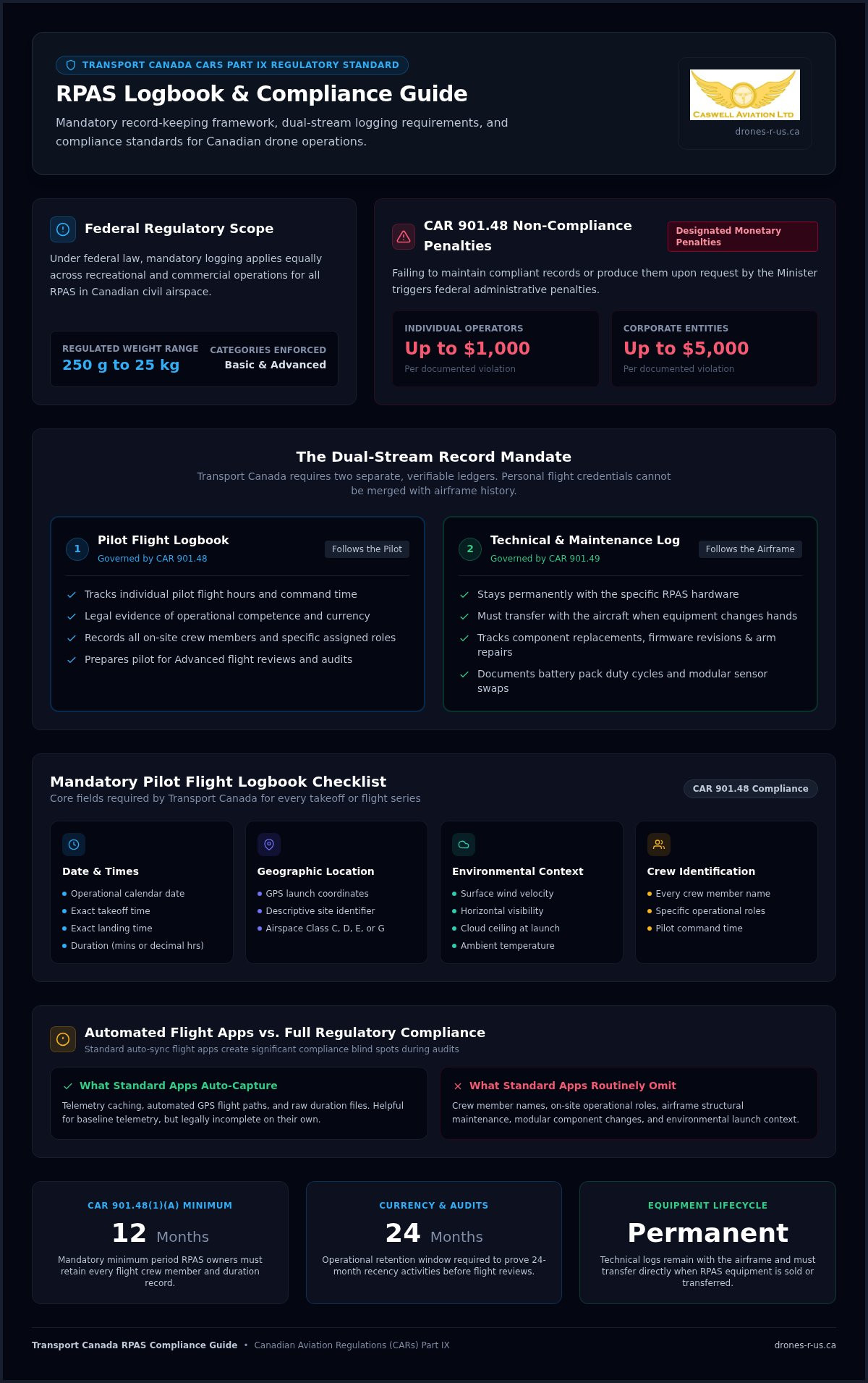
Operating a remotely piloted aircraft system (RPAS) in Canada means entering a regulated civil aviation environment. Transport Canada enforces logbook requirements through Part IX of the Canadian Aviation Regulations (CARs). These mandates are not optional guidelines for commercial operators alone. Under federal law, the same rules apply whether you fly for recreation or commercial enterprise, provided your system weighs between 250 grams and 25 kilograms.
Many pilots mistakenly believe third-party control apps maintain adequate records by caching telemetry. That assumption falls apart during a compliance review. Automated systems capture GPS paths, but they routinely fail to capture crew roles, component changes, and structural maintenance. Meeting drone pilot logbook requirements Transport Canada inspectors enforce requires maintaining two distinct, verifiable tracking streams: an operational pilot flight record and an airframe technical maintenance log. Neglecting either ledger can lead to designated administrative monetary penalties under CAR 901.48, reaching up to $1,000 for individual operators and $5,000 for corporate entities.
Understanding CARs Part IX Legal Obligations
Every certificate holder must comply with federal logging mandates across both Basic and Advanced operational categories. The legal architecture documented in the Regulation of UAVs in Canada establishes that pilots must produce their records upon formal request by the Minister. Specifically, CAR 901.48(1)(a) dictates that RPAS owners must log every flight crew member and the duration of each operation, retaining those entries for at least 12 months. When paired with technical log retention rules and pilot currency tracking, maintaining all operational files for a full 24-month window ensures complete compliance during audits.
Why Drone Flight Logs Differ from Traditional Aviation Logbooks
Traditional aviators log flight hours against fixed airframes and certified engines that undergo structured, calendar-based overhauls. Drone systems operate under a modular reality. A single RPAS pilot might cycle through four different smart lithium-polymer battery packs, swap out payload sensors, or replace damaged motor arms over a single weekend. Your logging framework must track individual battery duty cycles and firmware revisions alongside pilot command time. If you want to structure your operational foundation properly, reviewing our Transport Canada drone certification guide will help you align daily logging habits with federal standards.
Mandatory Pilot Flight Logbook Checklist: Required CAR 901.48 Records
Every operational takeoff requires formal documentation under federal aviation law. While manufacturers design systems to store telemetry files automatically, Transport Canada inspects human-managed pilot ledgers during audits and flight evaluations. Meeting the drone pilot logbook requirements Transport Canada establishes under Canadian Aviation Regulation 901.48 means compiling a strict set of personal flight records for every deployment, entirely separate from your hardware maintenance logs.
Your personal flight logbook serves as formal legal evidence of operational competence, command experience, and continuous currency. Failing to document crew assignments or duration details leaves your operational record vulnerable to enforcement actions.
Core Flight Data Points Required by Law
For each individual flight or consecutive series of flights, operators must capture specific temporal and spatial fields:
- Date and Times: Record the operational calendar date, the exact time of takeoff, the landing time, and total accumulated duration calculated in minutes or decimal hours.
- Geographic Location: Document precise GPS launch coordinates, a descriptive site identifier, and the relevant Canadian airspace classification (Class C, D, E, or G).
- Environmental Context: Note surface wind velocity, horizontal visibility, cloud ceiling, and ambient temperature at launch.
Crew Identification and Operational Roles
A primary enforcement gap in commercial operations is the failure to log all on-site personnel. Standard manufacturer software never tracks secondary crew automatically. You must record:
- Pilot-in-Command (PIC): The full legal name and Transport Canada pilot certificate number of the individual at the controls.
- Visual Observers (VO): Full legal names and assigned observation sectors for all participating observers maintaining line-of-sight monitoring.
- Support Crew: Sensor operators, ground safety coordinators, or technicians actively involved in the flight operation.
Categorizing Flight Nature and Purpose
Transport Canada inspectors examine flight categories to confirm operational limitations. Your log must specify the operational scope: commercial production, internal proficiency training, site surveying, or flight evaluation testing. If your mission involves night flight, operations within 30 metres of bystanders, or controlled airspace entries, reference your active NAV CANADA flight authorization number directly in your entry. Practising these procedures within structured online drone courses and in-person training ensures your flight logs remain organized and compliant under real-world scrutiny.
RPAS Technical and Maintenance Log Checklist: Compliance Under CAR 901.49
A critical distinction in Canadian aviation law separates the operator from the machine. While your personal flight log follows your career, the technical log belongs strictly to the aircraft. Under CAR 901.48(1)(b) and CAR 901.49, owners must maintain an unbroken record of all maintenance, modifications, and inspections performed on the airframe. These records must be retained for at least 24 months. If you sell or transfer your drone, federal law requires you to hand over the preceding 24 months of technical records to the new owner.
Failing to maintain this equipment ledger compromises airworthiness verification. Transport Canada auditors treat missing maintenance records with the same severity as unlogged flight hours. Meeting comprehensive drone pilot logbook requirements Transport Canada mandates means treating every propeller replacement and sensor calibration as a legally auditable event.
Airframe and Component Identification Records
Your technical log must open with definitive equipment identifiers to establish clear provenance:
- System Identifiers: Record the manufacturer, model, serial number, and official Transport Canada registration number (the C-number issued upon the $5 registration).
- Lifespan Airframe Time: Track total accumulated flight hours across the aircraft's entire operational lifespan.
- Modular Components: Log individual operational hours and installation dates for critical propulsion units, electronic speed controllers (ESCs), and payload gimbals.
Maintenance Actions, Repairs, and Firmware Logs
Every mechanical intervention demands immediate documentation. You must capture:
- Scheduled Inspections: Document routine pre-arm inspections and preventative structural overhauls recommended by the manufacturer's user manual.
- Corrective Repairs: Record the date, description of work, names of individuals performing the work, and specific part numbers installed following mechanical wear or minor mishaps.
- Firmware and Software: Log version numbers and installation dates for aircraft firmware, remote controller operating systems, and ground control station applications.
Battery Fleet Cycle Tracking
Intelligent flight batteries represent the primary point of failure for multi-rotor systems. Transport Canada inspectors expect evidence of disciplined energy management during technical audits. Assign a durable, physical identifier (such as B01, B02) to every battery pack in your fleet. For each pack, log total charge cycle counts, internal cell resistance checks, storage discharge compliance, and any thermal or voltage anomalies observed during operation. For an operational breakdown of broader airworthiness principles, consult our Canadian drone regulations reference guide to ensure your maintenance protocols align with national standards.
Digital Apps vs. Physical Logbooks: Choosing a Compliant System
Transport Canada does not dictate whether you log operational hours in a traditional bound book, a custom spreadsheet, or a cloud-based mobile application. The law requires only that your records are accurate, verifiable, and immediately producible during a ramp check or formal audit. Choosing the right system comes down to operational reliability. A software glitch or an unexported database won't shield you from statutory non-compliance penalties if an inspector requests your files.
Evaluating Digital Flight Management Platforms
Flight management software provides obvious efficiency by pulling telemetry directly from your controller. Despite this convenience, automated tools create distinct compliance hazards. Many proprietary platforms lock your flight history behind active monthly subscriptions or fail to store crew roles correctly. Remote Canadian operations often lack cellular coverage, meaning offline caching failures can leave you empty-handed in the field. When evaluating software, ensure the platform supports clean PDF and CSV exports that reflect all mandatory fields. You must manually verify each digital entry to guarantee it meets the drone pilot logbook requirements Transport Canada enforces under Part IX.
Maintaining Physical Hard-Copy Backups
Traditional physical aviation logbooks offer unmatched durability and legal clarity. A bound paper ledger provides a tamper-evident audit trail that never suffers from software obsolescence, corrupted flash storage, or dead tablet batteries during a field review. For enterprise teams, a hybrid workflow delivers the best balance: use digital logging for daily convenience, then transfer verified summaries into a physical master ledger each month. Archiving physical printouts ensures your operational and maintenance history survives the mandatory 24-month retention window intact. If you want to refine your operational record-keeping before facing a Transport Canada check, enroll in our online drone courses and in-person training to establish defensible logging standards.
Maintaining 24-Month Recency and Preparing for Professional Flight Reviews
Earning your pilot certificate is not a one-time achievement. Under Part IX of the Canadian Aviation Regulations, both Basic and Advanced certificate holders must actively maintain 24-month recency to exercise flight privileges legally. While you can maintain recency by retaking the online exam or finishing a self-paced study programme, undergoing an in-person flight evaluation provides the most comprehensive operational assessment. In every scenario, your personal records serve as the sole legal proof that you have satisfied these currency windows.
Failing to demonstrate recency invalidates your pilot credentials immediately. Operating an RPAS while uncurrent exposes you to identical penalties as flying without a certificate. Satisfying drone pilot logbook requirements Transport Canada inspectors scrutinize ensures your currency records withstand examination during random ramp checks or post-incident investigations.
Documenting 24-Month Recency Activities
Every pilot must maintain verifiable proof of their recency activities for at least 24 months from the completion date. Your logbook should contain a dedicated currency section detailing:
- Evaluation History: Dates, locations, and examiner signatures from completed flight reviews.
- Exam Results: Official reference numbers and confirmation dates for recurrent online Transport Canada examinations.
- Refresher Training: Certificates of completion and syllabus summaries from endorsed educational courses.
- Operational Flight Time: Cumulative command hours flown over the preceding 24 months, showing consistent handling competence across varied operating conditions.
Logbook Presentation for Flight Reviews
Before launching an aircraft during an Advanced or Level 1 Complex flight review, an authorized flight reviewer evaluates your documentation. The reviewer conducts a structured audit examining your personal flight log, system maintenance records, and equipment registration certificates. If your records show unverified battery cycles, missing visual observer names, or gaps in scheduled airframe maintenance, the reviewer cannot proceed with the practical flight assessment. To understand what evaluators examine before ground briefing begins, study our guide to Canadian drone flight reviews. When you are ready to validate your operational competency, book your assessment through Caswell Aviation Ltd's drone training and flight review programmes to complete your certification with confidence.
Standardize Your Flight Records for Total Audit Confidence
Rigorous record-keeping transforms regulatory compliance from an administrative chore into an operational asset. Maintaining distinct ledgers for your pilot command time and airframe technical maintenance protects your standing under CARs Part IX, while disciplined battery and repair logs ensure your equipment remains airworthy. When an inspector or flight reviewer requests your files, organized documentation proves that you operate with true aviation discipline.
Mastering the drone pilot logbook requirements Transport Canada enforces is also the foundational step toward earning advanced operational privileges. Whether you are tracking 24-month recency activities or preparing your aircraft ledger for a formal evaluation, orderly records give you peace of mind. When you are ready to validate your qualifications, ensure complete compliance with professional flight reviews and drone training across Canada through Caswell Aviation. With a nationwide curriculum built directly around federal standards and authorized evaluations for Advanced and Level 1 Complex certifications, you can operate with absolute confidence on every mission.
Frequently Asked Questions
Is a drone pilot logbook legally mandatory for all flights in Canada?
Yes, keeping flight records is mandatory under Part IX of the Canadian Aviation Regulations for any drone weighing between 250 grams and 25 kilograms. Federal law applies equally to recreational flyers and enterprise operators. Only micro-drones weighing under 250 grams are exempt from mandatory logging, though maintaining flight time remains a best practice for all aviators.
Can I rely solely on flight data stored automatically in my controller app?
No, automated flight applications alone do not satisfy drone pilot logbook requirements Transport Canada enforces during an audit. Built-in manufacturer software records telemetry coordinates and hardware status, but it consistently omits mandatory regulatory fields. You must manually record visual observer identities, pilot certificate numbers, operational mission types, and airspace authorization references.
What is the difference between a pilot log and an aircraft maintenance log?
A pilot logbook documents an individual's personal flight history, command time, and operational experience across different airframes throughout their aviation career. Conversely, an aircraft technical maintenance log belongs directly to the specific drone. It tracks lifetime airframe hours, component repairs, firmware updates, and battery duty cycles, and it must transfer to the new owner if the aircraft is sold.
How long must I keep my Transport Canada drone flight logs?
Retention schedules depend on the specific record category under federal aviation law. Under CAR 901.48, operational pilot flight records must be retained for at least 12 months from the flight date. Airframe technical maintenance logs and official documentation proving your 24-month pilot recency activities must be kept for a minimum of 24 months.
What specific information must be recorded for every commercial drone flight?
Canadian aviation law does not distinguish between commercial and private flights for record-keeping. Every entry must detail the operational date, takeoff and landing times, total flight duration, launch coordinates, and airspace class. You must also record the legal names and roles of all crew members, alongside any relevant NAV CANADA flight authorization clearances.
How do I prove my 24-month recency requirement using my flight logbook?
You prove recency by maintaining a dedicated section in your logbook that documents certified recurrent training activities. This includes logging the completion date and reference code of your online Transport Canada exam, records of completed self-paced study programmes, or an official sign-off from an authorized flight reviewer following an Advanced or Level 1 Complex flight evaluation.
What happens if Transport Canada inspects my operations and I have no logbook?
Operating without verifiable flight and maintenance records constitutes a designated regulatory violation under CAR 901.48. Transport Canada enforcement officers can issue administrative monetary penalties reaching up to $1,000 for individual pilots and $5,000 for corporations. Inspectors may also suspend your pilot certificate or pause commercial operating privileges until you demonstrate compliance with all drone pilot logbook requirements Transport Canada mandates.
Leave a comment