

Drone Pilot Gear Checklist for Legal, Safe Flights
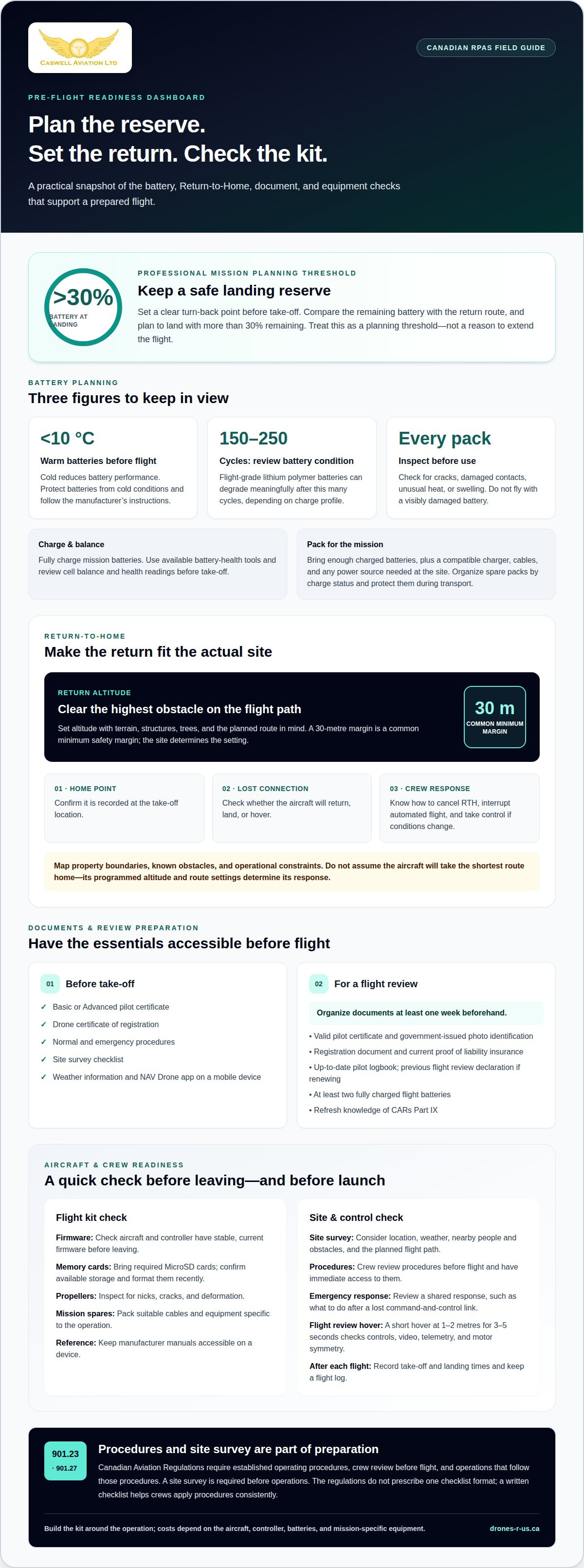
A pre-flight checklist is not prescribed in a specific format, but Canadian Aviation Regulations 901.23 (1) require RPAS pilots to establish normal operating procedures, and 901.23 (3) requires each crew member to review them before flight. A drone pilot gear checklist can make those procedures practical, while keeping required documents and flight equipment organized.
It’s easy to focus on batteries and propellers, but paperwork matters too. Basic and Advanced pilots need access to their pilot certificate, certificate of registration, normal and emergency procedures, and site survey checklist before flying. This guide covers what to prepare, from documents and batteries to Return-to-Home settings and a final equipment check, so you can review the essentials before takeoff.
Key Takeaways
- Canadian rules require established flight procedures, crew review before flight, and a site survey; a written checklist helps keep these steps consistent.
- Plan battery reserves and set Return-to-Home altitude with the route’s terrain and obstacles in mind.
- Keep your pilot certificate, registration, operating procedures, and site survey checklist accessible before takeoff.
- Inspect the drone, propellers, controller, and display, and prepare memory cards, firmware, and mission-specific spares before leaving.
- Match your equipment to the operation, including suitable anti-collision lighting for night flights.
Is a drone pre-flight checklist legally required?
Canadian Aviation Regulations require established operating procedures, but don’t prescribe one checklist format. Under 901.23 (1), RPAS pilots must establish normal procedures covering pre-flight, take-off, launch, approach, landing, and recovery. Under 901.23 (2), procedures must reflect relevant manufacturer instructions. Each crew member must review them before flight and have immediate access under 901.23 (3). Operations must follow those procedures under 901.23 (4). A written drone pilot gear checklist helps crews apply them consistently.
Site planning is also part of the required preparation. Under 901.27, an RPAS pilot must conduct a site survey before operations and consider relevant operational and environmental factors. The survey can be electronic, verbal, or on paper. Include the location, weather, nearby people and obstacles, and the planned flight path. Micro-drone pilots should also have procedures for site surveys and emergencies.
- Confirm firmware: Check that the aircraft and controller use stable, current firmware before leaving. This avoids a field delay for a large download.
- Prepare memory cards: Bring the required MicroSD cards, confirm available storage, and format them recently. This reduces the risk of running out of space during a mission.
- Pack flight-kit spares: Bring charged batteries, suitable cables, and any mission-specific equipment. For an RPAS flight review, bring at least two fully charged flight batteries.
- Check the aircraft: Inspect propellers for nicks, cracks, and deformation on review day. Damaged components can affect safe operation.
How much does a complete drone pilot gear kit cost in Canada? There’s no fixed total: costs depend on the aircraft, controller, batteries, and mission-specific equipment. Build your kit around the operation instead of buying accessories without a clear purpose.
What weather and visibility tools should drone pilots carry? Bring a mobile device with weather information and the NAV Drone app, then assess local conditions during the site survey. Keep the manufacturer’s manuals accessible on the device for reference during operations.
What first-aid and emergency gear should drone pilots bring? Carry a first-aid kit suited to the site, and keep emergency procedures accessible to the crew. Review an emergency procedure together before flight, such as how to respond to a lost command-and-control link.
For a flight review, organize your documents at least one week beforehand. Bring a valid Basic or Advanced RPAS pilot certificate in print or digital form, government-issued photo identification, the drone’s Transport Canada registration document, current proof of liability insurance, and an up-to-date pilot logbook. If you’re renewing, bring the previous flight review declaration. Refresh your knowledge of CARs Part IX before the assessment.
During the practical assessment, state intended actions clearly, such as climbing to 50 feet. A short hover test at 1-2 metres for 3-5 seconds checks controls, video, telemetry, and motor symmetry. After each flight, record take-off and landing times and keep a flight log. For photogrammetry, plan ground sample distance, camera settings, and image overlap before arriving on site.
Battery planning and Return-to-Home settings
Battery planning connects mission distance, weather, aircraft performance, and a safe landing reserve. Set a clear turn-back point before takeoff, then compare the remaining battery with the return route. A professional mission plan should allow the aircraft to land with more than 30% battery remaining. Treat that reserve as a planning threshold, not a reason to extend the flight.
- Charge and balance batteries: Fully charge mission batteries and use available battery-health tools in the flight app. Cell balance and health readings can identify concerns before the aircraft leaves the ground.
- Inspect every pack: Look for cracks, damaged contacts, unusual heat, or swelling. Don’t fly with a visibly damaged battery; safely dispose of batteries showing damage, particularly swelling.
- Plan for cold: Below 10 °C, warm batteries before flight because cold reduces performance. Keep them protected from cold conditions and follow the manufacturer’s instructions for use.
- Track battery age: Flight-grade lithium polymer batteries can degrade meaningfully after 150-250 cycles, depending on charge profile. Review cycle history alongside health readings and physical inspection.
Return-to-Home (RTH) settings need to match the actual site. Before launch, confirm the home point is recorded at the take-off location and that the RTH action suits the aircraft and operation. Set the return altitude above the highest obstacle on the flight path. A 30-metre margin is a common minimum safety margin, but terrain, structures, trees, and the planned route determine the setting. Map property boundaries, known obstacles, and operational constraints so the return path doesn’t cut across hazards.
Check the aircraft’s Return-to-Home behaviour in its software before each mission. Confirm whether it will return, land, or hover after a lost connection, and know how to cancel an RTH command. Don’t assume the aircraft will take the shortest route home: its programmed altitude and route settings determine its response. Make sure the crew knows how to interrupt automated flight and take control if conditions change.
Backup equipment supports the plan, but it doesn’t replace battery inspection. Pack enough charged batteries for the mission, plus the compatible charger, cables, and power source needed at the site. Keep spare packs protected during transport, separate from loose metal objects, and organized by charge status. After landing, let batteries cool before charging or storage, then check them for damage. Batteries not needed again soon should be stored at the manufacturer-recommended voltage, typically 40-60%.
Use these battery and failsafe steps as part of a repeatable flight routine. Drone flight training can help pilots build sound operational habits around equipment and mission preparation.
Documents Basic and Advanced pilots need access to
Keep required documents accessible during flight, not just at home. Basic and Advanced pilots need access to their pilot certificate, certificate of registration, normal procedures, emergency procedures, and site survey checklist. Store digital copies on the mobile device used for the flight, with paper backups where practical. Organize files so the pilot or crew can open the right version without searching through unrelated folders.
- Pilot certificate: Keep the applicable Basic or Advanced RPAS pilot certificate accessible because it identifies the pilot’s privileges.
- Registration document: Keep the aircraft’s certificate of registration available because the document relates to that specific drone.
- Normal procedures: Make the procedures available to every crew member because they cover the operation from pre-flight through recovery.
- Emergency procedures: Keep the current response steps close at hand because crews may need them during abnormal events.
- Site survey checklist: Record the site’s operational and environmental factors because conditions can change between locations and missions.
Canadian Aviation Regulations 901.23 (1) require established emergency procedures for control station failure, equipment failure, RPAS failure, and loss of command and control link. They must also address fly-away, flight termination, and detecting or avoiding conflicting air traffic and other hazards. Use clear language that crew members can follow under pressure. Identify the action, who performs it, and what the other crew members do.
Site survey records support the decision to fly at a specific location. Under Canadian Aviation Regulations 901.27, the pilot must conduct a site survey before operations and consider relevant operational and environmental factors. Include property boundaries, known obstacles, no-fly zones, nearby activity, and the planned route. The survey may be completed electronically, verbally, or on paper. Keep the record with mission documents so the crew can refer to the same information.
Some Advanced operations require additional documentation. Advanced pilots need proof of the manufacturer’s safety assurance declaration for operations in controlled airspace, near people, or over people. Request permission for controlled-airspace flights through the NAV Drone Portal. Keep the applicable declaration and permission details with the site plan, so the pilot can match the paperwork to the operation.
Before flying, confirm recency requirements and document access. Pilots must complete a recency exercise before flying if 24 months or more have passed since their last recency exercise. For an RPAS flight review, organize documents at least one week beforehand. Bring the required certificate, government-issued photo identification, registration document, proof of liability insurance, and an up-to-date pilot logbook. If renewing, include the previous flight review declaration. This advance preparation helps the candidate focus on the assessment and perform each required task without searching through a device or bag.
Drone and controller equipment preparation
Inspect the aircraft, controller, and display before packing. Look over the airframe, arms, landing gear, and propellers for damage. Check that each component is secure and moves as intended. A small crack or loose part can affect how the aircraft performs. Remove damaged propellers rather than relying on them for another flight.
- Charge the equipment: Confirm the aircraft, remote controller, and display tablet are charged. A powered controller helps maintain command and control during the planned operation.
- Check the software: Confirm the aircraft and controller use the same compatible firmware version. Review app prompts before travelling so updates don’t interrupt preparation on the ground.
- Pack mission spares: Bring compatible cables, propellers, and tools needed for the aircraft. Keep small parts contained, so they remain easy to find at the site.
- Protect transport equipment: Use a case or bag that fits the aircraft and its accessories. Secure the aircraft and batteries during transport to limit movement and accidental contact.
- Prepare the launch area: A landing pad can help mark a clear take-off and landing surface. Choose one suited to the ground conditions and aircraft footprint.
Which landing pads, cases, and transport bags work best for drone pilots? Choose a pad that stays stable on the launch surface, and a case or bag that fits the aircraft and protects its parts during transport. The right choice depends on the drone, the terrain, and the equipment needed for the mission.
What gear differs for recreational, Basic, and Advanced drone operations in Canada? Equipment depends on the operation and aircraft. Basic and Advanced pilots need access to their certificates, registration, procedures, and site survey checklist. Advanced operations in controlled airspace, near people, or over people also require proof of the manufacturer’s safety assurance declaration.
What equipment must Canadian drone pilots carry to meet Transport Canada rules? Pilots need access to required documents and established procedures, but the rules don’t prescribe one universal equipment kit. For controlled-airspace flights, request permission through the NAV Drone Portal. Carry the relevant documents in a usable form, digitally or on paper.
Before powering up, compare the flight plan with conditions at the site. Confirm that launch and landing areas are clear, and check that the aircraft’s controls respond correctly. Keep the controller within reach and its display visible throughout the flight. In an emergency, the pilot must be able to interrupt automated flight, cancel Return-to-Home, and disarm the motors.
Finally, scan the take-off area and flight path for people, vehicles, and obstacles. Confirm that the planned route respects site boundaries and airspace constraints. Keep emergency procedures accessible to crew members, and make sure everyone understands their role. These equipment checks support safe operations, but they don’t replace the site survey or operating procedures.
What gear is required for a drone pilot in Canada?
The required equipment depends on the aircraft and planned operation. Start with the drone, its controller, and a charged display device. Add mission equipment only when needed, such as a camera payload, MicroSD card, or landing pad. Keep manuals and operating procedures accessible on the ground and during flight. A useful kit supports the aircraft’s intended use without adding equipment the crew can’t manage safely.
Night operations have a specific lighting requirement: anti-collision lighting must be visible for at least 3 statute miles. Position and test the light before launch, then confirm it remains visible from the planned operating area. A light that is obstructed by the airframe or payload won’t serve its purpose. Include lighting checks in the flight procedure whenever the operation takes place at night.
- Aircraft and controller: Pack the aircraft, remote controller, display tablet, and compatible connection cables. Check that controls respond and the screen remains readable outdoors.
- Mission data: Bring MicroSD cards with enough storage for the planned capture. For mapping flights, prepare the camera settings and overlap plan before reaching the site.
- Site equipment: Carry a landing pad when the ground is uneven, wet, dusty, or covered with loose material. Select a case or transport bag that secures the aircraft and accessories.
- Emergency access: Keep emergency procedures available to the crew. Make sure the pilot can interrupt automated flight, cancel Return-to-Home, and disarm the motors.
- Operation-specific items: Pack the equipment needed for the location, weather, and payload. A survey mission may require different accessories from aerial photography or video work.
Documents are part of flight readiness, even though they aren’t physical aircraft gear. Basic and Advanced pilots need access to their pilot certificate, registration document, normal and emergency procedures, and site survey checklist. Advanced operations in controlled airspace, near people, or over people also require proof of the manufacturer’s safety assurance declaration. Keep digital records on the flight device, with a backup available in case the screen or battery fails.
Before departure, match the kit to the site survey. Confirm the flight route, airspace constraints, nearby obstacles, and weather conditions. Then check that every accessory fits the aircraft and won’t interfere with controls, sensors, or propellers. For night flights, verify the anti-collision light’s visibility against the 3-statute-mile requirement. A deliberate equipment check helps the pilot arrive prepared to perform the planned operation.
For structured preparation around Canadian flight requirements, build your drone pilot knowledge through focused learning.
Caswell Aviation: Fitek Gear Drone Harnesses for Smart Controllers
Caswell Aviation Ltd offers Fitek Gear Drone Harnesses for Smart Controllers as an option for pilots organising their controller setup. If your preparation also raises questions about Canadian operating procedures or certification, its Online Drone Courses and In-Person Training and Advanced & Level 1 Complex Flight Reviews provide a practical next step. For projects requiring aerial imagery, Caswell Aviation Ltd also offers Drone Aerial Photography and Video. Choose the support that fits your flight needs, whether you are preparing for a review, building knowledge, or planning an imagery project. Contact Caswell Aviation Ltd to discuss the next step.
Make Your Next Flight Routine More Consistent
Treat your drone pilot gear checklist as a working document, not a page that stays unchanged. After each mission, note which steps helped the crew prepare and which equipment was difficult to access. A new location, payload, or crew arrangement may call for a different sequence. Keep instructions clear enough for every crew member to follow, then review the process before the next operation. Regular refinements turn preparation into a practical routine instead of a last-minute scramble.
If you’re preparing for training, a flight review, or an aerial imaging project, Caswell Aviation Ltd can help you identify a suitable next step. Its Online Drone Courses and InPerson Training, Advanced & Level 1 Complex Flight Reviews, and Drone Aerial Photography and Video serve different operational needs. Contact Caswell Aviation Ltd to discuss what you’re planning. Approach each flight methodically, learn from each operation, and build confidence through sound preparation.
Frequently Asked Questions
What is the most commonly skipped pre-flight check?
One check pilots can overlook is making sure the camera or payload is ready for the mission. Before launch, verify the camera mode, storage destination, and capture trigger. For a mapping flight, confirm that the planned image overlap and ground sample distance match the mission plan. A brief review helps prevent a safe flight that fails to collect usable imagery.
What pre-flight safety checklist should drone pilots follow?
Use a checklist that follows the operation from setup to recovery, with steps every crew member can understand. Confirm assigned roles, review the planned response to an interruption, and make sure the pilot can take control from automated flight. Include a final check that the aircraft’s intended actions match the mission plan. Keep the procedure easy to follow in field conditions.
What drone batteries, chargers, and power accessories should pilots pack?
Pack batteries compatible with the aircraft, along with the manufacturer-recommended charger and its required cables. Add a suitable power source if the mission site lacks convenient charging access. Separate charged batteries from those awaiting charging, and label their status clearly to avoid choosing the wrong pack. For a longer field day, plan power around the flight schedule and expected downtime.
What spare parts and maintenance tools should be in a drone pilot kit?
Build your kit around the aircraft model and planned work. Useful examples include compatible spare propellers, the manufacturer’s fitting tool, and a small cloth for cleaning the camera lens. Store parts in labelled compartments so they’re easy to find without unpacking the whole case. Carry only tools you know how to use, and follow the aircraft manufacturer’s maintenance instructions.
Leave a comment