

Drone Flight Reviews in Alberta for Advanced and Level 1 Complex Operations
Passing the Advanced Exam is only one part of qualifying for Advanced Operations. Across Canada, a drone flight review follows a successful exam and must be completed with a certified reviewer within 12 months. Yes, the course includes a Flight Review with a Transport Canada reviewer.
It is reasonable to want to know what the review involves before you prepare. Advanced and Level 1 Complex reviews lead to different pilot certificates, and the Level 1 Complex review covers RPAS over 25 kg.
This article explains the requirements for a drone flight review in Canada, the flight skills and site awareness assessed, and how Caswell Aviation Ltd helps you prepare for a safe, organised evaluation. You will also learn how site conditions and reviewer-led practice relate to readiness, so you know what to expect before taking the next step.
Key Takeaways
- Understand how checklists, site surveys, take-off-area selection and awareness of other aircraft factor into the review.
- See how flight planning addresses controlled airspace, operations near or over people, and urban or built-up areas.
- Learn which site conditions support a practical review and how an instructor’s experience can guide preparation.
- Prepare to describe Level 1 Complex emergency procedures, including lost-link and fly-away actions and whom to contact after a fly-away.
- Identify when structured training or a professional flight review can help you prepare for your intended operations.
Flight reviews for Advanced Operations and Level 1 Complex Operations
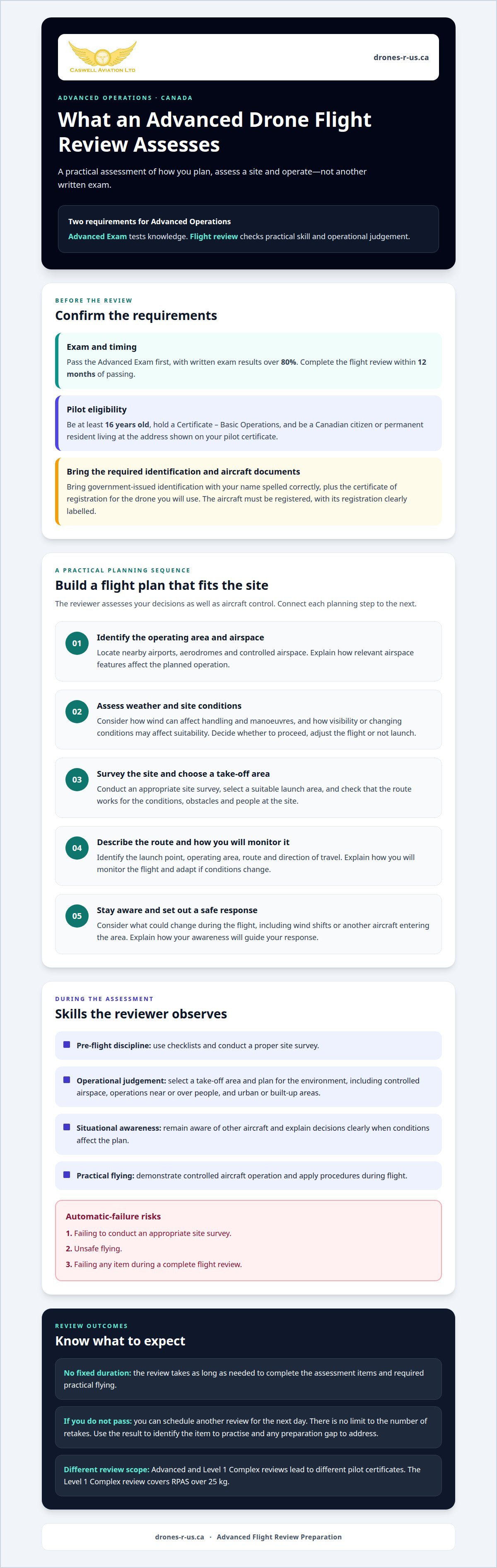
In Canada, the Advanced Exam and a flight review are the two knowledge and practical requirements for Advanced Operations. The review assesses flying skills and operational judgement, not just written knowledge.
Advanced Pilot Certificate Reviews
A drone flight review in Alberta is a practical assessment conducted by a certified reviewer. It checks whether you can plan and conduct a flight safely, applying your knowledge in an operating environment. The review is one step toward an Advanced Pilot Certificate, not another written exam.
For Advanced Operations, pilots must be at least 16 years old and complete the review within 12 months of passing the Advanced Exam. The assessment considers operations in controlled airspace, near or over people, and in urban or built-up areas. These capabilities distinguish Advanced privileges from Basic Operations.
Advanced Review Requirements and Exams
The Transport Canada Advanced RPAS exam tests knowledge; the flight review tests practical application. Pilots must pass the Advanced Exam before completing the review. They also need a Certificate - Basic Operations before the review, and successful written exam results with a score over 80%.
Prepare the required documents and aircraft. You’ll need government-issued identification with your name spelled correctly, along with the certificate of registration for the drone you’ll use. The aircraft must be registered, and its registration clearly labelled. Candidates must be Canadian citizens or permanent residents and live at the address shown on their pilot certificate.
Before the assessment, organize your documents, review operating procedures, and practise with the registered aircraft. A common mistake is arriving without the required identification or registration documents. Another is assuming that passing the written exam proves practical skill. The review assesses how you apply procedures during flight.
Flight Review Skills and Manoeuvres
The review examines how you use checklists, conduct a site survey, select a take-off area, and stay aware of other aircraft. These tasks connect pre-flight decisions with safe operation. A site survey is essential, not a formality: failing to conduct an appropriate survey is an automatic failure.
Reviewers also assess your ability to plan and conduct Advanced operations in the relevant environment. Unsafe flying is an automatic failure, as is failing any item during a complete flight review. Practise controlled flying and explain your decisions clearly, especially when conditions affect your launch area or flight plan.
Review Timing and Outcomes
The review’s duration depends on completing the assessment items and required practical flying; there is no fixed time for every review. The reviewer evaluates the full process, including planning, site assessment, aircraft operation, and awareness. Allow time to prepare your documents and equipment, not just for the flight itself.
If you fail a review, you can schedule another for the next day, and there is no limit to the number of retakes. Treat the result as specific feedback: identify the failed item, practise that skill, and address any preparation gap before trying again. For a drone flight review in Alberta, readiness means demonstrating sound decisions as well as aircraft control.
Airspace, weather, navigation, and flight planning
A flight plan connects your intended operation with conditions at the review site. In Alberta, be ready to explain how airspace, weather, navigation, and your chosen flight area shape your decisions.
Start by identifying the airspace around the proposed operating area. A map or planning tool can help you locate nearby airports, aerodromes, and controlled airspace. The key is to recognize relevant features and explain how they affect your planned operation. For example, a route near an airport requires careful airspace assessment before launch.
Include weather in your assessment from the outset. Wind can affect aircraft handling and the control input needed for a manoeuvre. Visibility and changing conditions also influence whether the area is suitable for the planned flight. A sound plan links the conditions observed on site to a clear decision: proceed, adjust the flight, or do not launch.
Plan your navigation so you can clearly describe the intended flight. Identify the operating area, route, launch point, and direction of travel. Then consider what might change during the flight, such as a shift in wind or another aircraft entering the area. This shows the reviewer that you can stay aware and adapt, rather than relying only on your original route.
A useful planning sequence is to:
- Identify the operating area and nearby airspace features.
- Assess weather conditions that could affect control or visibility.
- Choose a take-off area that supports the planned route.
- Describe how the flight will be monitored and adjusted.
- Set out a safe response if conditions or traffic change.
Make sure each step connects to the next. For example, if wind affects your planned direction of travel, explain how the route or launch position accounts for it. If another aircraft appears, your situational awareness should inform your response. The reviewer assesses your planning judgement as well as aircraft control.
Make the plan specific to the site. A route that works in an open area may not suit a built-up setting with nearby obstacles or people. Your site survey, weather assessment, and navigation plan should be consistent. A mismatch, such as a route crossing a hazard you identified, signals a gap in preparation.
For an Advanced review, flight planning also supports operations in controlled airspace, near or over people, and in urban or built-up areas. Use the intended operation to guide preparation, and explain how each site condition informs the plan. A focused Advanced and Level 1 Complex flight review can assess these practical decisions as part of the review.
Flight review site capabilities and locations
To book a drone flight review in Alberta, arrange an assessment with a certified reviewer and identify whether you need the Advanced or Level 1 Complex review. The reviewer sets the fee, which is shown before booking.
Choose a site that lets the reviewer assess practical decisions as well as basic aircraft control. It needs a safe take-off area and enough room for the planned flight exercises. Nearby people, obstacles, and other aircraft also matter because they can affect your site survey and operating plan.
No single location suits every assessment. The planned operation, airspace, and local conditions determine what the reviewer needs to observe. An open area may provide clear space for manoeuvres, while a built-up setting can introduce obstacles and nearby people to consider. In either case, explain how the site conditions affect your plan.
A useful site assessment links the launch point to the intended flight area. For example, an obstacle near the take-off location may limit the safe direction of travel. A route near people may call for a different plan from one in a clear area. The reviewer assesses whether you recognize these factors and make sound choices.
Before the review, confirm the meeting location and aircraft requirements with the reviewer. Bring the registered RPAS you intend to use, with its registration clearly labelled, and its certificate of registration. These are required for the assessment to proceed with the correct aircraft and documentation.
At the site, the review includes practical checks such as:
- Surveying the area for hazards and identifying a suitable take-off area.
- Considering nearby people, obstacles, and potential aircraft activity.
- Connecting the planned route to the site’s conditions.
- Explaining how a change in conditions could affect the operation.
Your choice of location also affects how clearly you can demonstrate awareness. Overlooking a relevant hazard during the site survey is a serious gap; failing to conduct an appropriate survey is an automatic failure. Be prepared to explain what you observed and how it informed your launch decision.
Alberta’s varied settings make site-specific judgement important. A rural field, urban area, and location near an aerodrome each present different planning considerations. The review evaluates your decisions for the actual site, rather than assuming one location or flight plan suits every operation.
Instructor qualifications and experience
A certified reviewer must conduct the flight review. Instructors can help you prepare, but training and formal assessment are distinct roles. Understanding the difference clarifies who teaches a skill and who evaluates it during the review.
Experience is most useful when it turns requirements into clear, practical decisions. For example, an instructor can explain how a site survey informs take-off-area selection, then help you practise the process. During the assessment, the reviewer evaluates whether you can demonstrate those skills independently.
Preparation should connect classroom knowledge with real flight tasks. A useful training session might work through a checklist, discuss a sample site, and practise a planned manoeuvre. The instructor can explain why each step matters; the reviewer later assesses your performance against the review requirements. Some reviewers also offer a preparation session before the review.
Choose training that addresses the operations you intend to conduct. Advanced Operations include controlled airspace, operations near or over people, and urban or built-up areas. Examples from these settings can help you explore how decisions change with the site. Training should also cover the sequence from pre-flight planning to safe flight conduct.
A structured, instructor-led skills review can help identify gaps before the assessment. For instance, practise describing a site survey, selecting a launch area, and explaining how you stay aware of other aircraft. The goal is to connect each action to a sound operational decision, not simply repeat a checklist from memory.
Keep the roles clear during preparation:
- Instructor: explains procedures, demonstrates tasks, and supports practice.
- Certified reviewer: conducts the flight review and evaluates demonstrated knowledge and skills.
- Pilot: applies procedures, explains decisions, and operates the aircraft safely.
Reviewers also have responsibilities after assessment. In Canada, a reviewer submits flight review results online within 24 hours. This is separate from the instructor’s role in helping a candidate prepare, and it reinforces why formal assessment must be carried out by a certified reviewer.
When preparing for a drone flight review in Alberta, use instruction to strengthen the skills the assessment examines. Practise explaining your decisions as well as performing tasks: why a launch area suits the site, how a checklist guides preparation, and what changes when conditions affect the plan. This makes training relevant to the practical assessment without confusing instruction with certification.
Caswell Aviation Ltd: Advanced & Level 1 Complex Flight Reviews
Caswell Aviation Ltd offers Advanced and Level 1 Complex flight reviews for pilots preparing to demonstrate their practical skills. If you need to strengthen your knowledge before assessment, online drone courses and optional in-person training support preparation for Transport Canada Advanced and Level 1 Complex certification.
Choose the review that matches the certificate you’re pursuing. For Level 1 Complex, preparation should include ground-school proof and clear explanations of lost-link and fly-away procedures. For Advanced Operations, focus on applying checklists, site surveys, and flight planning to the review setting.
Contact Caswell Aviation Ltd to discuss an Advanced or Level 1 Complex flight review.
A pilot does not necessarily need to hold an Advanced certificate before pursuing the combined outcome: Transport Canada allows a pilot holding only a Basic drone license to complete a Level 1 Complex Flight Review and earn both Advanced and Level 1 Complex certificates. If that route fits your goal, clarify with Caswell Aviation Ltd that your preparation and review are intended to support both certificates. Use the opportunity to identify what you already understand, what needs further attention, and how you will explain your decisions during the review. A focused plan can help keep preparation aligned with the certificates you intend to earn, rather than treating the two outcomes as unrelated steps.
Consider knowledge maintenance as part of planning, not only as something to address before an assessment. Transport Canada may invalidate a drone flight review result if the pilot lets their knowledge level lapse for more than 2 years. Keep the potential effect of a lapse in mind when deciding when to prepare and complete a review, and ask Caswell Aviation Ltd how to approach a review if your knowledge may no longer be current. Continuing to revisit the procedures and explanations relevant to your operations can help you stay ready to demonstrate what you know. Before arranging a review, make sure you understand which certificate or certificates you are seeking and whether your preparation addresses each goal. That can make the review plan clearer and help you decide what support to request.
Caswell Aviation: Advanced & Level 1 Complex Flight Reviews
Caswell Aviation offers Advanced and Level 1 Complex flight reviews for pilots preparing to demonstrate their practical skills. If you need to strengthen your knowledge before assessment, online drone courses and optional in-person training support preparation for Transport Canada Advanced and Level 1 Complex certification.
Choose the review that matches the certificate you’re pursuing. For Level 1 Complex, preparation should include ground-school proof and clear explanations of lost-link and fly-away procedures. For Advanced Operations, focus on applying checklists, site surveys, and flight planning to the review setting.
Contact Caswell Aviation to discuss an Advanced or Level 1 Complex flight review.
Set Your Next Flight Goal
Set a clear preparation goal based on the operations you intend to conduct. A drone flight review in Alberta can be the next step in your development as a pilot, and the decisions you practise can inform how you approach future flights. Focus on the judgement and habits you want to carry into your work.
Before moving ahead, consider what you want to be ready to do and where you need more practice. A focused plan can make your next stage of learning more relevant to your goals.
If you’re ready to discuss your next step, contact Caswell Aviation Ltd. A clear goal gives you a practical place to begin.
Frequently Asked Questions
Does this course include a Flight Review?
Yes. The course includes a flight review with a Transport Canada reviewer. Treat instruction and assessment as connected but distinct parts of preparation: use the learning stage to build understanding, then demonstrate practical judgement during the review. Set a clear study goal around the operations you intend to conduct, so your preparation goes beyond written exam performance.
What certifications do I receive?
You may receive an Advanced certificate, a Level 1 Complex certificate, or both, depending on the review pathway completed. These are separate qualifications, so decide which operations you want to conduct before choosing your goal. If you are pursuing both, organize your study plan around each qualification’s requirements rather than assuming one assessment automatically covers every intended operation.
What equipment do I need?
You need the RPAS intended for the assessment and its normal control equipment. Choose an aircraft suitable for the review category, then practise with that same setup so its handling is familiar. For Level 1 Complex, the aircraft category matters because the review concerns RPAS over 25 kg. Avoid relying on a different aircraft during preparation if it handles differently.
What topics are covered?
The assessment connects operational knowledge with practical decisions. Candidates should be prepared to discuss how a planned operation fits its location and how their decisions support safe flight. Level 1 Complex preparation also includes emergency-response knowledge. A useful study method is to explain the reason behind each operational choice, rather than memorizing isolated terms without connecting them to a flight scenario.
Who is this course for?
The course is intended for people working toward Transport Canada Advanced or Level 1 Complex certification. It can suit pilots who want structured learning before an assessment or who benefit from optional in-person instruction. Start by identifying the certificate you are pursuing and the experience you want to gain. That helps you choose a preparation approach suited to your learning needs.
Who needs a drone flight review in Canada?
Pilots pursuing the qualifications for Advanced Operations or Level 1 Complex operations need the applicable review in their certification pathway. The review is not a substitute for deciding which certificate matches the intended work. For example, a pilot planning operations that require Advanced privileges should prepare for that pathway, while a pilot seeking Level 1 Complex qualification should follow its distinct requirements.
What are the requirements to take a drone flight review?
Requirements depend on the review category. Advanced candidates must meet the age, certificate, exam-result, residency, and timing criteria described above. Level 1 Complex candidates also need the required ground-school proof. Before planning an assessment, identify the intended certificate and use its prerequisites to organize your preparation. Foreign pilots must apply for an SFOC-RPAS before a review.
What documents and equipment should I bring to a drone flight review?
Bring the documents and aircraft needed to establish your identity, registration, and eligibility for the assessment. Keep the paperwork together and make sure it matches the RPAS you’ll operate. The preparation sections above explain the specific items for each pathway. A simple packing routine can prevent administrative omissions from distracting you during the practical assessment.
Leave a comment