

Drone Accident Reporting in Canada: Pilot Guide
A drone accident doesn’t automatically mean the same report goes to the same authority. With drone accident reporting Canada, the first decisions are more immediate: protect people, manage hazards, and establish what happened before choosing a reporting path.
If you’re unsure whether to contact emergency services, Transport Canada, the Transportation Safety Board (TSB), or NAV CANADA, that uncertainty is understandable. A serious injury, a fly-away, or damage to the aircraft can call for different actions. Transport Canada’s occurrence-analysis requirements are also distinct from the TSB’s mandatory reporting criteria. Knowing which process may apply can help you avoid missing an important step.
This guide explains how to respond safely, check which requirements may apply, and preserve records for accurate follow-up. You’ll learn what to do first, how to distinguish Transport Canada record-keeping from TSB reporting, and what to document, including flight logs, photos, and your analysis of the cause. The sequence is straightforward: put safety first, classify the occurrence, then follow up with the facts in hand.
Key Takeaways
- Assess what happened before assuming that aircraft damage means a formal report is required.
- Prioritize people and hazards. Equipment recovery and paperwork can wait until the scene is safe.
- For drone accident reporting Canada, check current official criteria and determine whether Transport Canada, the TSB, or both may need to be involved.
- Keep relevant records intact and save copies of reports, reference numbers, and communications for follow-up.
- Use the review to identify practical improvements to operating procedures, aircraft condition checks, site assessments, and pilot decision-making.
Drone accident reporting in Canada: what counts as an occurrence?
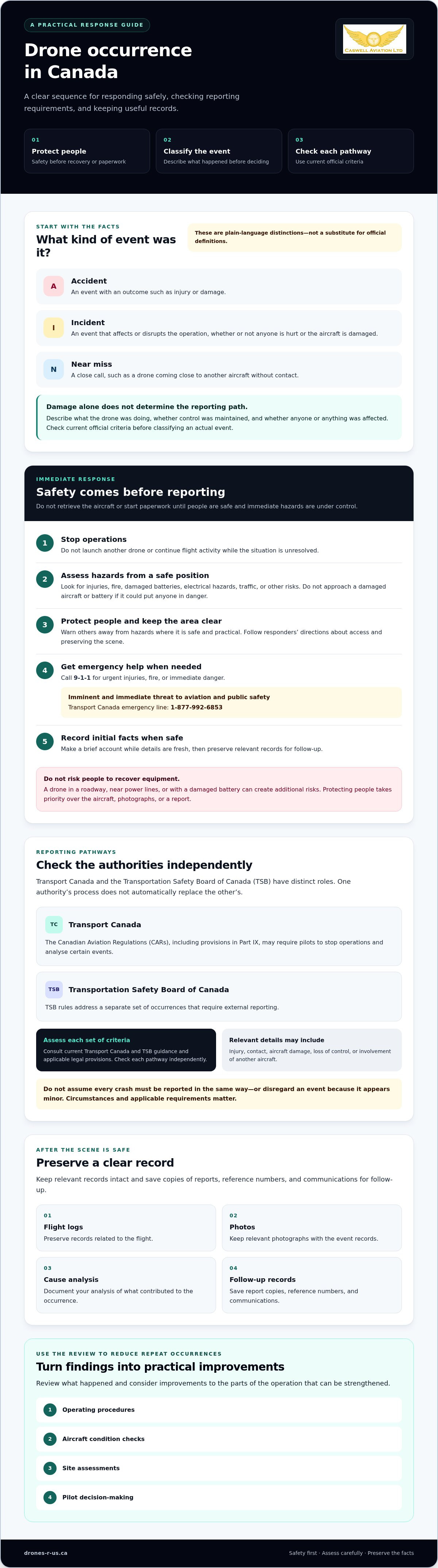
A drone occurrence is an event connected with a drone operation that involves, or could involve, harm, damage, loss of control, or a disruption to the flight. This plain-language description is a starting point for assessing what happened. It isn’t a substitute for a regulatory definition or a formal classification by an authority.
An accident is generally understood as an event with consequences such as injury or damage. An operational event may involve a problem during a flight without those consequences, while a near miss describes a situation where harm or a collision was narrowly avoided. These everyday distinctions can help you describe an event, but they don’t determine whether a formal report is required.
Damage alone doesn’t determine the reporting path. A hard landing might leave visible damage, while a loss of control could end without an impact. The circumstances matter, as do the applicable requirements. For drone accident reporting Canada, classify the event only after checking current official criteria. Don’t assume every crash must be reported in the same way, or that an event can be disregarded because it appears minor.
Accident, incident, and near miss: how are they different?
In plain English, an accident involves an outcome such as injury or damage. An incident is an event that affects or disrupts the operation, whether or not anyone is hurt or the aircraft is damaged. A near miss is a close call, such as a drone coming close to another aircraft without contact. A collision, hard landing, or loss of control can have different consequences, so check official definitions before classifying an actual event.
These terms can be used differently in everyday conversation and regulatory reporting. Start by describing what occurred: what the drone was doing, whether control was maintained, and whether anyone or anything was affected. Don’t decide that an event is “minor” based only on the repairs needed or the absence of injury.
Which Canadian rules and authorities may apply?
Transport Canada and the Transportation Safety Board of Canada (TSB) have distinct roles. The Canadian Aviation Regulations (CARs), including provisions in Part IX, may require pilots to stop operations and analyse certain events. TSB rules address a separate set of occurrences that require external reporting. One authority’s process doesn’t automatically replace the other’s. For background on the regulatory framework, see this overview of Canadian Drone Regulations.
Before deciding what to do, consult current Transport Canada and TSB guidance, along with the applicable legal provisions. Check the event against each set of criteria independently. Relevant details may include injury, contact, aircraft damage, loss of control, or involvement of another aircraft. The next section covers immediate actions. Reporting decisions should follow a careful assessment of the facts and current requirements.
Immediate Steps After a Drone Accident in Canada
Safety comes before reporting and evidence collection. Don’t retrieve the aircraft or start paperwork until people are safe and immediate hazards are under control. If emergency responders or investigators ask you to preserve the scene, follow their directions. Avoid moving or disturbing anything unless doing so is necessary to protect someone from immediate harm.
- Stop operations. Don’t launch another drone or continue flight activity while the situation is unresolved.
- Assess hazards from a safe position. Look for injuries, fire, damaged batteries, electrical hazards, traffic, or other risks. Don’t approach a damaged aircraft or battery if doing so could put you or others in danger.
- Protect people. Warn others away from hazards and keep the area clear where it’s safe and practical.
- Get emergency help when needed. Call 9-1-1 for urgent injuries, fire, or immediate danger. For an imminent and immediate threat to aviation and public safety, Transport Canada lists its emergency line at 1-877-992-6853.
- Record initial facts when safe. Make a brief account while details are fresh, then preserve relevant records for follow-up.
Secure people and the area before recovering the aircraft
A drone in a roadway, near power lines, or with a damaged battery can create additional risks. Don’t put yourself or bystanders in danger to retrieve equipment. If responders attend, follow their instructions about access and preserving the scene. Protecting people takes priority over recovering the aircraft, taking photographs, or completing a report.
Record initial facts while the event is fresh
Once immediate risks are managed, make a factual note of the date, time, location, aircraft, pilot, witnesses, and sequence of events. Include the weather and operating conditions you observed. Describe known damage, but don’t guess at its cause. Take photographs of the aircraft and surrounding area only when it’s safe and appropriate, and when doing so won’t interfere with responders or a request to preserve the scene.
Keep observations separate from conclusions. For example, note that control was lost or that the drone made contact with an object, rather than assuming why it happened. These details can help you check which requirements apply under drone accident reporting Canada guidance. Once urgent safety needs are addressed, Transport Canada’s Drone Incident Report Form is a resource for reporting unsafe drone use. It isn’t a replacement for emergency calls or every reporting process. Next, identify which official reporting criteria apply to the occurrence.
After the immediate response and follow-up, pilots who want to strengthen their regulatory knowledge and operational decision-making can explore online and in-person drone training.
How to Report a Drone Accident in Canada
There isn’t one reporting route for every drone occurrence. For drone accident reporting Canada, use the event’s facts to check current official criteria, then follow the instructions for each authority that may apply. Reporting to one organization doesn’t necessarily meet a separate requirement to notify another.
Use this decision path:
- Is there immediate danger? Contact emergency services or the appropriate aviation authority as needed. Take safety actions before classifying the report.
- Could the event meet a reporting criterion? Review the current Canadian Aviation Regulations (CARs) and TSB criteria. Don’t assume visible damage alone settles the question.
- What do the official instructions require? Follow the relevant authority’s current reporting channel and timing instructions. If more than one set of criteria applies, address each separately.
Transport Canada and TSB: check which reporting route applies
Transport Canada administers aviation regulations, including requirements in CAR 901.49 for certain drone occurrences. The Canadian Aviation Regulations for drone incidents set out circumstances in which a pilot must cease operations, analyse the cause, and retain an analysis record. This is separate from deciding whether an external report must be submitted.
The Transportation Safety Board of Canada (TSB) investigates selected transportation occurrences to advance safety and has separate reportability criteria. Check the current TSB instructions as well as Transport Canada’s. The details of the event determine which criteria and channels apply. Don’t treat one submission as a substitute for the other. For broader regulatory context, consult the Canadian drone regulations reference guide, then verify any requirement against official sources.
Information to have ready before making a report
Prepare a clear account so you can answer questions accurately. Gather what you know, and mark unknown details as unknown rather than filling gaps with guesses.
- Pilot and operator contact details, plus aircraft make, model, registration, or identification details if applicable.
- Date, time, location, and a concise sequence of events, including the flight’s purpose and relevant operating conditions.
- Known injuries, damage, witnesses, and any involvement of another aircraft or property.
- Available records, such as flight logs, photographs, and notes made at the scene.
Separate direct observations from assumptions about cause or responsibility. Then follow the official reporting instructions for the applicable authority. Requirements and submission channels can change, so confirm them when the occurrence happens rather than relying on an old form, deadline, or remembered threshold.
Preserving Evidence and Post-Reporting Steps
Accurate records help you answer follow-up questions and review the occurrence without relying on memory alone. Preserve relevant information in its original form where possible. Don’t alter or delete material that may be relevant to a review or investigation, and avoid posting it publicly. If an authority or investigator gives instructions about the aircraft, site, or records, follow them.
For occurrences covered by CAR 901.49, the pilot must keep a record of the cause analysis for 12 months and make it available to Transport Canada upon request. This requirement applies to the specified occurrences, not automatically to every event. Check the current regulation and official guidance to confirm what applies to yours.
Flight records, images, and aircraft information
Preserve available flight logs, controller records, photographs, maintenance notes, and communications related to the flight. Keep original files, and note when, where, and by whom each photo or record was created. If you need to share a copy, retain the original unchanged. Don’t attempt to repair, test, or otherwise alter the aircraft if doing so could disturb evidence or conflict with instructions from an authority.
Core records to retain: flight and controller logs, original photographs, aircraft and maintenance information, occurrence notes, submitted reports, reference numbers, and communications with authorities.
Follow-up, communication, and operational decisions
Keep a dated record of each authority contact, the information you provided, any instructions received, and outstanding follow-up. Save a copy of every report you submit, along with its confirmation or reference number. If a regulator or investigator requests additional material, note what was requested and when you provided it.
Don’t resume operations with the aircraft until its condition and the operating site have been assessed and you’ve checked any applicable requirements or instructions. Keep confirmed facts separate from working theories. A fault, weather condition, or pilot action might be relevant, but avoid assigning cause or blame before reliable information is available. A careful record supports accurate drone accident reporting Canada follow-up and a more useful review of what can be improved.
Once immediate reporting and follow-up are complete, pilots can strengthen their regulatory knowledge and decision-making through online and in-person drone training.
Prevent repeat occurrences with sound training and operating procedures
A post-occurrence review is an opportunity to improve the operation, not assign blame. Use documented facts to examine how the flight was planned and conducted. Consider whether procedures were clear, the aircraft was in suitable condition, site hazards were assessed, and the pilot’s decisions matched the conditions at the time.
Keep the review practical. Identify a specific change only when the available information supports it. For example, you might clarify a checklist step, add a site hazard to future planning, or revisit a decision point with the pilot. If the cause remains uncertain, record that uncertainty rather than treating an assumption as a finding.
Use the occurrence to strengthen future flight planning
Compare the operation with your procedures and current official Canadian guidance. Review the site, aircraft condition, operating limits, and decisions made before and during the flight. Ask what information was available to the pilot and whether the plan addressed the conditions encountered. Then update checklists or training priorities when the review identifies a clear, useful improvement. This keeps the process constructive and evidence-based.
Regulatory knowledge and structured practice can help pilots make more informed operating decisions. Regularly reviewing applicable rules, flight planning, and procedures can also reveal gaps before the next operation. Keep these reviews current as requirements and operating circumstances change.
When additional drone training may help
Consider structured learning if you need to refresh your understanding of Canadian rules, strengthen planning habits, or practise making decisions in more complex operating conditions. Training can support ongoing skill development. It isn’t a substitute for assessing an occurrence, meeting reporting requirements, or following instructions from authorities.
Caswell Aviation Ltd offers online and in-person training to prepare pilots for Transport Canada Advanced and Level 1 Complex certification, along with professional flight reviews for pilots pursuing advanced drone operating certificates. These options may be useful after the occurrence has been addressed and any required follow-up is complete. If you’re reviewing drone accident reporting Canada requirements as part of broader regulatory learning, explore drone training options at your own pace.
Build confidence for your next flight
A calm, methodical response helps pilots make sound decisions after an occurrence. Put people and immediate safety first, then check current official criteria to determine which reporting steps may apply. Transport Canada and the TSB have distinct processes, so don’t assume that contacting one authority fulfils every requirement.
Preserve relevant records, follow instructions from authorities or investigators, and use confirmed facts to review procedures, aircraft condition, site hazards, and decision-making. These habits make drone accident reporting Canada more manageable and help turn a difficult event into practical learning for future operations.
After urgent response and reporting follow-up are complete, continued learning can build regulatory knowledge and strengthen operational decisions. Caswell Aviation offers online and in-person training for Transport Canada Advanced and Level 1 Complex certification, as well as professional flight reviews for pilots pursuing advanced drone operating certificates. Explore drone training options when you’re ready to build on your experience.
With careful preparation and a commitment to learning, you can approach future flights with greater clarity and confidence.
Frequently Asked Questions
Do I need to report every drone crash in Canada?
No. A crash doesn’t automatically mean the same external report is required for every occurrence. The facts and applicable criteria matter, including injuries, contact with a person, effects on flight characteristics, loss of control, or involvement of another aircraft. Under CAR 901.49, certain occurrences require the pilot to stop operations, analyse the cause, and keep a record. Check current Transport Canada and TSB criteria separately before deciding what applies.
Who do I report a drone accident to in Canada?
It depends on the occurrence. Transport Canada administers aviation regulations and provides a Drone Incident Report Form for reporting unsafe drone use. The Transportation Safety Board of Canada (TSB) has separate criteria for occurrences it must be notified about. These processes have different purposes, and contacting one authority doesn’t necessarily meet another requirement. For drone accident reporting Canada, compare the event’s facts with current official instructions from each authority that may apply.
How soon must I report a drone accident in Canada?
There isn’t one timing rule that applies to every event and reporting route. If an occurrence meets TSB reporting criteria, contact the TSB as soon as possible by the quickest means available and follow its instructions. Some immediate hazards require urgent contact with emergency services or an aviation authority. CAR 901.49 also requires operations to cease immediately for specified incidents, followed by analysis. Check current official instructions promptly to confirm the applicable steps and timing.
What should I do if a drone accident injures someone?
Protect the injured person and others first. Call 9-1-1 if urgent medical assistance is needed, and don’t approach the drone if it presents a hazard. Once immediate safety needs are addressed, document what you directly observed and check current reporting criteria. An injury requiring medical attention is among the occurrences listed under CAR 901.49. A death or serious injury may also meet TSB criteria, so consult the TSB’s current instructions without delay.
What information should I include when reporting a drone accident?
Give a factual account and provide the details requested by the reporting authority. Be ready with the date, time, location, pilot and operator details, aircraft identification, and a clear sequence of events. Include known injuries or damage, witnesses, operating conditions, and relevant records such as flight logs or photographs. Separate confirmed observations from assumptions about cause or responsibility. Keep a copy of the submitted report, confirmation, reference number, and related communications.
Can I fly my drone again after an accident?
Don’t resume operations until you’ve assessed the aircraft and site, addressed any hazards, and checked applicable requirements. For specified incidents under CAR 901.49, pilots must cease operations and analyse the cause. Follow any directions from authorities or investigators about the aircraft, records, or scene. If damage or a system issue could affect performance or flight characteristics, don’t treat a visual check alone as proof that the drone is suitable to fly.
Does a drone near miss need to be reported in Canada?
It may. A near miss involving another aircraft, or an event that created a risk of collision, should be checked against current CARs and TSB criteria. Under CAR 901.49, a collision or risk of collision with another aircraft is among the specified incidents requiring operations to cease and the cause to be analysed. Whether external reporting is also required depends on the facts and applicable rules. Consult official guidance rather than dismissing the event because no contact occurred.
Leave a comment